+372 5498 2448
  • +372 5498 2448
  • +372 5498 2448
English
  • English
  • Spanish
  • Italian
  • Arabic
Expert Consultation

EMI License in Finland: Authorization to Issue Electronic Money Across the European Market

Offshore Pro Group assists fintech companies in obtaining an Electronic Money Institution (EMI) license in Finland — a full payment authorization that allows a business to issue electronic money, open client payment accounts, process payment operations, and serve users across the European Economic Area under a single license.

Excellent 4,6 out of 5

Offshore Pro Group Trustpilot rating

The Finland EMI License in Brief

A concise overview of the key parameters that define electronic money authorization in Finland.

Regulator

Financial Supervisory Authority (FIN-FSA)

License type

Electronic Money Institution — Full EMI or the simplified Small EMI regime

Authorization scope

Issuing electronic money, opening client payment accounts and e-wallets, processing payments and transfers

Geographical reach

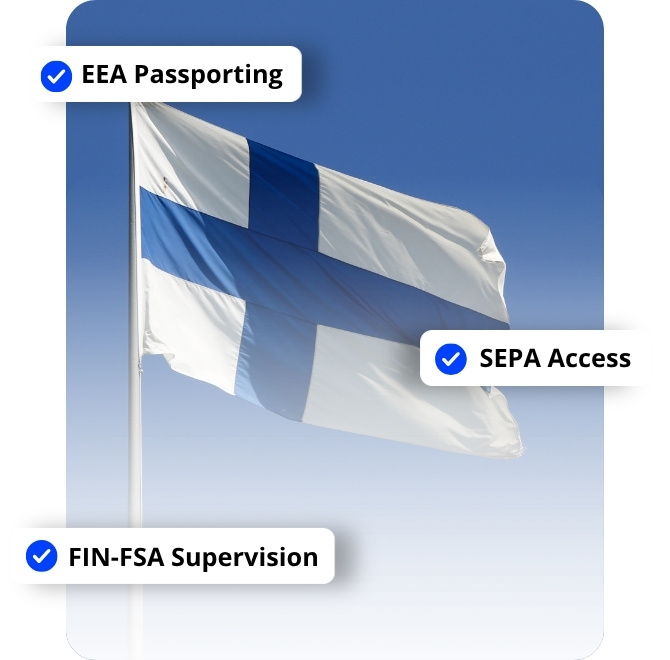
Finland, with EEA-wide passporting available under a Full EMI

Timeline

Typically 9–12 months, including preparation, submission, and regulatory review

Minimum capital (Full EMI)

From €350,000, in line with the Electronic Money Directive (2009/110/EC)

Corporate requirement

A company registered in Finland with its head office in the country

Corporate tax

Standard corporate income tax rate of 20%

Key regulatory framework

Electronic Money Directive (2009/110/EC), PSD2, DORA

Why Choose an EMI License in Finland

An EMI license represents a complete payment infrastructure. It enables a company to launch electronic wallets, execute international transfers, issue payment cards, and integrate payment solutions into online platforms and marketplaces.

When selecting a licensing jurisdiction, the credibility of the regulator matters as much as the speed of approval. Finland is not among the fastest jurisdictions for fintech licensing — FIN-FSA carefully examines the business model, risk management system, and operational structure, which extends the process. That scrutiny, however, is precisely what strengthens confidence in companies authorized in Finland.

During the assessment, the regulator evaluates not only the legal structure of the company but the real processes behind it: how payments are executed, where client funds are held, how the risk management framework is organized, and which technology solutions are used to process operations.

Alongside rigorous regulation, several characteristics distinguish the Finnish jurisdiction:

A transparent and formalized licensing procedure

A transparent and formalized licensing procedure —

the regulator's requirements are described in detail, and the structure of the application and the list of documents are known to applicants in advance.

A stable legal system

A stable legal system —

financial-sector regulation is based on European directives and rarely changes without a lengthy transition period.

An advanced digital infrastructure

An advanced digital infrastructure —

Finland is among the EU countries with a high level of economic digitalization and active adoption of electronic services.

Access to SEPA and European Passporting

One of the principal advantages of an EMI license in the European Union is the ability to operate across several national markets at once. After obtaining authorization in one EU country, a company may provide payment services in other EEA states without repeat licensing, by notifying the national regulators of those states. This mechanism is known as European passporting.

The legal basis for this model is established in European payment services legislation — primarily the Payment Services Directive (PSD2). Its provisions extend to companies holding an EMI license in accordance with the Electronic Money Directive (2009/110/EC).

A further element of European payment infrastructure is SEPA (the Single Euro Payments Area). It unites banks and payment institutions across more than 30 European countries and sets common standards for euro transfers, so that payments between accounts in different European countries are executed under the same rules as domestic bank transfers — typically within one business day.

Who Needs a Finnish EMI License

A Finnish EMI license is suited to businesses that intend to build regulated payment infrastructure within the European Economic Area, including:

Check
Electronic money issuers seeking to issue and manage e-money for European users.
Check
Payment companies executing transfers and processing payment operations.
Check
Fintech businesses building scalable payment products across multiple EU markets.
Check
Electronic wallet providers offering stored-value and e-wallet solutions.
Check
Payment platforms and online marketplaces integrating payment solutions into their services.
Check
Card-issuing programs delivering payment cards to their customers.

For companies planning to operate in several EU countries or to build scalable payment infrastructure, the Full EMI license — rather than the nationally restricted Small EMI regime — is generally the appropriate route.

EMI License Types in Finland: Small EMI and Full EMI

The European Union provides two authorization tiers for organizations working with electronic money: the full Electronic Money Institution license (Full EMI) and a simplified regime for smaller companies (Small EMI).

Small EMI

The Restricted Small EMI License

  • Average outstanding electronic money No more than €5 million
  • Passporting Not available
  • Geographical scope Country of registration only
  • Minimum initial capital Not fixed (depends on business model and volume of operations)

In Finland, the Small EMI regime is intended for smaller payment companies operating on the national market. This format carries lighter requirements than the full Electronic Money Institution license, but comes with limitations: the average outstanding electronic money must not exceed €5 million, and European passporting is unavailable, so the company cannot provide payment services in other EEA states.

For fintech companies planning to operate in several EU countries or building scalable payment infrastructure, this regime is generally not suitable.

Full EMI

The Full Electronic Money Institution License

  • Average outstanding electronic money No set limit
  • Passporting Available
  • Geographical scope EU and EEA states
  • Minimum initial capital From €350,000

The Full EMI is the principal license format for fintech companies planning to operate on the European payment market. It allows a company to issue electronic money, open client payment accounts and electronic wallets, process payment operations and money transfers, and provide services in other EEA states through passporting. The minimum share capital is €350,000.

This is the license type most frequently used by international fintech companies. It allows payment services to be scaled across the European market without establishing a separately licensed structure in each country, and to serve clients across jurisdictions under a single license.

EMI License Requirements in Finland

Obtaining an EMI license in Finland involves a comprehensive review by the Financial Supervisory Authority (FIN-FSA), including assessment of capital, governance, and organizational structure.

01

Capital and financial stability.

A core requirement is sufficient capital. Under the Electronic Money Directive (2009/110/EC), this must be no less than €350,000, and the company must confirm the availability of funds when submitting its application. Minimum capital alone does not guarantee approval — the regulator analyzes the financial model of the future business and the company's ability to maintain an adequate level of own funds once operations begin. As part of the authorization procedure the applicant submits a documentation package including: a programme of operations describing the planned payment services; a business plan and forecast budget covering at least three years; a description of the governance, internal control, and risk management systems; a security and payment-data protection policy; business continuity plans; and information on the ownership structure, management, and organizational structure of the company.

02

Local presence (substance).

FIN-FSA requires that a licensed company genuinely operate in the country. The Electronic Money Institution license is not intended for nominal structures, so the regulator assesses where key management decisions are made and where control over the organization's activities is actually exercised. The company must be registered in Finland with its head office located in the country, and part of the payment activity must genuinely be carried out in the licensing jurisdiction. The regulator also assesses corporate governance against the principle of sound and prudent management, reviewing the management structure and composition of the board, risk management and monitoring procedures, the internal control and compliance system, and the experience and business reputation of managers, as well as the operational infrastructure for processing payments, protecting payment data, and ensuring business continuity.

03

AML/KYC and the compliance system.

Like other EU financial institutions, EMI-licensed companies must comply with anti-money-laundering and counter-terrorist-financing legislation, and FIN-FSA gives particular attention to the AML/KYC control system. Companies must implement customer identification and verification (KYC) procedures, transaction monitoring, and mechanisms to detect suspicious transactions, conducting additional checks and, where necessary, reporting such operations to the competent authorities. The regulator also reviews the internal compliance system — whether AML/CFT policies, internal control procedures, and financial-crime risk management mechanisms are in place — and the allocation of responsibilities, including designated officers for compliance and anti-money-laundering.

04

Safeguarding of client funds.

European regulation sets specific rules for handling user funds received in exchange for electronic money, ensuring client money is not mixed with the institution's own funds or used for its operational activities. The most common approach is holding user funds in separate accounts at banks or other credit institutions. Directive 2009/110/EC also sets the deadline for placing funds under the safeguarding mechanism — no later than five business days after the electronic money is issued. FIN-FSA reviews the chosen model, the accounting procedures, and the internal control system, assessing whether the company can confirm its liabilities to users at any moment and maintain transparent, regularly reconciled records of client funds.

05

Technology infrastructure and operational resilience.

Because EMI activity involves processing payments, the regulator assesses the reliability of the technology infrastructure — how payment systems are built, how client data is protected, and what measures prevent service disruptions. Under PSD2, payment organizations must implement incident identification and handling procedures, control the security of payment services, and regularly assess related risks (Articles 95–96), and must apply strong customer authentication (SCA) to protect electronic payments and personal data (Article 97). At EU level, the Digital Operational Resilience Act (DORA) sets unified rules for managing IT risks, responding to technological and cyber incidents, and ensuring the stable operation of digital financial services.

Required Documents

FIN-FSA expects a complete and well-structured application. Based on the authorization requirements, the documentation package includes:

Business and operational documentation

  • Check Programme of operations describing the planned payment services
  • Check Business plan and forecast budget covering at least three years
  • Check Business continuity plans

Governance and internal control

  • Check Description of the governance, internal control, and risk management systems
  • Check Security and payment-data protection policy

AML/compliance documentation

  • Check AML/KYC policies and internal control procedures
  • Check Financial-crime risk management mechanisms

Ownership and management information

  • Check Information on the ownership structure of the company
  • Check Information on management and the organizational structure

Offshore Pro Group prepares and coordinates this documentation package so that it meets the structure and level of detail FIN-FSA expects.

The Licensing Process Step by Step

Obtaining the license takes, on average, 9–12 months — covering document preparation, submission, and regulatory review. If FIN-FSA requests additional materials or asks for individual elements of the application to be refined, the procedure may take longer.

Step 1

Company registration and application preparation.

The applicant registers a legal entity in Finland and prepares the licensing documentation package, including a description of the future activity, the management structure, and the payment organization's processes. The regulator must receive sufficient information to assess the business model, governance, and financial stability.

Step 2

Application submission.

The company submits its license application to FIN-FSA. The materials are provided to the regulator electronically, together with the application form and required annexes. On receipt, FIN-FSA checks the package for completeness and begins a detailed analysis.

Step 3

Review and dialogue with the regulator.

FIN-FSA conducts a detailed analysis of the submitted materials, assessing the business model, ownership structure, financial projections, and organization of internal processes. During the review the regulator typically raises additional questions or requests further documents — a normal part of financial licensing.

Step 4

Licensing decision.

After the review is complete, FIN-FSA decides on the application. If the company meets the regulatory requirements, the regulator issues the electronic money institution license.

Once the license is granted, the organization may provide payment services and issue electronic money in Finland, and operate in other EU countries through financial-services passporting.

Regulatory and Compliance Obligations

An EMI license carries continuing obligations.

  • Check Companies must maintain their AML/CFT framework, including customer identification and verification, transaction monitoring, and reporting of suspicious operations to the competent authorities.
  • Check They must operate robust risk management and internal control systems consistent with sound and prudent management.
  • Check They must safeguard client funds — holding them in separate accounts or under another permitted scheme, no later than five business days after the electronic money is issued — and maintain transparent, regularly reconciled records.
  • Check They must apply strong customer authentication under PSD2 and manage operational and IT risk in line with DORA.
  • Check They must also prepare annual financial statements, submit them to the Finnish Trade Register no later than eight months after the end of the financial year, and provide reporting to FIN-FSA.

Taxation of EMI Companies in Finland

Corporate income tax

EMI organizations in Finland are usually established as limited companies and are subject to the standard corporate tax regime, with a corporate income tax rate of 20%. Finnish tax residents are taxed on profit earned both in Finland and abroad.

VAT treatment

Most payment and fund-transfer operations in the EU are exempt from VAT, a rule established in the VAT Directive 2006/112/EC (Article 135(1)(d)).

Accounting, reporting, and audit

Finnish companies keep accounting records and prepare annual financial statements, which after approval are filed with the Finnish Trade Register no later than eight months after the end of the financial year; licensed EMIs must also report to FIN-FSA. A company must undergo an audit if at least two of the following thresholds are exceeded in both the latest and the preceding financial year: assets above €100,000, annual turnover above €200,000, or an average of more than three employees.

Buying a Ready-Made EMI License in Finland

Potential advantage

Some fintech projects consider acquiring an already-licensed company with an EMI license instead of completing the full licensing procedure. The main advantage is time: if the license is already in place and the company meets the regulator’s requirements, a new owner can enter the market and begin operations more quickly.

Due diligence and approval

However, the buyer assumes the entire history of the company — including possible liabilities and risks connected with past activity — so a thorough legal and regulatory due diligence is normally conducted before the transaction. The regulator’s requirements also apply: when control over a licensed company is acquired, FIN-FSA assesses the new shareholders and management, examining the business reputation of investors, their experience in the financial sector, and the origin of funds. If the new owners do not meet the requirements or the transaction could create risks, the regulator may decline to approve the change of control. Acquiring a licensed EMI company therefore requires the same careful preparation as obtaining a license from scratch.

EMI License Costs and Timeline

The total cost depends on the business structure, the chosen payment model, and the company’s readiness for licensing. The principal cost drivers include:

Full EMI

Minimum capital

€350,000

The minimum capital for an EMI must also be accounted for — no less than €350,000.

Expected timeline

9–12 months

The expected timeline is 9–12 months.

Project budget

Calculated individually

The precise budget depends on the fintech project’s business model and the payment services the company plans to provide. Offshore Pro Group can calculate the cost of licensing and estimate the necessary expenses for a specific project.

  • Check Legal and fintech advisory services — preparing the license application, business plan, and other documents for the regulator.
  • Check Company registration in Finland — state fees and preparation of corporate documents.
  • Check Preparation of internal documents for the regulator — AML/KYC policies and risk management and internal control procedures, usually developed by lawyers or compliance consultants.
  • Check Opening a safeguarding account or connecting another client-fund protection scheme.
  • Check Organizing operational infrastructure — for example, connecting payment systems, IT solutions, and compliance tools.

How Offshore Pro Group Supports Fintech Projects

Offshore Pro Group supports fintech projects through every stage of obtaining an EMI license — from assessing the business model to submitting the application to the regulator and launching payment infrastructure. This support includes helping to:

Assess the project before licensing

Assess the project before licensing —

reviewing the business model, company structure, and alignment with the regulator's requirements.

Prepare the license documentation

Prepare the license documentation —

the programme of operations, business plan, and descriptions of the risk management and internal control systems.

Develop compliance documents

Develop compliance documents —

AML/KYC policies and internal control and client-fund protection procedures.

Register the company and build a governance structure

Register the company and build a governance structure —

consistent with regulatory requirements.

Organize safeguarding

Organize safeguarding —

protecting client funds through a separate account or another permitted scheme.

Submit the license application and liaise with the regulator

Submit the license application and liaise with the regulator —

throughout the review.

Offshore Pro Group can also assist in selecting a partner bank and organizing the payment infrastructure needed to launch a fintech project.

Why Clients Choose Offshore Pro Group

A structured process.

A structured process.

Offshore Pro Group approaches EMI licensing as a defined, stage-by-stage project, coordinating documentation, corporate setup, and regulatory communication in a single workflow.

Regulatory understanding.

Regulatory understanding.

The team works within the frameworks that govern Finnish and European electronic money — the Electronic Money Directive, PSD2, and DORA — so applications reflect what FIN-FSA expects.

Document coordination.

Document coordination.

From the programme of operations to AML/KYC policies and safeguarding arrangements, the required materials are prepared and aligned to the regulator's structure and level of detail.

Personalized support.

Personalized support.

Each fintech project is assessed on its own business model, with cost and scope estimated for the specific services the company intends to provide.

Request an EMI Licensing Consultation with Offshore Pro Group

Offshore Pro Group assists fintech founders and executives in assessing eligibility, reviewing the required documents, defining a licensing strategy, and understanding each stage of the Finnish EMI application process.

Clarify the list of required documents, the nuances of the process, the timeline, and the cost with the portal’s specialists.

Your privacy is our priority, and we guarantee 100% confidentiality.

Frequently Asked Questions

How long does it take to obtain an EMI license?

On average, 9–12 months, including document preparation and regulatory review. Under European rules, the regulator must reach a decision within three months of receiving the complete documentation package.

Yes. However, among the members of the board of directors there usually must be at least one resident of an EEA country. If there are none, permission from the Finnish Patent and Registration Office (PRH) is required.

Yes. An EMI license allows operation in other EEA states through the passporting mechanism, after notifying the national regulator of the intention to provide services.

Yes. The capital is not frozen in an account. However, the company must continuously maintain a minimum level of own funds, so these funds may only be used in a way that keeps the capital requirements satisfied.

A PI license allows the provision of payment services — for example, fund transfers and payment processing. An EMI license provides the same capabilities but additionally allows the issuance of electronic money.

Yes. An EMI may serve crypto companies as clients — for example, processing payments or issuing payment cards. However, providing crypto services (exchange, custody of crypto assets, and so on) in the EU requires separate authorization as a crypto-asset service provider under the MiCA regulation.

Most often the regulator refuses when it is not confident in the reliability of the project — for example, due to problems with the business reputation of shareholders, a weak risk management system, or an incomplete documentation package.

Legally it is a standard requirement, but in practice banks conduct thorough checks of the business and its owners. Because of bank compliance, opening such an account can take time.

Yes. However, when control over a licensed company is acquired, the regulator reviews the new owners and may decline to approve the transaction.

It authorizes issuing electronic money, opening client payment accounts and electronic wallets, processing payment operations and money transfers, and — under a Full EMI — providing these services across the EEA.

The Financial Supervisory Authority (FIN-FSA), which assesses the company's capital, governance, and organizational structure during licensing.

From €350,000, in line with the Electronic Money Directive (2009/110/EC), with proof of funds required at application.

Most payment and fund-transfer operations in the EU are exempt from VAT under the VAT Directive 2006/112/EC (Article 135(1)(d)).

Offshore Pro Group supports the project from assessing the business model, through preparing documentation and compliance policies and registering the company, to submitting the application and liaising with FIN-FSA, and can also help arrange safeguarding and payment infrastructure.