Cayman Islands Offshore Company Formation
The Cayman Islands is a top-tier offshore jurisdiction for global business, investment funds, crypto projects, and asset-protection structures. It combines English common law, tax-neutral treatment of foreign income, and a flexible Exempted Company format that is widely accepted by banks, funds, and institutional investors.
Excellent 4,6 out of 5

Key Advantages of a Cayman Islands Offshore
Company
Cayman structures are designed as specialized, yet flexible vehicles for cross-border investments, fund platforms, and high-end asset holding.

Political and Legal Stability
The Cayman Islands is a British Overseas Territory with an AA-level sovereign risk rating, a stable political environment, and a legal system based on English common law. This gives investors and counterparties confidence in contract enforcement, corporate governance, and dispute resolution.
Fast and Simple Incorporation
Exempted companies can typically be incorporated within about 3 business days after KYC is complete. There are no mandatory requirements for paid-in share capital, local shareholders, or resident directors, which keeps the setup process straightforward and efficient.
0% Tax on Foreign-Source Income
Cayman companies are generally exempt from local corporate income tax, capital gains tax, withholding tax on dividends, and royalties on income earned outside the islands. Many structures also obtain a tax-exempt certificate, meaning no income tax applies for up to 20 years.
Strong International Reputation and Market Access
Cayman is a global hub for investment and hedge funds, as well as capital markets structures. A large share of the world’s hedge funds and fund assets is domiciled here, which makes the jurisdiction familiar to institutional investors, exchanges, and regulators — especially in Hong Kong, London, and New York.
High Level of Confidentiality
The Cayman Islands does not require public disclosure of shareholders or beneficial owners in open registers. Information on directors is accessible only via official channels, and beneficial-owner data is available only to competent authorities under AML/CFT and information-exchange frameworks.
No Exchange Controls
There are no foreign-exchange controls. Funds can move freely in and out of the jurisdiction, and the Cayman Islands dollar is closely tied to the US dollar. In practice, USD is widely used, simplifying international settlements.
Cayman Islands Exempted Company
The primary format for foreign investors is the Cayman Islands Exempted Company. It is designed for business conducted outside the islands and is widely used for funds, crypto projects, holding structures, and pre-IPO vehicles.
Benefits of a Cayman Exempted Company

Tax-neutral treatment of foreign-source income under current rules.
Highly recognized by international investors, exchanges, and regulators.
Flexible share capital and shareholder structure (single shareholder allowed).
High level of confidentiality for owners and investors.
No requirement to hold annual meetings in Cayman.
Can be incorporated and managed entirely remotely.
Best suited for: investment funds, venture and crypto projects, asset-holding and pre-IPO structures, and international businesses that need a reputable, tax-neutral platform.
Key Features

Legal Form: Separate legal entity with limited liability for shareholders.
Business Scope: Primarily for activities outside the Cayman Islands; local business is restricted.
Ownership: At least one shareholder (individual or entity; no nationality or residency restrictions).
Management: At least one director; directors may be residents or non-residents, individuals or corporate entities.
Capital: No statutory minimum; share capital can be denominated in any major currency and does not have to be fully paid in at incorporation.
Meetings: No obligation to hold AGMs in the Cayman Islands; meetings can be held anywhere or replaced by written resolutions.
Confidentiality: Shareholder and beneficial-owner data is not included in public registers; information on directors is available only through official requests.
Law: Governed by the Cayman Companies Act (as revised) and related regulations.
Cost of Cayman Islands Company Formation
Cayman law requires that Exempted Companies be incorporated through licensed local providers; you cannot file directly with the Registrar as a private individual. Our packages reflect this reality: each level bundles registered-agent services, government fees, and the core services you need, so you receive a ready-to-use Cayman company without handling the local bureaucracy yourself.
Standard
Typical timeframe: from 3 business days after KYC approval
A core package for clients who want a Cayman Exempted Company under
their direct control, with all necessary corporate services but no
professional directors or bundled banking.
Package Includes:
Preparation of documents and filing with the Cayman Registrar
Payment of the government incorporation fee
Registered agent services for 12 months
Provision of a registered office address in the Cayman Islands for 12 months
Full set of original corporate documents
Courier delivery of the corporate document pack
Professional
Typical timeframe: from 3 business days after KYC approval
Designed for clients who want a greater distance between themselves
and the company in external documentation by appointing a
professional director or manager.
Package Includes:
All services from the Standard package
Appointment of a professional director or manager for 12 months
Support with corporate governance documents and reflecting the real control structure
Premium
Typical timeframe: from 3 business days after KYC approval (banking timelines depend on the chosen institution)
Best when you need not only incorporation but also a corporate
account, so the structure can start handling transactions, capital
flows, or investment proceeds as soon as possible.
Package Includes:
All services from the Standard package
Additional support in preparing notarized/apostilled corporate documents, where required
Assistance with opening a corporate bank account or EMI account suitable for Cayman structures
Coordination with the chosen institution from application to account approval, subject to their internal KYC and risk policy
Our 6-Step Cayman Company Incorporation Process
To keep the project predictable, we break Cayman company formation into six clear stages.
Consultation and Structure Design
We start with a strategy discussion to clarify:
-
Your goals (fund formation, crypto project, holding, asset protection, pre-IPO, etc.)
-
Desired ownership structure and investor profile
-
Need for professional directors, managers, or special governance features
-
Whether banking on Cayman or elsewhere is required
Based on this, we confirm that a Cayman Exempted Company is appropriate—or suggest alternatives if another jurisdiction is a better fit.
Name Check and Reservation
You propose one or more company names. We:
-
Check that each option complies with Cayman naming rules
-
Confirm availability with the Registrar of Companies
-
Reserve the chosen name once approved
Document Collection and Preparation
You provide standard KYC and profile documents. We:
-
Draft the Memorandum and Articles of Association
-
Prepare application forms and supporting documents for the Registrar
-
Prepare powers of attorney where a professional director/manager is used
-
Align the documentation with banks’ and regulators’ expectations as needed
Once you approve, we will submit the incorporation package.
Incorporation and Corporate Structuring
The Registrar processes the application and issues the Certificate of Incorporation. We then:
-
Confirm appointment of directors and issue shares
-
Prepare internal registers of directors and members
-
Draft initial resolutions and any governance documents required for your case
Bank Account Opening (If Included)
If banking is part of your structure, we:
-
Select banks or EMIs that work with Cayman companies and fit your transaction profile
-
Prepare the KYC and business profile package (including source-of-funds/source-of-wealth documentation)
-
Coordinate communication with the institution until the account is approved, or alternative options are agreed
Delivery of the Corporate Pack
You receive a full corporate pack via secure courier, typically including:
-
Certificate of Incorporation
-
Memorandum and Articles of Association
-
Director and shareholder registers (internal)
-
Initial resolutions and share certificates
-
Notarized or apostilled copies, where requested
-
Banking documents (if the Premium package is used)
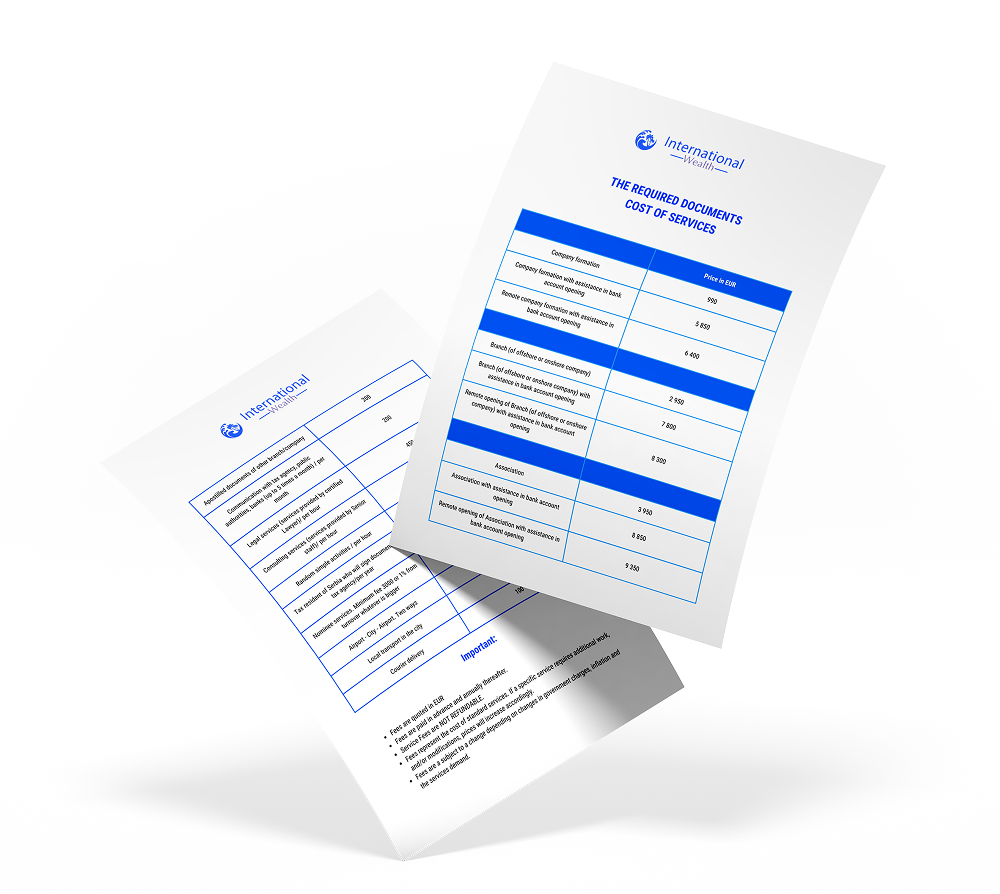
Documents Required for Cayman Company Formation
We tailor the exact list to your structure, but a typical Cayman Exempted Company requires:
For Individuals (Shareholders, Directors, Beneficial Owners)
Completed application/brief questionnaire with basic company details
Copy of passport (color scan; certified where required)
Proof of residential address (utility bill or bank statement, not older than 3 months)
Short CV or professional profile
Information on the source of funds and the source of wealth (e.g., contracts, sale agreements, bank statements)
For Corporate Shareholders or Controllers
Certificate of Incorporation/registration
Constitutional documents (Memorandum and Articles, or local equivalent)
Register of directors and shareholders
Recent certificate of good standing (or equivalent)
Evidence of current business activity (key contracts, invoices, etc., if required)
We pre-check each document for compliance with Cayman’s KYC and AML requirements and coordinate any required translations, certifications, or apostilles.
Additional Information
Accounting Records and Retention
Cayman Exempted Companies must maintain proper accounting records and supporting documentation that reflect their actual transactions and financial position. These records:
-
May be kept at the registered office or another agreed location
-
Must be available to the registered office provider or
authorities on request
-
Typically, it must be retained for at least five years
There is no mandatory audit requirement for non-licensed, non-regulated companies, but funds and regulated entities are subject to stricter rules.
Annual Return and Government Fees
Each company must file an annual return and pay an annual government fee to maintain good standing. The annual return confirms basic corporate details and compliance with the Companies Act (as revised). Late filing can lead to penalties and, eventually, loss of good standing.
In practice, your registered office provider or agent:
-
Prepares and files the annual return
-
Ensures payment of the government fee
-
Keeps internal registers and statutory records up to date
Economic Substance Requirements
If your Cayman company undertakes certain relevant activities (for example, fund management, finance and leasing, headquarters, distribution and service centers, and IP exploitation), it may be subject to Economic Substance rules. Depending on the activity, this can require:
-
Adequate local management and oversight in Cayman
-
Local expenditure and operational presence
-
Board meetings held in Cayman
-
Proper documentation to evidence real activity
Many simple holding or SPV-style structures face lighter requirements but must still complete substance-related filings. We help you assess whether your structure is in scope and outline a compliant implementation plan.
Corporate Structure and Governance
The minimal structure for a Cayman Exempted Company normally includes:
-
At least one director (individual or corporate, any nationality)
-
At least one shareholder (individual or corporate, any
nationality)
Key points:
-
There is no requirement for resident directors or local
shareholders.
-
Directors run the company, approve major transactions, and
appoint advisers.
-
The company may appoint a secretary, but this is not strictly
mandatory; in simpler structures, the director or the registered
office provider can perform those functions.
-
Changes in directors or officers must be recorded in internal
registers and notified to the Registrar within the statutory
timeframe. Late notifications can trigger fines.
The service agreement with the registered office/corporate provider typically defines who maintains the records and interfaces with the Cayman Islands General Registry.
Bank Account Opening for a Cayman Company
Deposit protection in the Cayman Islands is not provided through a broad public insurance scheme like the FDIC in the US. In practice, local banks rely on their own risk frameworks and regulatory capital requirements, so each institution applies its own onboarding and risk policies:
-
Opening a bank account in Cayman itself is easier when the
company has real ties to the jurisdiction (local business, real
estate, investors, or family links).
-
Many Exempted Companies instead open accounts in other reputable
jurisdictions or with international EMIs that are comfortable with
Cayman structures.
We help you:
-
Choose suitable banks or EMIs (Cayman or foreign) based on your
business model and geography
-
Prepare a complete KYC, business profile, and source-of-funds
package
-
Navigate local compliance specifics to maximize the chances of
approval
Annual Maintenance and Good Standing
To keep your Cayman company in good standing and avoid penalties or strike-off, you must:
-
Pay annual government and service-provider fees on time
-
File the annual return by the required deadline
-
Maintain updated corporate registers and accounting records
-
Keep the KYC information with the registered agent current
Most clients delegate these tasks to their registered office provider, who tracks deadlines, prepares filings, and ensures that all formalities are kept up to date.
Why Choose Offshore Pro Group for Your Cayman Company Formation?
20+ Years of Experience
We have worked with Cayman companies for over two decades, including fund structures, holding vehicles, and crypto/FinTech projects. We understand how Cayman law and regulatory practice translate into real-world requirements.
End-to-End, Turnkey Support
From assessing whether Cayman is the right jurisdiction to incorporation, banking, substance planning, and annual maintenance, you work with a single coordinated team instead of juggling multiple providers.
Direct Work with Licensed Providers
We cooperate with licensed registered agents and local professionals in the Cayman Islands. This avoids unnecessary intermediaries, shortens timelines, and keeps communication clear.
Compliance-First, Investor-Friendly Approach
We help you structure the company so that it satisfies KYC/AML, Economic Substance, and investor expectations from the start, reducing the risk of later account closures, regulatory questions, or tax surprises.
Launch Your Cayman Islands Company
A Cayman Islands Exempted Company is a proven tool for funds, crypto, and FinTech projects, asset holding, and pre-IPO structures—combining tax-neutral treatment of foreign income, strong confidentiality, and a globally recognized legal framework. Incorporation is fully remote, so you can set up and manage your company from anywhere without traveling to the islands.
FAQ on Cayman Islands Companies
What is a Cayman Islands Exempted Company?
It is a limited liability company designed primarily for business conducted outside the Cayman Islands. It is the standard form used for funds, asset holding, crypto, FinTech, and pre-IPO structures.
How long does it take to register a Cayman company?
Incorporation of a straightforward Exempted Company usually takes around 3 business days after your KYC package is complete and the structure is agreed upon.
Do I need to travel to the Cayman Islands to set up a company?
No. Incorporation is handled entirely remotely through licensed registered agents. All KYC, signatures, and document exchanges are completed electronically and via courier.
Is it mandatory to open a bank account in Cayman?
Not necessarily. Some companies maintain Cayman accounts; others work with banks or EMIs in other jurisdictions. The best choice depends on your business model, risk profile, and the expectations of your investors and partners.
Do Cayman companies pay taxes locally?
Exempted Companies are generally not subject to local income tax, capital gains tax, or withholding tax on foreign-source income. You must still comply with tax rules in the countries where you or your investors are tax residents and where business is conducted.
What is a tax-exemption certificate?
Many Exempted Companies apply for a certificate confirming that no income tax will apply in Cayman for a fixed period (often up to 20 years). This offers additional certainty for long-term projects and investors.
Do Cayman companies need Economic Substance?
It depends on their activities. Structures involved in fund management, finance and leasing, headquarters, or relevant IP-related activities may have to demonstrate adequate substance in Cayman. We help you determine whether your company is in scope and what level of substance is required.
Do Cayman companies have to file audited financial statements?
Non-regulated Exempted Companies typically do not have to file audited accounts with the authorities. However, they must maintain sufficient accounting records and be prepared to present them upon request.
How long must records be kept?
As a rule, at least five years, although in practice, many clients retain records for longer, especially for regulated or high-value structures.
Are shareholders and beneficial owners publicly disclosed?
No. Details of shareholders and beneficial owners are not available in public registers. Relevant information is maintained by the registered office provider and may be accessed by competent authorities under AML/CFT and information-exchange rules.
Can I use professional directors or shareholders?
Yes. Professional directors and corporate service providers can be appointed to enhance privacy and add a layer of formality. This does not remove your obligations to disclose ultimate beneficial owners to banks and authorities during KYC.
Can a Cayman company be re-domiciled to another jurisdiction?
Continuation (re-domiciliation) is possible both into and out of the Cayman Islands, subject to the rules of the destination jurisdiction. This allows you to move the corporate “home” while preserving legal identity and corporate history.
How do I properly close a Cayman company?
The cleanest method is a formal winding-up or voluntary liquidation, in which outstanding obligations are settled, and the company is struck off as dissolved. Simply abandoning the company can lead to penalties and future complications when you need proof of proper closure.
Discuss Your Cayman Structure with a Specialist
Contact us for a no-obligation consultation. We’ll analyze your goals, outline suitable Cayman options (or alternatives where needed), and provide a clear checklist of documents, timelines, and costs so you can move from idea to a working, compliant offshore structure with confidence.
Contact an ExpertUliana Syva
Consultant for company registration, bank account opening, residency, and citizenship.
1000+
successful cases
13+
years of experience




-matt.webp)
.webp)