Hong Kong Company Formation
Form a Hong Kong company remotely in about 3 working days and plug straight into one of Asia’s biggest business and banking hubs. You get a compliant vehicle under Hong Kong law, access to world-class banks and payment platforms, and a territorial tax system that taxes only Hong Kong–sourced profits.
Excellent 4,6 out of 5

Benefits of Hong Kong
Company Formation
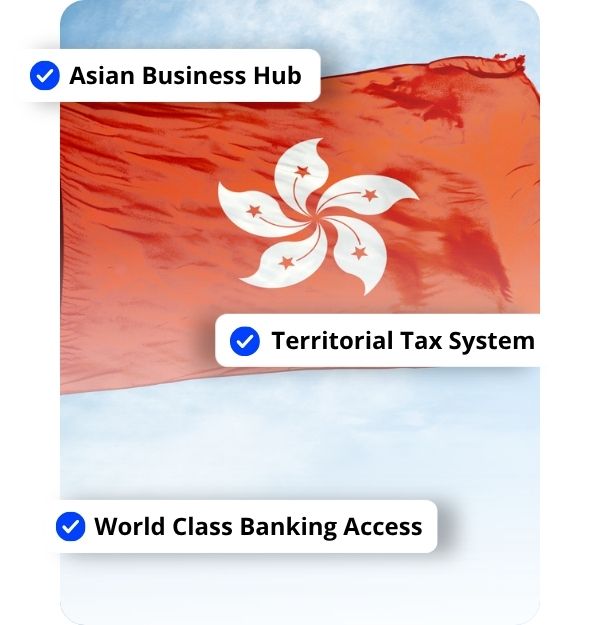
Hong Kong is a bridge between Mainland China and the wider Asia–Pacific region. It combines a pro-business legal system, clear tax rules, and deep financial markets that are familiar to international investors.

Territorial tax system
Profits tax applies only to profits arising in or derived from Hong Kong; offshore-sourced profits may be exempt if properly structured and supported.
Low, two-tier profits tax rates
Companies pay 8.25% on the first HK$2 million of assessable profits and 16.5% on the remainder—rates that are competitive with many Western jurisdictions.
Extensive double tax treaty network
Hong Kong has signed over 50 comprehensive double taxation agreements (DTAs), helping to reduce or eliminate double taxation on cross-border income.
No foreign-exchange controls
Funds can move in and out freely. Companies routinely hold multi-currency accounts (HKD, USD, EUR, and more) and transact globally without FX restrictions.
World-class financial center
More than 70 of the world’s 100 largest banks have a presence in Hong Kong, giving companies access to sophisticated banking, trade finance, and investment services.
Fully remote incorporation
With a licensed agent, incorporation can be done entirely online. Standard cases are often completed in around 3 working days; packages with banking typically take 1–2 weeks.
Hong Kong Private Company Limited by Shares
The standard Hong Kong vehicle for international founders is the private company limited by shares. It combines limited liability, flexible ownership, and straightforward reporting with access to Hong Kong’s territorial tax system and banking sector.
Benefits

Low, two-tier profits tax (8.25%/16.5%) on Hong Kong–sourced income only
No tax on dividends or capital gains under current rules
Access to over 50 DTAs for reduced withholding on cross-border payments
Strong reputation as a major Asian financial center, not a “classic” tax haven
Remote setup and administration through licensed service providers
No foreign-exchange controls; easy to hold multi-currency accounts
Best suited for trading and sourcing businesses, e-commerce and online services, consulting, regional holding structures, and companies working with Mainland China and wider Asia–Pacific markets.
Key Features

Legal Form: Private company limited by shares, incorporated under the Hong Kong Companies Ordinance
Ownership: Minimum 1 shareholder (individual or corporate, any nationality); up to 50 shareholders
Directors: At least 1 natural-person director (any nationality). Additional corporate directors are allowed. The same individual may serve as both the sole director and the sole shareholder.
Company Secretary: Mandatory; must be a Hong Kong resident individual or a licensed local corporate secretary
Registered Office: Must maintain a physical registered address in Hong Kong
Share Capital: No statutory minimum; in practice, many companies start from HK$10,000 authorized capital with a fully flexible paid-up amount
Liability: Limited to the amount of share capital subscribed by shareholders
Compliance: Annual audited financial statements, profits tax return filing, and annual return to the Companies Registry are mandatory
Use Cases: Trading, holding, consulting, and professional services, online platforms, regional headquarters, and most other lawful commercial activities
Cost of Hong Kong Company Formation
In Hong Kong, companies are incorporated through licensed service providers who liaise with the Companies Registry and Inland Revenue. The packages below bundle official fees and professional services, so you receive a ready-to-use company without having to handle the bureaucracy yourself.
Standard
Processing time: from 3 working days
Suitable if you want a compliant Hong Kong legal entity quickly, for market entry, structuring, or early-stage partner discussions—and plan to sort banking separately or later.
Package Includes:
Preparation of incorporation documents and company registration
Payment of the government registration fee
Registered agent services for 12 months
Provision of a registered office address for 12 months
Full set of original corporate documents
Courier delivery of the corporate document set
Professional
Processing time: from 7 working days
Designed for clients who value formal corporate attributes (company seal/chop) to support contract signing and dealings with Asian partners and authorities.
Package Includes:
Preparation of incorporation documents and company registration
Payment of the government registration fee
Registered agent services for 12 months
Provision of a registered office address for 12 months
Full set of original corporate documents
Courier delivery of the corporate document set
Production of a corporate seal/chop for contracts and internal documentation
Premium
Processing time: from 14 days
Best for entrepreneurs who want a Hong Kong company with a working corporate account as soon as possible—ideal for trading, online business, and projects that need live banking quickly.
Package Includes:
Preparation of incorporation documents and company registration
Payment of the government registration fee
Registered agent services for 12 months
Provision of a registered office address for 12 months
Full set of original corporate documents
Courier delivery of the corporate document set
Opening of a corporate account (bank or fintech/payment institution, depending on profile)
How to Register a Hong Kong Company: Step-by-Step
Setting up a company in Hong Kong is a structured, document-driven process that can be completed fully online through a licensed service provider. Below is a simplified roadmap that outlines what happens from the moment you choose a name to when your company is ready to trade and open accounts.
Name Check and Company Type
On your initial consultation, we help you choose the right configuration, typically a Company limited by shares—standard commercial vehicle for trading and services—or a Company limited by guarantee—suitable for non-profit or membership-based organizations. You propose several name options. They must not duplicate existing names, mislead the public, or infringe third-party trademarks.
Define Structure (Directors, Shareholders, Secretary)
We agree who will act as director(s) and shareholder(s), whether you need professional officers, who will serve as the Hong Kong company secretary (individual or licensed firm), and the share structure and internal registers of members.
KYC and Document Preparation
We collect KYC documents and prepare the statutory forms, typically including Form NNC1—incorporation form for a company limited by shares, Articles of Association, and “Consent to Act as Director” forms for any individual who is both a founder and a director. Our team checks completeness and consistency before filing.
Filing with the Hong Kong Companies Registry
We submit the signed documents electronically to the Companies Registry, pay government fees, and monitor the application.
Issuance of Corporate Documents
Once approved, you receive the Certificate of Incorporation, Business Registration Certificate, and filed incorporation forms and Articles. Electronic and paper versions have equal legal force. Thereafter, you can proceed to banking, contracts, and operational setup.
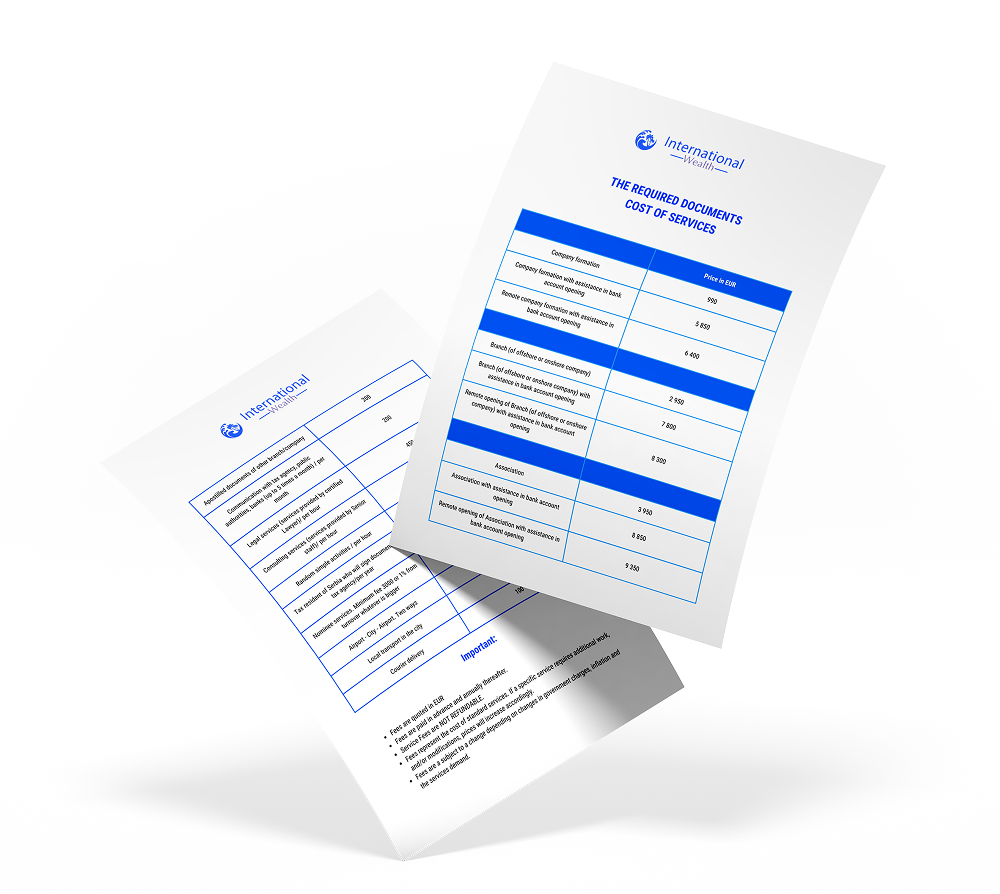
Required Documents for Hong Kong Company Formation
To keep the process smooth, we pre-check your documents before filing. Typical requirements:
For Individual Founders, Directors, or Shareholders
Clear scan of a valid passport
Proof of residential address (utility bill or bank statement not older than 3 months)
For Corporate Shareholders
Certificate of Incorporation (or equivalent)
Constitutional documents (Memorandum & Articles/Articles of Association)
Information on ownership structure and directors (registers or official extracts)
Short profile or résumé of directors (if requested)
Our specialists review the full package before submission, so you avoid rejections or delays.
Additional Information
Opening a Corporate Bank Account in or for Hong Kong
Hong Kong’s banking system is robust and tightly regulated, which is good for credibility—but it also makes account opening the toughest stage for many non-resident clients.
Why Account Opening Is Challenging
Banks apply strict KYC/AML standards and may ask for:
-
Detailed business description and plan
-
Contracts or letters of intent with Asian counterparties
-
Evidence of business activity or experience
-
Proof of the source of funds and wealth
-
Sometimes, a personal visit by a director or signatory
As a result, applications can take weeks and may still be declined if the profile is not convincing.
Options: Traditional Banks vs. Fintech/EMI Platforms
Local Hong Kong banks
-
Full-service corporate accounts, trade finance, cards, FX, and more
-
Higher documentary and substance expectations, often including local ties or operations
-
In many cases, in-person onboarding for at least one director/signatory
Fintech platforms / EMIs (neobanks)
-
Remote onboarding, often faster decisions
-
Multi-currency IBAN-style accounts or virtual accounts for international payments
-
Ideal for online business, consulting, and early-stage structures
-
May have restrictions on certain industries or high-risk geographies
Offshore Pro Group can help you select a realistic target bank or EMI and prepare a bank-friendly profile, thereby improving your chances of approval.
Taxation & Reporting for Hong Kong Companies
Territorial Profits Tax
Hong Kong follows the territorial source principle: profits tax is charged only on profits arising in or derived from Hong Kong. Offshore-sourced income may not be taxable locally if substance and documentation support that position.
Two-Tier Profits Tax Rates
For corporations, the current two-tier regime (subject to ongoing rules) is:
-
8.25% on the first HK$2 million of assessable profits
-
16.5% on profits above HK$2 million
There is no separate local tax on dividends, bank interest, or capital gains.
No VAT, No Dividends WHT
-
No value-added tax (VAT) or GST
-
No withholding tax on dividends and bank interest
-
No capital gains tax under current law
Global Minimum Tax for Large Groups
From financial years starting on or after 1 January 2025, Hong Kong is implementing a domestic minimum top-up tax (HKMTT) to ensure that in-scope multinational groups with consolidated revenue of at least €750 million pay an effective rate of at least 15% on Hong Kong profits, in line with OECD BEPS 2.0 Pillar Two.
For most small and mid-sized international companies, the regular two-tier profits tax system continues to apply.
Accounting, Audit, and Annual Filings
Every active Hong Kong company must:
-
Maintain proper books and records
-
Prepare annual financial statements
-
Have the accounts audited by a Hong Kong-licensed auditor
-
File Profits Tax Returns and respond to queries from the Inland Revenue Department
Accounting and audit costs depend on transaction volume and how well records are maintained. Many SMEs outsource bookkeeping to local firms instead of hiring full-time staff.
Why Register a Hong Kong Company with Offshore Pro Group
Setting up a Hong Kong company is not only about filling out forms; it’s about making sure your structure works for tax, banking, compliance, and long-term strategy.
End-to-end support
We guide you from initial planning and choice of structure, through incorporation and bank/EMI selection, to annual compliance and renewals.
Remote, transparent process
All steps are organized online. You know upfront what’s included, what extra costs might arise, and how long each step typically takes.
Banking-oriented approach
We look at your case the way banks and regulators do, so your company has a better chance of being accepted by financial institutions.
Tailored structures
We factor in your tax residence, corporate group, and long-term plans (for example, regional office, holding, or trading hub) to design a structure that can scale.
Start Your Hong Kong Company Today
Registering a company in Hong Kong gives you a compliant, flexible vehicle in one of the world’s leading financial centers—with territorial taxation, strong treaty support, and access to Asian markets. Offshore Pro Group will guide you through each step: from choosing the right structure to incorporation, banking, and ongoing compliance.
FAQ: Hong Kong Company Formation
Can a foreigner register a company in Hong Kong?
Yes. There are no nationality or residency restrictions for directors or shareholders. A non-resident can fully own and manage a Hong Kong company.
Do I need to visit Hong Kong to incorporate?
No. Incorporation itself can be completed remotely through a licensed agent. A physical visit may be required later by certain banks, but it’s not needed for company registration.
How long does it take to set up a company?
Standard incorporations can be completed within about 3 working days after all documents and KYC checks are in place. Packages including a bank or EMI account may take 1–2 weeks or longer, depending on the institution’s due diligence.
What is the minimum share capital?
There is no statutory minimum paid-up share capital. Many companies start with HK$10,000 authorized capital and a small paid-up amount (for example, HK$1–10,000) for simplicity.
What taxes does a Hong Kong company pay?
Companies pay profits tax only on Hong Kong-sourced profits, at two-tier rates of 8.25% and 16.5%. There is no VAT, no tax on dividends or bank interest, and no capital gains tax under current rules.
Is a Hong Kong company automatically “offshore” and tax-free?
No. Tax treatment depends on where profits are generated. Purely offshore structures may argue for exemption, but the Inland Revenue Department expects proper documentation and substance analysis. Your home country may also have CFC rules and worldwide-income taxation.
Do all Hong Kong companies need audited accounts?
In practice, yes, for almost all active companies. Private companies are generally required to prepare audited financial statements and file them together with their Profits Tax Return. Only companies that have been formally declared dormant under the Companies Ordinance can be exempt from ongoing reporting while they remain dormant.
How does the global minimum tax affect Hong Kong companies?
Only multinational enterprise groups with consolidated revenue of at least €750 million fall under the new 15% global minimum tax and Hong Kong’s domestic top-up tax regime. Smaller businesses continue under the existing profits tax system.
Is it difficult to open a bank account in Hong Kong?
For non-resident owners and new companies with no local track record, opening an account at a traditional Hong Kong bank can be challenging. Banks may require detailed documentation, a strong business case, and, in some cases, a personal visit.
Can my Hong Kong company use an overseas bank or EMI?
Yes. Many Hong Kong companies use accounts in other financial centers or reputable EMIs/fintech platforms. This is common for online business, consulting, and international trade.
Will my account be multi-currency?
Most corporate accounts (traditional or fintech) can support multiple currencies such as HKD, USD, EUR, GBP, and others, making global payments easier.
What are the main annual costs for a Hong Kong company?
Typical annual costs include:
-
Government business registration fee and levy
-
Registered office and company secretary services
-
Bookkeeping and audit
-
Tax-return preparation and filing
Exact amounts depend on the provider and transaction volume.
Can I change directors or shareholders later?
Yes. Changes are made via board/shareholder resolutions and filings with the Companies Registry. Your service provider prepares documentation and updates internal registers and public records.
Can my Hong Kong company employ staff abroad?
Yes. A Hong Kong company can hire employees in other jurisdictions, subject to local labor and tax laws. This may affect where profits are considered to arise for tax purposes and should be planned carefully.
Discuss your Hong Kong structure with an expert
Tell us about your plans, get a realistic timeline and cost estimate, and find out whether a Hong Kong company is the right tool—or whether another jurisdiction better fits your goals.
Contact an ExpertUliana Syva
Consultant for company registration, bank account opening, residency, and citizenship.
1000+
successful cases
13+
years of experience


Other Services
Alongside Hong Kong company formation, we can help you set up and maintain structures in a range of other offshore and onshore jurisdictions. This lets you combine an Asia hub with additional entities for holding, trading, asset protection, or EU access.