


Open an Offshore Bank Account
An offshore bank account helps individuals and businesses manage money internationally, diversify assets, and build a more resilient financial structure outside their home country. It can support multi-currency banking, cross-border transfers, personal wealth management, and corporate operations in several jurisdictions. We help clients choose the right bank, EMI, or jurisdiction and complete the opening of an offshore bank account with legal and compliance support from start to finish.
Excellent 4,6 out of 5

Understanding the Value of Offshore Banking
An offshore account is not a mystery product. It is simply a bank account opened outside your country of residence and used for lawful international banking, asset diversification, and cross-border financial management.
What is an offshore account?
In simple terms, an offshore account is a foreign bank account held in another jurisdiction. The offshore account meaning is not secrecy for its own sake. It is about flexibility: holding money in other currencies, making international transfers more efficiently, and reducing dependence on one domestic banking system. That is the basic offshore bank account meaning in practical terms.
What is an offshore bank account and why do people use one?
Clients usually open an offshore bank account to manage international payments, support business in several countries, hold funds in stronger currencies, or protect part of their capital outside the banking system of their home country. This is why both companies and private clients explore offshore banking when local banking becomes too narrow for their goals.
Offshore vs onshore banking
Domestic or onshore accounts are usually built for local salary flows, everyday payments, and resident banking. Offshore banking is designed for international transfers, multi-currency operations, foreign business activity, and broader asset diversification. The difference is not that one is “legal” and the other is not. The difference is purpose, jurisdiction, and how the banking structure supports global activity.
Why Global Clients Choose Offshore Solutions
Clients choose offshore solutions when they need more flexibility than domestic banking can usually provide.

International payments and multi-currency operations
An international offshore bank account can simplify payments across borders, reduce friction in currency conversions, and support international transfers in USD, EUR, GBP, and other currencies.
Asset diversification and capital protection
Keeping all funds in one home-country bank creates concentration risk. Offshore structures help spread banking exposure across jurisdictions and support longer-term capital protection.
Managing global business and overseas partners
For internationally active companies, an offshore business bank account can make it easier to work with suppliers, clients, and contractors in different countries.
Better support for non-residents
A non-resident offshore bank account may be a better fit for clients who live abroad, move frequently, or do not want all banking tied to one tax-residency jurisdiction.
Access to broader financial infrastructure
Many offshore banks and EMIs offer better support for global payments, foreign counterparties, and multi-jurisdiction account management than local retail banks.
Stronger separation of personal and business finances
For founders and internationally mobile entrepreneurs, an offshore corporate bank account or offshore company account can create cleaner separation between private wealth and operating funds.
Identifying the Ideal Candidate for Offshore Banking
Offshore banking is most useful for clients whose financial life already extends beyond one country.
-
 Private clients with cross-border financial needs
 -
International businesses and offshore companies
-
Non-residents and internationally mobile clients
-
Expats and overseas workers
-
Freelancers and consultants with foreign clients
-
Digital nomads and global professionals
-
HNWIs and internationally minded investors
-
Companies seeking cleaner corporate banking
Selecting the Right Account Type for Your Goals
Different goals require different account types. The right structure depends on whether the priority is personal use, business activity, savings, payments, or investment access.
Personal Offshore Accounts for lifestyle and global mobility
Best for private clients who need international transfers, multi-currency access, and a foreign banking setup outside their home country.
Corporate & Business Accounts for international trade
An offshore business bank account is designed for companies that need cross-border banking, supplier payments, invoicing, and corporate financial management.
Private Banking & Wealth Management for high-net-worth individuals
A higher-tier solution for clients who want personalized service, relationship management, and broader investment or wealth-structuring options.
Specialized Merchant Accounts for global e-commerce
Useful for businesses accepting card payments online, especially where global acquiring and settlement support are needed.
Brokerage & Investment Accounts for access to world markets
A practical choice for clients who want investment exposure through an international structure tied to offshore banking.
High-yield Savings and Fixed-Term Deposit options
This can include an offshore savings account, fixed-term deposits, or structured reserve solutions for longer-term capital preservation. In some cases, clients may also need an offshore current account or even an offshore euro account depending on operational needs.
Traditional Banks vs. EMIs: Choosing the Right Provider
There is no single bank or payment institution that works for every international client.
The right solution depends on your goals, where you live or operate, which currencies you use, how often you send or receive payments, and whether you need a traditional bank for long-term stability or an EMI for faster day-to-day operations.
With Offshore Pro Group, the goal is not simply to open an account, but to select the banking format that best fits your profile, transaction flow, and long-term financial strategy.
Traditional Offshore Banks
Traditional offshore banks are usually the right fit for clients who value stability, reputation, asset protection, and deeper banking relationships.
- Better suited for larger balances and long-term wealth preservation
- Stronger fit for private banking, holding structures, and international business operations
- Provides direct SWIFT access and more traditional banking infrastructure
- Involves stricter compliance checks and more detailed documentation
EMI Solutions
EMIs are often a better answer for digital businesses, internationally mobile clients, and fast-moving cross-border operations.
- Faster onboarding and lower entry thresholds in many cases
- Flexible multi-currency payments and simpler online account access
- Practical for freelancers, service businesses, e-commerce, and remote teams
- Best for operational payments, debit cards, and day-to-day account management
Remote Opening vs. Physical Visit: Navigating the Onboarding Process
Modern offshore banking can often be opened remotely, but not every provider follows the same rules. The onboarding format depends on the bank, the jurisdiction, and the client profile.
Remote Opening
- Available with many EMIs and selected offshore banks
- KYC documents are usually submitted online
- Video KYC or online verification may be required
- Best for clients who want speed and no international travel
- Often suitable for personal accounts, smaller corporate accounts, and digital-first banking setups
Physical Visit
- More common with traditional or premium banks
- A personal meeting may still be requested in higher-value or more selective cases
- Original documents or in-person signing may be required
- Often relevant for private banking or more conservative institutions
- Can still be worthwhile when the client wants a deeper long-term banking relationship
Best Jurisdictions to Open an Offshore Bank Account
The best jurisdiction depends on your residency, business activity, balance size, currencies needed, and the type of provider that fits your profile. Some clients look for strong private banking, others for fast remote onboarding, and others for a practical overseas bank account for international operations.
Traditional Offshore Banks
Traditional offshore banks are usually chosen by clients who value stronger banking infrastructure, long-term stability, and more established international relationships. These solutions are often better suited for larger balances, private banking needs, and companies that require direct SWIFT access and deeper asset protection structures.
| JURISDICTION | ACCOUNT TYPE | VISIT | REG. TIME | CURRENCIES | CARDS | MIN. DEPOSIT | FEE | ACTION |
|---|---|---|---|---|---|---|---|---|
 Belize | Personal | Not required | 1 month | USD, EUR, CAD, GBP, CHF | Prepaid Visa | From 2,000 | 2,999 EUR | See More |
Belize | Corporate | Not required | 1 month | USD, EUR, CAD, GBP, CHF | Prepaid Visa | From 2,000 | 3,999 EUR | See More |
 Cyprus | Personal | Required | 1 month | – | Debit, Credit, Prepaid | – | 2,999 EUR | See More |
Cyprus | Corporate | Required | 1 month | – | Business Debit/Credit | – | 3,999 EUR | See More |
 China | Corporate | Required for CNY | 2-4 weeks | CNY, USD, EUR + | Mastercard, UnionPay | – | 7,500 EUR | See More |
 Liechtenstein | Personal | Not required | 1-2 months | CHF, EUR, USD, GBP, JPY | – | 5,000 CHF | 2,999 EUR | See More |
Liechtenstein | Corporate | Not required | 1-2 months | CHF, EUR, USD, GBP, JPY | – | 5,000 CHF | 3,999 EUR | See More |
 Panama | Personal | Not required | 1 month | USD | Visa, Mastercard | 0 – 5,000 USD | 3,000 EUR | See More |
Panama | Corporate | Not required | 1 month | USD | Visa, Mastercard | 10k – 50k USD | 4,225 EUR | See More |
 Saint-Lucia | Personal | Not required | 1-2 months | Multicurrency | Visa Credit | 5,000 EUR | 2,999 EUR | See More |
Saint-Lucia | Corporate | Not required | 1-2 months | Multicurrency | Visa Credit | 5,000 EUR | 3,999 EUR | See More |
 Serbia | Personal | Optional (POA) | 1 day – 1 month | EUR, USD, CHF + | Visa Debit/Credit | – | 3,000 EUR | See More |
Serbia | Corporate | Optional | 1 month | EUR, USD | Visa Debit | – | Varies | See More |
 Singapore | Personal | Not required | 1 month | Multi + Crypto | – | – | 2,000 EUR | See More |
Singapore | Corporate | Not required | 1 month | SGD, USD, GBP, EUR | Visa | – | From 2,999 USD | See More |
 USA | Personal | Not required | 1 month | EUR, USD | Mastercard | – | 5,000 EUR | See More |
USA | Corporate | Not required | 1 month | EUR, USD | Visa | – | 6,000 EUR | See More |
 Switzerland | Personal | Not required | 2-4 weeks | – | UnionPay, Visa, MC | 100k – 500k CHF | From 2,999 EUR | See More |
Switzerland | Corporate | Not required | 2-4 weeks | – | UnionPay, Visa, MC | 100k – 500k CHF | From 3,999 EUR | See More |
 Montenegro | Personal | Not required | 1 month | EUR, USD | Mastercard | – | 2,999 EUR | See More |
Montenegro | Corporate | Not required | 1 month | EUR, USD | Visa | – | 3,999 EUR | See More |
Belize
Belize
Cyprus
Cyprus
China
Liechtenstein
Liechtenstein
Panama
Panama
Saint-Lucia
Saint-Lucia
Serbia
Serbia
Singapore
Singapore
USA
USA
Switzerland
Switzerland
Montenegro
Montenegro
EMI Solutions
EMIs are often a better fit for digital businesses, service companies, and internationally mobile clients who need faster onboarding and more flexible multi-currency payments. These solutions are usually easier to manage online and are especially practical for day-to-day international operations.
| JURISDICTION | ACCOUNT TYPE | REG. TIME | CARDS | FEE | ACTION |
|---|---|---|---|---|---|
 Canada | Personal | 1-3 days | Visa | From 3,000 EUR | See More |
Canada | Business | 1-3 days | Visa | From 3,000 EUR | See More |
Canada | Merchant | 1-3 days | Visa | From 3,000 EUR | See More |
 United Kingdom | Personal | 1-10 days | Visa, Mastercard | From 2,200 EUR | See More |
United Kingdom | Business | 1-10 days | Visa, Mastercard | From 3,000 EUR | See More |
United Kingdom | Merchant | 1-10 days | Visa, Mastercard | From 3,000 EUR | See More |
 Lithuania | Personal | 1-7 days | Visa, Mastercard | From 2,200 EUR | See More |
Lithuania | Business | 1-7 days | Visa, Mastercard | From 3,000 EUR | See More |
 Hong Kong | Business | 1-7 days | Visa | From 3,000 EUR | See More |
 Kazakhstan | Personal | 3-7 days | No Cards (Crypto/SWIFT) | From 2,200 EUR | See More |
Kazakhstan | Business | 3-7 days | No Cards (Crypto/SWIFT) | From 3,000 EUR | See More |
Singapore | Business | 1-7 days | Visa | From 3,000 EUR | See More |
 Czech Republic | Personal | 1-5 days | Visa (Virtual) | From 2,200 EUR | See More |
Czech Republic | Business | 1-5 days | Visa (Virtual) | From 3,000 EUR | See More |
 Mauritius | Business | 5-10 days | No Cards | From 3,000 EUR | See More |
USA | Personal | 1-5 days | Visa, Mastercard | From 2,200 EUR | See More |
USA | Business | 1-5 days | Visa, Mastercard | From 3,000 EUR | See More |
 Netherlands | Business | 3-5 days | Visa (Physical) | From 3,000 EUR | See More |
 Estonia | Personal | 1 day | Visa | From 2,200 EUR | See More |
Estonia | Business | 1 day | Visa | From 3,000 EUR | See More |
 Mexico | Personal | 1-3 days | Mastercard | From 3,000 EUR | See More |
Mexico | Business | 1-3 days | Mastercard | From 3,000 EUR | See More |
The Proven Step-by-Step Path to Opening Your Offshore Account
Opening the right offshore account is less about luck and more about matching the right client to the right provider with the right compliance file.
Aligning your banking objectives with the right provider
We begin by understanding whether you need personal banking, business banking, private banking, merchant support, or a more specialized international structure.
Shortlisting the most compatible banks or EMIs
Based on your profile, we identify the institutions most likely to support your goals and compliance profile. This is a crucial part of how offshore bank account services actually work in practice.
Preparing a flawless KYC and compliance file
We help structure the documents, clarify the source of funds, and make sure the application is internally consistent before submission.
Navigating the application and due diligence process
We assist throughout the review stage, including clarification requests, onboarding questions, and compliance follow-up.
Account activation and initial funding
Once approved, the account is activated and ready for funding, online banking setup, transfers, and operational use.
Documents Required for Opening an Offshore Account
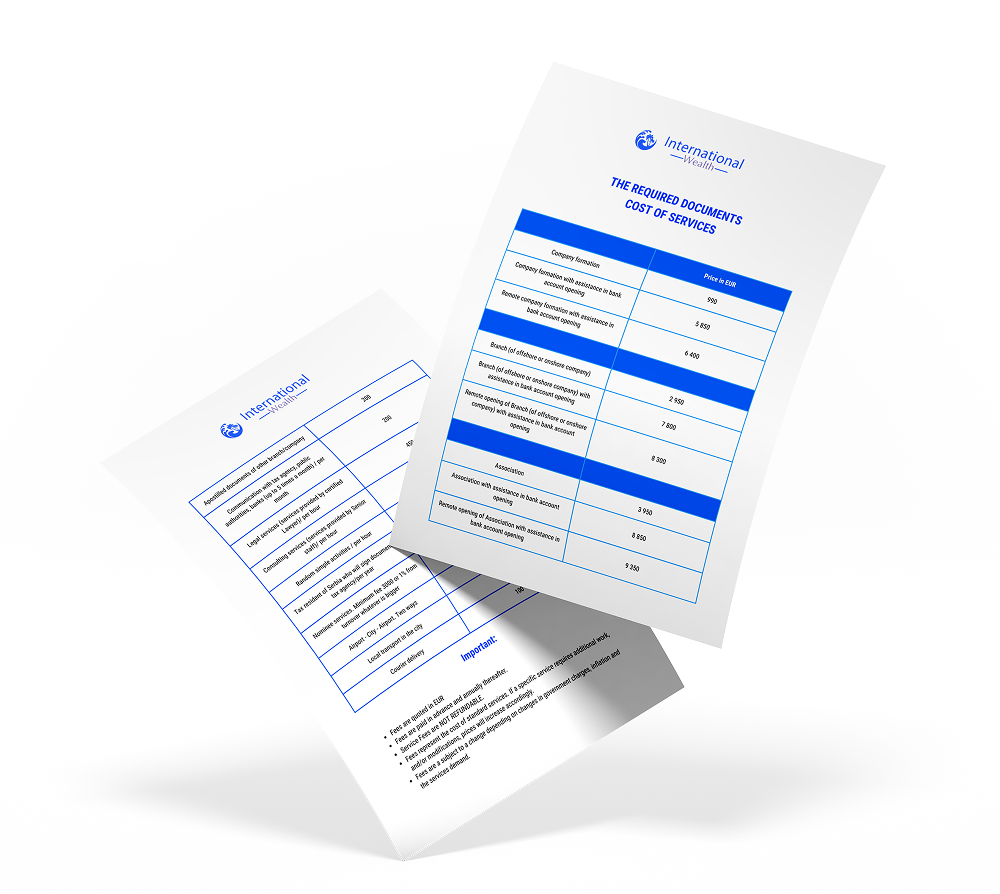
Banks want clarity before they open any foreign account. That means KYC, AML checks, due diligence, and documentary proof that the client and the funds are legitimate.
Documents for personal clients:
Passport or national ID
Secondary photo ID where requested
Proof of residential address
Source of funds declaration
In some cases, a bank reference letter or tax-related documents
Documents for companies and UBOs:
Certificate of Incorporation and company formation documents
Memorandum and Articles of Association where relevant
Ownership structure and UBO details
List of directors or control persons
Proof of business address
Licenses or regulatory documents where applicable
Bank references or supporting financial documents
How to prove source of funds and business activity: Banks usually want documents showing how money was earned and why the account is needed. This can include salary slips, contracts, invoices, tax returns, business financials, investment records, or documents confirming the lawful source of capital. For company applications, the bank may also want to understand the actual business model and expected transaction flow.
See Which Offshore Banking Solution Fits Your Profile
The hardest part is usually not the form. It is choosing the right structure before you apply. A personal account, offshore corporate bank account, EMI, private bank, or offshore business account all serve different purposes, and the wrong choice wastes time fast.
Contact an ExpertUliana Syva
Consultant for company registration, bank account opening, residency, and citizenship.
1000+
successful cases
13+
years of experience


Legal, Tax, and Compliance Considerations
Offshore banking works best when it is built on transparency, not myths. Legal structure, tax reporting, and compliance discipline matter much more than the fantasy of “hidden” accounts.
Is offshore banking legal?
Yes. Offshore banking is legal when used within the law and combined with proper tax disclosure, KYC compliance, and lawful source-of-funds documentation.
KYC, AML, and due diligence explained
Banks must understand who the client is, how the funds were earned, and what the account will be used for. These checks are designed to prevent money laundering, sanction breaches, and opaque financial misuse.
Tax reporting and transparency obligations
Clients remain responsible for reporting foreign accounts and income in their country of residence. Depending on the client’s status, CRS, FATCA, FBAR, or other reporting rules may apply.
Why compliance matters more than secrecy
Modern offshore banking is not about hiding assets. It is about lawful international finance, asset diversification, and financial privacy within the law. Strong compliance is what makes the structure durable.
Why Choose Offshore Pro Group to Open an Offshore Account
Choosing the right offshore solution is not about collecting random bank names. It is about getting the structure right before you submit the application.
Pre-Screening Before Submission
We assess your profile, goals, expected use, and compliance risk before any formal filing. That helps avoid poor-fit providers and unnecessary refusals.
Matching the Right Bank or EMI
Not every provider is suitable for every client. We help match the right institution to your actual banking needs, whether that means a personal account, offshore company account, EMI, or private bank.
Stronger Compliance Preparation
We help clients prepare cleaner KYC, AML, due-diligence, and source-of-funds documentation. That gives the application a more coherent and bankable structure.
End-to-End Support
We stay involved from the first consultation to activation and initial funding. That makes the whole process faster, clearer, and easier to manage.
Ready to Build Your International Banking Setup?
An offshore bank account is not just another account. It is the foundation of a more flexible international financial structure for personal wealth, business operations, and global banking access. Whether you want to open offshore account options for personal use, compare offshore bank accounts for business, or build a safer international payment setup, we can help. Contact us for a confidential consultation, and we will help you identify the right path for opening an offshore bank account that actually fits your profile.
Frequently Asked Questions
What is an offshore bank account and how does it work?
It is a bank account opened outside your country of residence. It can be used for international transfers, multi-currency banking, and lawful asset diversification. That is the simple answer to what is an offshore bank account and how offshore banking works in practice.
Is offshore banking legal?
Yes. Offshore banking is legal when the client complies with tax reporting, source-of-funds rules, and general banking regulations in the relevant jurisdictions.
What is the difference between an offshore account and a regular onshore bank account?
A domestic account is usually built for local banking. An offshore one is designed for international transfers, foreign currencies, cross-border business, and broader asset diversification.
What is the difference between an offshore bank and an Electronic Money Institution (EMI)?
Traditional banks usually offer deeper banking relationships and stronger classical banking infrastructure. EMIs are often faster, more flexible, and better suited to digital onboarding and operational payments.
What taxes do I still need to report when banking offshore?
That depends on your residence country and tax status. Foreign accounts, income, and certain transfers may need to be reported under local rules, CRS, FATCA, or similar frameworks.
Can US citizens open offshore accounts, and what are the FATCA or FBAR obligations?
Yes, in many cases they can. But offshore banking for US citizens involves strict reporting duties, including FATCA and potentially FBAR, so the structure must be built carefully.
Can a non-resident or a foreign business open an offshore bank account?
Yes, in many cases. A non-resident offshore bank account or foreign corporate account is possible if the bank accepts the jurisdiction, business activity, and compliance profile.
Can I open an offshore bank account online, or do I need to visit the bank in person?
Both are possible, depending on the provider. Many EMIs and some banks support remote opening, while more selective or traditional institutions may still require a visit.
What documents are required for the application, and how do banks verify the Source of Funds?
Usually ID, proof of address, and documents explaining how the funds were earned. For companies, incorporation documents, UBO details, and business records are also required.
How long does it take to open an offshore account and what is the minimum deposit?
That depends on the provider and the case complexity. Some accounts are opened within days, while others take several weeks. Minimum deposits vary from modest thresholds to much higher requirements in premium banks.
Can I get full online banking access and a debit card with my offshore account?
In many cases, yes. Many providers offer full online banking and, depending on the product, debit card access for personal or business use.
Why do offshore bank account applications get rejected?
Common reasons include weak documentation, unclear source of funds, business activities outside the bank’s risk appetite, or inconsistencies in the application.
Are offshore bank accounts safe, and is my deposit protected?
Safety depends on the bank, the jurisdiction, the account type, and the applicable deposit-protection framework. That is why provider selection and jurisdiction quality matter so much.