


Offshore Bank Account for Crypto: Personal and Corporate Banking Solutions
An offshore bank account for crypto helps investors, entrepreneurs, and international companies manage digital-asset-related wealth through a more structured banking environment. It can support fiat withdrawals, stablecoin-linked workflows, multi-currency balances, and cross-border transfers when the client can document the origin of funds properly. We help clients identify the right bank or jurisdiction, prepare the compliance file, and open a workable banking structure for personal or corporate use.
Excellent 4,6 out of 5

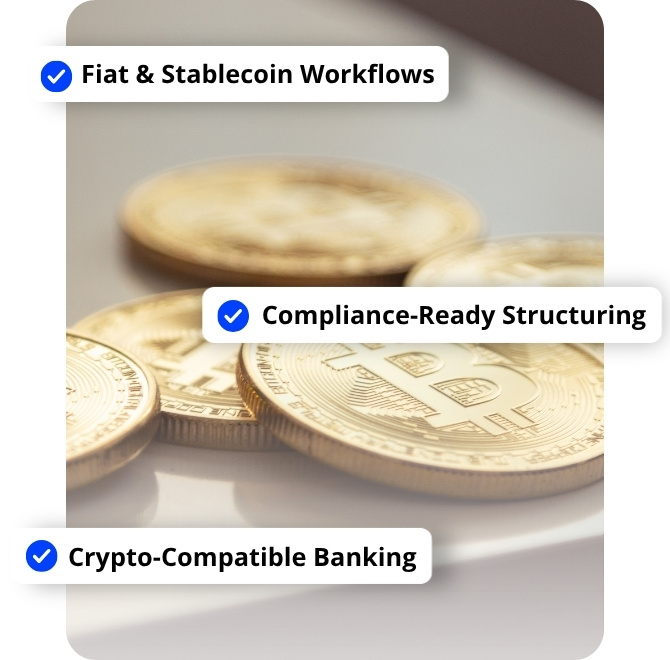
What Is an Offshore Bank Account for Crypto?
An offshore banking solution for crypto is not just a foreign account with a trendy label. It is a banking relationship built for clients whose wealth, transactions, or business activity involve Bitcoin, stablecoins, or broader digital assets.
A cryptocurrency offshore bank account is usually opened in a jurisdiction or with a bank that is more comfortable reviewing crypto-related source of funds than a standard domestic retail bank. The account itself is still a bank account, not an exchange wallet. It is designed to receive, hold, and move fiat funds connected to lawful crypto activity, and in some cases support stablecoin-related settlement or crypto-to-fiat workflows.
In practical terms, it usually includes:
-
 Personal or corporate onboarding depending on the client profile
 -
Multi-currency banking in USD, EUR, GBP, and sometimes other currencies
-
International wire transfers and cross-border payment support
-
Compliance review of wallet history, exchange records, and source of wealth
-
Access to a more suitable banking structure for digital-asset-related proceeds
This is why an offshore bank account for crypto differs from a regular home-country account. The difference is not magic. It is risk appetite, banking policy, and the bank’s willingness to understand lawful crypto activity rather than rejecting it on sight.
Why Crypto Investors and Businesses Use Offshore Banking
Clients turn to offshore banking when ordinary retail banks no longer match the way they earn, move, or structure capital.

Access to crypto-friendly banking services
Some banks are simply better prepared to review digital-asset wealth. That makes them more practical for clients who need a crypto-friendly offshore bank rather than a bank that treats every Bitcoin transaction like a minor apocalypse.
Multi-currency accounts and fiat withdrawals
A strong structure allows clients to convert crypto proceeds into fiat, hold balances in several currencies, and manage withdrawals more efficiently across borders.
International diversification and asset structuring
An offshore account can help reduce concentration risk by keeping all banking exposure out of one domestic system. It can also fit into a broader asset protection or international planning structure.
Better separation of personal and business activity
For founders, traders, and crypto operators, separating personal wealth from company cash flow is often essential. Banking becomes cleaner when the structure matches the real activity.
Cross-border flexibility for global operations
An offshore setup may be more suitable for international transfers, counterparties in several countries, and clients who operate across multiple jurisdictions.
More realistic support for digital-asset proceeds
A properly selected offshore crypto bank account can provide a more workable route for lawful crypto-origin wealth than a domestic bank that simply does not want the file.
Who Can Qualify for a Crypto-Friendly Offshore Bank Account
This type of banking is designed for clients whose financial life or business model goes beyond ordinary local banking.
-
High-net-worth individuals (HNWIs)
-
Crypto investors and traders
-
Entrepreneurs and business owners
-
Expatriates and international residents
-
Professionals in fintech or blockchain
-
Individuals seeking privacy and asset protection
-
Clients with legal compliance
Get Help Choosing the Right Bank or Jurisdiction
The hardest part is rarely filling in forms. The hard part is choosing a bank or jurisdiction that actually fits your crypto profile before you apply. That is where expert matching matters. We review the nature of your activity, the size of your capital, whether you need a personal or company structure, how you convert crypto to fiat, and what kind of transactions you expect to make. This helps avoid weak applications and unnecessary rejections.
Contact an ExpertUliana Syva
Consultant for company registration, bank account opening, residency, and citizenship.
1000+
successful cases
13+
years of experience


What Banks Usually Want to Understand About Crypto Activity
Banks do not approve crypto-related clients based on enthusiasm. They approve them based on evidence, consistency, and risk logic.
Source of Funds and Source of Wealth
The bank wants to understand how the client earned the money and how the overall wealth was built. That may include trading profits, business income, salary, inheritance, investment gains, or sale of assets. For crypto clients, this usually means exchange records, wallet history, and a clear narrative explaining how Bitcoin or other holdings were accumulated.
Trading, Treasury, OTC, and Investment Activity
Banks also want to understand the type of crypto activity involved. Occasional long-term investing is different from high-frequency trading. Treasury management for a company is different from OTC volume or proprietary digital-asset operations. The bank needs to see what you actually do, not just the label “crypto investor.”
Fiat, Stablecoin, and Cross-Border Transfer Needs
A bank will look at whether you need fiat withdrawals, stablecoin-linked settlement, SWIFT transfers, international wires, or treasury management across several jurisdictions. It will also assess expected transaction volume and counterparties.
Offshore Bank Account for Crypto: Personal vs Corporate Setup
The right structure depends on how you manage crypto-related funds, how much asset separation you need, and whether your activity is personal or business-based.
Corporate/Offshore Company Account
- Better suited for business-related crypto activity, treasury management, and larger operational workflows
- Creates clearer separation between personal and corporate assets
- Works well for clients with multiple revenue streams, partners, or more complex ownership structures
- Useful when stronger internal controls and long-term asset structuring are needed
Personal Account
- More suitable for individuals managing their own crypto wealth without a separate company
- A simpler option for personal investing, holding, and fiat-related banking needs
- Usually faster and more straightforward to structure than a corporate setup
- Best for clients with lower structural complexity and no need for formal asset separation
Choosing the Right Jurisdiction for Crypto Banking
Some clients need a traditional offshore bank with stronger private-banking logic. Others need a more practical international banking hub with cleaner onboarding for digital-asset wealth. The best route depends on residence, activity type, transfer needs, and documentation quality.
Crypto-Friendly Traditional Banks
| JURISDICTION | VISIT | REG. TIME | CURRENCIES | CARDS | MIN. DEPOSIT | FEE | ACTION |
|---|
Crypto-Friendly EMI Solutions
EMI solutions are often faster to open and more flexible for payments, transfers, and digital access. They are especially useful for clients who need remote onboarding, lower entry thresholds, and efficient international money movement.
| JURISDICTION | REG. TIME | CARDS | FEE | ACTION |
|---|
AML/KYC Requirements Before You Apply
Crypto-friendly banking still means real banking. That means KYC, AML checks, source-of-funds review, and a compliance process that can actually withstand scrutiny.
Personal Documents
Passport or national ID
Secondary photo ID, if requested
Proof of residential address, such as a utility bill, bank statement, lease agreement, or tax document
Proof of source of funds and, where required, source of wealth
Corporate Documents
Certificate of Incorporation and company formation documents
Memorandum and/or Articles of Association
Ownership structure, UBO details, and list of directors or control persons
Proof of business operating address
Business licenses or regulatory documents, if applicable
Company financial statements, bank references, or supporting source-of-funds documents
Tax residency or tax-related company documents, where required
Crypto Asset Documents
Wallet history
Exchange statements and transaction records
Proof of crypto origin, including purchase records, OTC records, mining or staking records, or blockchain evidence
Evidence showing how funds or crypto moved into the relevant wallet, exchange, or banking structure
Additional materials showing lawful and compliant crypto activity
Depending on the bank, additional documents may be requested during compliance review, especially in cases involving higher transaction volume, complex ownership structures, or substantial crypto-origin wealth.
For many clients, the key question is how to explain transfers from bitcoin wallet to offshore bank account or from bitcoin exchange to offshore bank account without triggering avoidable concern. The answer is preparation: documented flows, consistent records, and a clear explanation of the origin and purpose of funds.
How to Open an Offshore Bank Account for Bitcoin or Crypto
The process is more structured than retail banking, but it becomes manageable when the profile is reviewed properly from the start.
Initial Assessment and Profile Review
We begin by reviewing your capital profile, digital assets, activity type, and banking goals. This helps identify the banks or jurisdictions most likely to fit your case.
Bank or Jurisdiction Matching
Based on your profile, we shortlist suitable banks, EMIs, or jurisdictions with a more realistic approach to crypto-related clients and offshore structuring.
Pre-Screening and Document Collection
We help collect personal, corporate, and crypto-origin documents, review them for consistency, and prepare the package for submission.
Submission, Compliance Review, and Activation
The file is submitted to the chosen institution. We follow the KYC and AML review, respond to follow-up requests, and support the case until activation.
Risks, Compliance, and Tax Considerations
A compliant structure is the only structure that lasts. Crypto-related banking requires careful attention to documentation, transaction monitoring, and tax obligations.
KYC and Proof of Funds
Banks need to understand who you are and where the money comes from. That is especially true for any bitcoin offshore bank account or offshore bank account for bitcoin application where crypto-origin wealth is involved.
AML Reviews and Transaction Monitoring
Approval does not end monitoring. Banks may continue reviewing incoming and outgoing transactions, counterparties, unusual activity, and whether the account use matches the original profile.
Legal and Tax Reporting Obligations
An offshore structure does not remove the client’s reporting duties at home. You remain responsible for foreign account disclosure, tax compliance, and lawful reporting in your country of residence.
Why Work With Offshore Pro?
Choosing a crypto-friendly offshore banking solution is not just about finding a bank. It is about matching your profile, documents, and transaction logic to a provider that can realistically approve your case.
Pre-Screening Before Submission
We assess your banking profile before any formal application is sent. This includes your crypto activity, source of funds, transaction pattern, and jurisdiction fit.
What this means for you: You reduce the risk of avoidable rejection and avoid wasting time on banks that are unlikely to accept your case.
Crypto Compliance Expertise
We understand how banks review wallet history, exchange statements, source of wealth, and fiat conversion flows. Our team helps present crypto activity in a way compliance officers can actually work with.
What this means for you: Your application looks clearer, stronger, and more consistent during AML and KYC review.
Jurisdiction and Bank Matching
Not every offshore bank or EMI is suitable for every crypto-related profile. We help identify the right banking solution based on your structure, activity type, and international transfer needs.
What this means for you: You get a more realistic route to approval and a banking setup that fits your actual goals.
End-to-End Support
We support the full process, from pre-screening and document preparation to submission, follow-up, and activation. You are not left alone in the middle of compliance questions or banking silence.
What this means for you: The process becomes faster, clearer, and easier to manage from start to finish.
Request a Crypto-Friendly Offshore Banking Consultation
If you need a compliant offshore bank account for crypto, the right starting point is a proper profile review, not a random application. We help investors, founders, and international clients assess bankability, choose the right jurisdiction, and build a stronger compliance package before submission. Contact us for a confidential consultation, and we will help you identify the solution that best fits your crypto activity and banking goals.
Frequently Asked Questions
Can I open an offshore bank account if my wealth comes from cryptocurrency?
Yes, in many cases you can, provided the origin of the assets is lawful and properly documented. The stronger your records, the better your chances of approval.
Do offshore banks accept Bitcoin, stablecoins, or only fiat proceeds from crypto?
That depends on the bank. Some institutions are comfortable only with fiat proceeds after conversion, while others may accept more direct crypto-related source-of-funds logic when documented clearly.
Is a company account better than a personal account for crypto activity?
Not always, but often yes for businesses, treasury operations, and more structured activity. A personal account may be sufficient for simpler individual investment use.
Which jurisdictions are best for opening a crypto-friendly offshore account?
That depends on the client profile, but international banking hubs and selected offshore jurisdictions are commonly reviewed for crypto-related cases. The right fit depends more on bank policy than on geography alone.
What documents do banks usually require from crypto-related applicants?
Usually identity documents, proof of address, source-of-funds evidence, exchange statements, wallet history, and where relevant corporate documents. Some banks may ask for more depending on the risk profile.
How long does it take to open a crypto-friendly offshore bank account?
The timing depends on the bank, the jurisdiction, and the quality of the file. Straightforward cases can move relatively quickly, while more complex ones take longer because compliance review is deeper.
Do I need proof of wallet history or exchange statements?
Often yes. Many banks want to see how the Bitcoin or crypto assets were acquired, held, and transferred before they approve the account.
How do I know whether my profile is bankable before applying?
The most reliable way is pre-screening. A proper review of your documents, activity type, and banking goals can show whether your case is strong before you submit it.
Can I use an offshore account for trading, treasury, or international transfers?
Yes, where the account profile and bank policy allow it. The bank will want your actual use to match what was disclosed during onboarding.
Why do banks reject some crypto-related applications?
Usually because of weak documentation, unclear source of funds, inconsistent activity descriptions, or a mismatch between the client and the bank’s risk appetite.
Does crypto-friendly banking mean no AML or KYC review?
No. It means the bank is more open to compliant crypto-related activity, not that it ignores AML or KYC rules. Real crypto-friendly banking still involves real compliance.
Can I hold both fiat and digital-asset-related proceeds in the same banking structure?
In many cases yes, but it depends on the institution and how the structure is set up. Some banks are more comfortable with fiat flows linked to documented digital-asset activity than with direct crypto exposure.