Wyoming Company Formation
Wyoming is one of the most attractive U.S. states for forming a company, especially for international founders, consultants, online business owners, and entrepreneurs who want a low-cost and privacy-friendly structure. It is widely known for its simple formation process, low annual maintenance costs, strong asset-protection features, and the fact that the state does not impose a state income tax. Wyoming LLCs can be formed remotely, with only a registered agent in the state required.
Excellent 4,6 out of 5


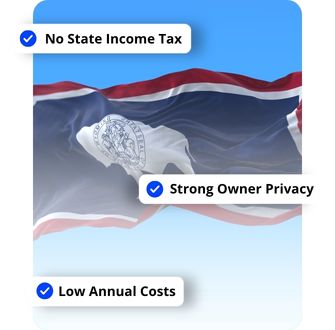
Key Advantages of a Wyoming
Company
Wyoming structures are designed as practical vehicles for international projects that need a U.S. legal presence, flexible management, relatively low compliance costs, and a higher level of privacy than many other states.

Simple, Fast Registration
A Wyoming LLC can usually be formed quickly once the structure is agreed and the filing information is ready. The official state filing fee for a domestic Wyoming LLC is $100, and the registration process can be handled remotely through the Wyoming Secretary of State system or by paper filing.
Strong Privacy for Owners
Wyoming is popular because public state filings for LLCs do not require listing the members in the formation document. In practice, the registered agent appears in the public filing record, while internal ownership details are typically kept off the public register.
Low Annual Maintenance Costs
Wyoming companies are relatively inexpensive to maintain. The annual report/license tax for LLCs is $60 or $0.0002 of assets located and employed in Wyoming, whichever is greater. Annual reports are due on the first day of the anniversary month of formation.
No Wyoming State Income Tax
Wyoming is one of the few U.S. states with no state income tax. That makes it especially attractive for founders comparing it with higher-cost or higher-tax jurisdictions, although federal U.S. tax rules and tax rules in other states or countries may still apply depending on the company’s activity and the owner’s residence.
Strong Asset Protection Features
Wyoming LLCs are widely used because they combine limited liability with a state-law framework that is generally considered favorable for protecting owners from business liabilities and keeping a legal separation between personal and business assets. The LLC format is especially appealing for small and medium-sized private businesses.
Remote Setup with a Registered Agent
You do not need to be physically present in Wyoming or in the U.S. to form a Wyoming LLC. However, state law requires every LLC to maintain a registered agent with a physical Wyoming address for service of process and official notices.
Wyoming LLC
A Wyoming LLC is the standard structure most international entrepreneurs choose when entering the U.S. market through Wyoming. It is flexible, simple to manage, and suitable for consulting, e-commerce, online services, trading, digital business, and certain holding structures.
Benefits

Limited liability for all members
Strong privacy compared with many other states
No Wyoming state income tax
Fast and relatively low-cost formation
No need for physical presence in the U.S. for formation
Suitable for non-U.S. founders managing the business remotely
Flexible internal arrangements through an Operating Agreement
Wyoming LLCs are typically chosen for consulting, online business, holding activities, and other international structures where flexibility, privacy, and ease of maintenance are important.
Key Features

Legal form: separate legal entity with limited liability for members
Ownership: one or more members, whether individuals or legal entities
Management: may be member-managed or manager-managed
Capital: no statutory minimum capital requirement
Registered agent: mandatory in Wyoming
Formation document: Articles of Organization filed with the Wyoming Secretary of State
Internal governance: typically set through an Operating Agreement
Annual maintenance: annual report/license tax and active registered-agent service required
Tax treatment: often used as a pass-through structure for U.S. tax purposes by default, though the actual tax result depends on elections, activity, source of income, and the owner’s own tax profile
Cost of Wyoming Company Formation
Wyoming companies must maintain a registered agent in the state, and international founders typically use a service provider to handle filing, compliance coordination, EIN processing, and banking support. Our packages are structured so clients can choose between basic formation, formation plus EIN, or a more complete setup with banking support.
Basic
Typical timeframe: 1–2 business days for formation
Best for entrepreneurs who want a fast, privacy-oriented U.S. registration and plan to manage tax, banking, and operational setup separately.
Package Includes:
Preparation of formation documents
Filing and registration of the Wyoming LLC
Payment of state filing fee
Electronic certificate
Registered agent for the first year
Professional
Typical timeframe: 5–10 business days
Ideal for companies that need an EIN in addition to formation, for example, to contract with counterparties, work with platforms, or prepare for account opening and compliance.
Package Includes:
Preparation of company formation documents
Registration of the company in Wyoming
Payment of applicable state fees
Registered agent services for 12 months
Obtaining an EIN from the IRS
Premium
Typical timeframe: 10–20 business days
Best for entrepreneurs who want a more complete U.S. setup, including company registration, EIN, and support with opening an online bank or fintech account for operations and incoming payments.
Package Includes:
Collection and preparation of incorporation documents
Registration of the Wyoming LLC
Obtaining an EIN
Full support with opening an account in an online bank or FinTech institution
Registered agent services for 12 months
Our 4-Step Wyoming Company Incorporation Process
To make the process predictable, Wyoming company formation can be broken into four clear stages.
Consultation and Structure Selection
We first clarify the purpose of the company: online business, consulting, SaaS, e-commerce, asset holding, contract work, or another business model. For most non-U.S. founders, a Wyoming LLC is the preferred structure because it is simpler and more flexible than a corporation. At this stage, we also discuss whether you need an EIN and whether you plan to open a U.S. bank or fintech account.
Document Collection and Preparation
You provide the core information needed for filing and compliance. We prepare the Articles of Organization, confirm the registered-agent arrangement, and gather the data required for EIN processing if your package includes it. An Operating Agreement is not filed publicly with the state, but it is strongly recommended as an internal governance document.
Filing and Registration
We file the Wyoming LLC formation documents with the Wyoming Secretary of State and obtain confirmation of registration. The state filing fee is $100. If your package includes EIN processing, that application is also prepared and submitted after formation. Wyoming’s official filing materials confirm the $100 fee and the use of Articles of Organization for LLC formation.
Delivery of the Corporate Pack and Banking Support
After registration, you receive the company formation documents and, where applicable, EIN confirmation and banking assistance. If you are opening a business account, the next stage typically involves KYC review, business-description review, and source-of-funds checks by the bank or fintech institution. This part often takes longer than the state registration itself.
Documents Required for Wyoming Company Formation and Banking
The exact document list depends on your structure and the bank or EMI chosen, but in practice, the following items are commonly requested.
For Individuals
Valid passport or government-issued ID
Proof of residential address not older than 3 months
Basic CV or business profile, where useful
Source-of-funds or source-of-wealth documents, especially for banking and compliance
For Corporate Owners or Controllers
Certificate of incorporation or registration
Constitutional documents
List of directors and shareholders or equivalent corporate register
Registered address of the corporate owner
Board resolution or similar authorization where required
Documents confirming the representative’s authority to act
For banking, institutions usually want not only the company documents and EIN, but also a clear business description, expected payment flows, counterparties, and evidence explaining where the business funds come from.
Additional Information
Why Wyoming Is Often Chosen over Other States
Wyoming is frequently compared with Delaware and Nevada. Delaware is usually preferred for venture-backed startups and complex corporation structures, while Wyoming is often chosen for simpler, privately held LLCs where privacy, low maintenance costs, and ease of administration are the main goals. For international consultants, online founders, and closely held businesses, Wyoming often feels more practical than a state built primarily around corporate finance culture.
Registered Agent Requirement
Every Wyoming LLC must maintain a registered agent with a physical address in the state. This is not optional. The registered agent receives legal documents, official notices, and service of process for the company. If the company fails to maintain an active registered agent, it can fall out of compliance.
Annual Report and Good Standing
Wyoming LLCs must file an annual report and pay the related annual license tax. The due date is the first day of the anniversary month of formation. If the company fails to file on time, it becomes delinquent, and if the report is not filed within the statutory grace period, administrative dissolution can follow.
Federal Beneficial Ownership Reporting
This is one of those U.S. topics that changes very fast. Under FinCEN’s March 2025 interim final rule, all domestic entities created in the United States (including domestic Wyoming LLCs) are exempt from BOI reporting to FinCEN. Foreign entities registered to do business in the U.S. may still have filing duties, so this should always be checked at the moment of incorporation.
Opening a Bank Account for a Wyoming LLC
A Wyoming company does not have to bank in Wyoming. In practice, many clients use online banks, EMIs, or fintech platforms that support U.S. business entities and remote onboarding. Traditional U.S. banks may still require an in-person visit depending on the institution, the business model, and the nationality or residence of the founders. That is why the banking phase is usually more compliance-heavy than the state formation phase itself.
Ongoing Maintenance
To keep a Wyoming LLC in good standing, you generally need to:
-
Maintain an active registered agent
-
File the annual report on time
-
Pay the annual license tax
-
Keep adequate internal records
-
Handle any federal, state, or local tax filings that apply to the actual activity of the company
Why Choose Offshore Pro Group for Your Wyoming Company Formation?
Setting up a Wyoming company is easy on paper, but choosing the right structure, handling compliance properly, and planning for banking and tax issues from the start makes a major difference in practice. We help you build a Wyoming company that is not only registered quickly but also aligned with your actual business goals.
Individual, Goal-Driven Structuring
We look at your actual business model (consulting, online services, e-commerce, SaaS, contract work, investment holding, or another format) and determine whether Wyoming is the right fit.
End-to-End Support
From formation to EIN, banking support, and annual maintenance guidance, you work with one coordinated team rather than trying to assemble the process yourself across multiple providers.
Transparent Pricing
Our packages clearly distinguish between simple registration, formation plus EIN, and the more complete setup with banking support.
Compliance and Practical Accuracy
We focus not only on getting the company registered, but also on helping it work in practice — with registered-agent compliance, annual maintenance, EIN processing, and realistic banking expectations.
Launch Your Wyoming Company
A Wyoming LLC can be a highly practical tool for international online business, consulting, e-commerce, and private holding structures. It combines low costs, privacy-oriented public filing rules, remote setup, and straightforward maintenance in one of the most entrepreneur-friendly U.S. states.
FAQ on Wyoming Companies
What type of Wyoming company do non-residents usually form?
In practice, non-U.S. residents most commonly choose a Wyoming LLC. It is flexible, relatively inexpensive to maintain, and simpler than a corporation for private business activities. Corporations can be used in some cases, especially where investor-style structures are needed, but the LLC is usually the default choice for international founders.
How long does it take to register a Wyoming company?
A straightforward Wyoming LLC formation can often be completed very quickly once the filing information is ready. In the package model you provided, the formation-only option is positioned at 1–2 business days, while packages with EIN or banking take longer because IRS and banking review add time after the state filing.
Do I need to travel to Wyoming or to the U.S.?
No. A Wyoming LLC can be formed remotely. What you do need is a registered agent with a physical Wyoming address.
Can my Wyoming LLC have only one owner?
Yes. Single-member Wyoming LLCs are commonly used. One person can own the company and can also manage it directly, unless a different internal structure is chosen.
Is a Wyoming LLC tax-free?
Not exactly. Wyoming does not impose a state income tax, which is one reason the state is so attractive. But that does not mean the company is free from all taxes. Federal U.S. tax rules may still apply, and tax can also arise based on where the owners live, where customers are located, or whether the company has activity creating nexus in another state.
What is the annual fee for a Wyoming LLC?
The annual report/license tax is $60 or $0.0002 of the value of assets located and employed in Wyoming, whichever is greater. For many smaller companies with limited in-state assets, that means the minimum is $60.
When is the Wyoming annual report due?
It is due on the first day of the anniversary month of formation. So if the company was originally formed on May 15, the annual report is due on May 1 each year.
Does forming in Wyoming automatically mean I owe Wyoming sales tax?
No. Simply forming a Wyoming entity does not automatically mean the business must register for Wyoming sales tax. The key issue is whether the company has the kind of physical or economic connection to Wyoming that creates tax obligations there. The state’s excise tax guidance makes that distinction clear.
What annual filings does a Wyoming LLC have?
At the state level, the main recurring filing is the annual report together with the annual license tax. Beyond that, the company must also maintain an active registered agent and keep its internal records in order. Depending on the company’s tax profile, federal tax returns or information returns may also be required.
What happens if I miss the annual report deadline?
The Wyoming Secretary of State states that the entity becomes delinquent after the due date passes, and if the annual report is still not filed within the statutory period that follows, the company can be administratively dissolved.
Does a Wyoming LLC need audited financial statements?
Not usually for ordinary private companies. However, the company should still keep proper internal records and documentation to support tax filings, banking compliance, and any business transactions.
Are owner names publicly available in Wyoming?
Wyoming is considered privacy-friendly because public LLC formation records do not normally require the members to be listed in the filed Articles of Organization. The registered agent appears in the public filing, but internal ownership arrangements are generally not part of the standard public formation record.
Does a Wyoming LLC have to file BOI reports with FinCEN?
As of the current FinCEN interim final rule, domestic U.S. entities, including domestic Wyoming LLCs, are exempt from BOI reporting. Foreign entities registered to do business in the U.S. may still have obligations, so this should be checked case by case.
Does using professional managers or nominees eliminate KYC obligations?
No. Even where more privacy is built into the public-facing structure, banks and regulated financial institutions still require full disclosure of the ultimate beneficial owners and control persons.
Does a Wyoming LLC need a bank account in Wyoming?
No. A Wyoming LLC can use banks or financial institutions elsewhere in the U.S. or, depending on the structure and business model, in other jurisdictions.
Can a Wyoming company open a bank account remotely?
Often yes, especially through online banks or fintech institutions that support remote onboarding. Traditional banks may be stricter and may sometimes require personal attendance.
What documents do banks usually ask for?
Usually the company formation documents, EIN confirmation, passport and proof of address for the owners or managers, business description, expected transaction profile, and source-of-funds documentation.
Can I change the structure later if my business grows?
In practice, yes, many businesses later restructure when they grow, raise money, add partners, or move into a more investor-facing model. The exact legal path depends on what structure you are moving to and what tax consequences may arise.
How do I keep my Wyoming company in good standing?
The essentials are simple: keep the registered agent active, file the annual report on time, pay the annual fee, and stay current with any tax or compliance obligations that apply to the actual business activity.
What happens if I just ignore the company?
Missed reports and unpaid fees can lead to delinquency, loss of good standing, and eventual administrative dissolution. That can create trouble later if you want to reopen banking, prove ownership history, or use the entity in a new structure.
Discuss Your Wyoming Structure with a Specialist
Contact us for a no-obligation consultation. We’ll analyze your goals, confirm whether a Wyoming LLC is the right fit, explain the difference between formation-only, EIN, and banking packages, and provide a clear checklist of documents, timelines, and costs so you can move from idea to a working U.S. company with confidence.
Contact an ExpertUliana Syva
Consultant for company registration, bank account opening, residency, and citizenship.
1000+
successful cases
13+
years of experience


Other Offshore Company Formation Services
Other Services We Offer