Delaware Company Formation
Delaware is the most popular U.S. state for incorporating companies, especially for international founders, tech startups, and investment structures.
Excellent 4,6 out of 5

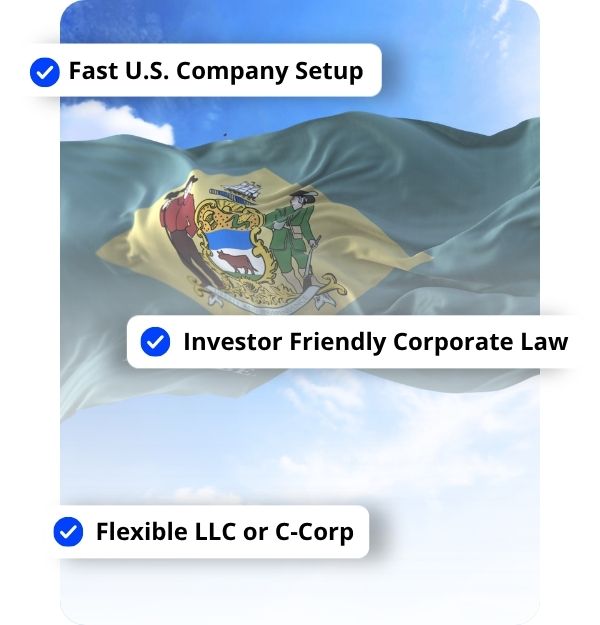
Key Advantages of a Delaware
Company
Delaware structures are designed as practical vehicles for international projects that need a U.S. footprint, investor familiarity, and flexible governance.

Simple, Fast Registration
A Delaware company can usually be formed within 1–2 business days once the structure is agreed upon and the basic KYC package is ready. Only one owner and one director/manager are required, and they can be individuals or entities from any jurisdiction.
Flexible, Business-Friendly Corporate Law
The Delaware General Corporation Law (DGCL) is one of the most developed corporate statutes in the world. It lets founders tailor share rights, voting rules, and board powers with a high degree of flexibility.
Specialized Business Court (Court of Chancery)
Corporate disputes are handled by the Delaware Court of Chancery, a specialized court without juries where judges focus on business law. This creates fast, predictable decisions and a deep body of case law.
Attractive State-Level Tax Environment
LLCs are often treated as pass-through entities for U.S. tax purposes, while corporations are taxed at the federal level and, where applicable, at the state level on Delaware-source income.
High Degree of Confidentiality (with Modern Transparency Rules)
For LLCs, Delaware does not require members or managers to be listed in public filings; only the registered agent’s details appear in the public record. Most corporations and LLCs are required to file beneficial-ownership details with FinCEN in a non-public database.
No Minimum Capital Requirements
There is no statutory minimum share capital for a Delaware LLC or corporation. Founders can start with modest capital and adjust later as the business grows, making it an incredibly easy option to launch.
Delaware LLC
A Delaware LLC is a flexible vehicle for international business, holding, and tech projects. It combines limited liability for members with a contract-based Operating Agreement, allowing you to customize management, profit-sharing, and exit rules with minimal formalities.
Benefits

Limited liability for all members
May be treated as a pass-through entity for US tax purposes (if properly structured)
No Delaware state income tax on income earned outside Delaware
Simple, fast incorporation and low ongoing formalities
High level of privacy—members’ names are not listed in public state records
Flexible profit distribution rules not tied to percentage ownership
Suitable for non-US founders managing the company remotely
Often chosen for international online projects, holding/asset-protection structures, and family or joint-venture investments.
Key Features

Legal form: separate legal entity with limited liability for members
Ownership: one or more members (individuals or entities, any nationality)
Management: member-managed or manager-managed, as defined in the Operating Agreement
Capital: no statutory minimum capital; contributions can be cash, property, or services (where permitted)
Governance: internal rules are set primarily by the Operating Agreement rather than rigid statute
Meetings: no requirement to hold physical meetings in Delaware; decisions can be taken by written consent
Taxation: by default treated as a pass-through (disregarded entity/partnership) for US tax, with the option to elect corporate treatment
Law: governed by the Delaware Limited Liability Company Act and applicable federal law
Delaware Corporation (C-Corp)
A Delaware C-Corporation is the classic US company form for venture capital, scalable startups, and international groups. It uses a share-based structure with a board of directors, making it easier to grant equity, run funding rounds, and prepare for an eventual sale or IPO.
Benefits
Well understood by US and international investors, funds, and stock exchanges
Clear share structure with the ability to issue multiple classes of stock
Limited liability for shareholders; personal assets are protected from corporate debts
Efficient corporate dispute resolution through the Delaware Court of Chancery
Flexible tools for ESOPs, option plans, and other equity-based incentives
Strong, predictable case law under the Delaware General Corporation Law
Typically used for VC-backed startups, holding companies, and international groups planning serious fundraising or an eventual public listing.
Key Features
Legal form: stock corporation with limited liability for shareholders
Ownership: one or more shareholders (individuals or entities, any nationality)
Management: the board of directors oversees the company; officers handle daily operations
Capital: no fixed minimum capital; founders define authorized share capital and classes in the charter
Share structure: can issue common and preferred shares with different voting and economic rights
Governance: formal requirements for board/shareholder meetings, minutes, and Annual Report filings
Taxation: subject to US federal corporate income tax on worldwide income, plus Delaware franchise tax; shareholders may be taxed on dividends (classical “double taxation”)
Law: governed by the Delaware General Corporation Law and extensive Delaware corporate case law
Cost of Delaware Company Formation
Delaware companies must be formed through a registered agent; you cannot file directly with the state as a private individual from abroad. Our packages bundle registered agent services, state fees, and key services so you can receive a working Delaware structure without navigating U.S. bureaucracy alone.
Standard
Typical timeframe: 1–2 business days for formation
Best for international businesses, asset-holding structures, and online projects that want the flexibility of a Delaware LLC and plan to handle tax and banking arrangements in their own way.
Package Includes:
Preparation of LLC formation documents
Filing and registration of the LLC in Delaware
Payment of state formation fees
Licensed registered agent services for 12 months
Registered office address for 12 months
Professional
Typical timeframe: 5–10 business days
Ideal for IT companies, online platforms, consulting, and e-commerce projects that need a U.S. entity and EIN for invoicing, payment processing, and basic reporting but plan to open a bank account separately or in another jurisdiction.
Package Includes:
Preparation of incorporation documents
Registration of the company in Delaware
Payment of applicable state fees
Registered agent services and registered office address for 12 months
Obtaining an EIN from the IRS
Premium
Typical timeframe: 10–20 business days
Best for companies that require a complete U.S. setup, including a tax ID and a corporate account, to receive payments, work with payment processors, and integrate with international platforms.
Package Includes:
Collection and preparation of incorporation documents
Registration of the company in Delaware (LLC or Corporation)
Obtaining an EIN (U.S. federal tax identification number)
Full support with opening an account in a reputable online bank/FinTech institution
Registered office address and registered agent services for 12 months
Our 4-Step Delaware Company Incorporation Process
To make the project predictable, we structure Delaware company formation into four clear stages.
Consultation and Structure Selection
We discuss your goals (online business, SaaS, holding, investment, family wealth, etc.), whether an LLC or a C-Corp is more suitable, the ownership and management structure, and whether you need an EIN and a U.S. bank/FinTech account. We then confirm that a Delaware entity is appropriate—or suggest alternatives if another jurisdiction would be a better fit.
Document Collection and Preparation
You provide a basic KYC and business profile. We draft the formation documents (Certificate of Formation for an LLC or Certificate of Incorporation for a Corporation), prepare the operating agreement (LLC) or standard bylaws (C-Corp) tailored to your needs, collect information required for the EIN application, and coordinate any notarization, apostilles, and translations where necessary.
Filing and Registration
We file the formation documents with the Delaware Division of Corporations, receive the stamped Certificate of Formation/Certificate of Incorporation, arrange registered agent and registered office services, and apply for an EIN with the IRS (if included in your package). Formation of a straightforward LLC or C-Corp typically takes 1–2 business days after filing; obtaining an EIN and opening a bank account can add extra time.
Delivery of the Corporate Pack and Banking Support
You receive a full corporate pack, usually including:
-
Certificate of Formation / Certificate of Incorporation
-
Operating Agreement (LLC) or Bylaws and initial resolutions (C-Corp)
-
Registers of members/shareholders and managers/directors (internal)
-
EIN confirmation (if included)
-
Banking details and account confirmation (for packages with bank support)
All documents are delivered by secure courier to your chosen address.
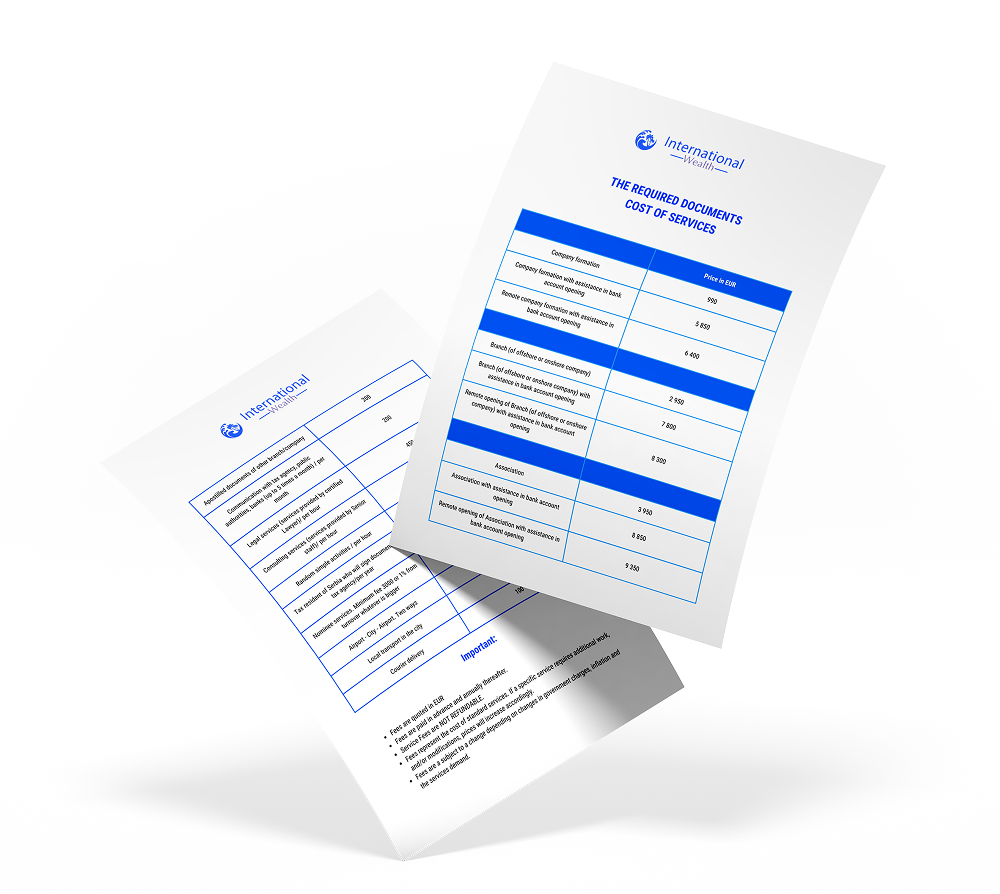
Documents Required for Delaware Company Formation and Banking
We adapt the document list to your structure and chosen bank but typically request:
For Individuals (Owners, Directors, Managers)
Valid passport or other ID (with photo and signature)
Proof of residential address (utility bill, bank statement, or similar, not older than 3 months)
Basic CV or business profile, where useful for banking
Evidence of source of funds/source of wealth (contracts, bank statements, sale agreements, etc., especially for banking and compliance)
For Corporate Shareholders or Controllers
Certificate of Incorporation/registration
Constitutional documents (Articles, Memorandum, operating agreement, etc.)
List of directors and shareholders of the corporate owner
Registered address of the corporate owner
Board resolution authorizing the investment or ownership
Documents confirming the representative’s authority to act
We pre-check each document for compliance with Delaware and banking KYC/AML requirements to reduce the risk of delays.
Additional Information
Delaware LLC vs. C-Corp: Which Structure to Choose?
For non-U.S. founders, both entities can work. The right choice depends on your capital-raising plans, tax profile, and how you want profits to be distributed.
| Parameter | Delaware LLC (Limited Liability Company) | Delaware C-Corp (Corporation) |
|---|---|---|
| Management structure | Very flexible: members can manage directly or appoint managers | Board of directors manages; shareholders act via voting |
| Typical use cases | Holdings, family investment vehicles, joint ventures, real estate, online SMEs | Venture-backed startups, scalable tech, pre-IPO structures, international M&A |
| Taxation (high-level) | Usually pass-through: profits taxed at owner level; no separate state income tax if no business in Delaware (federal/other-state tax still applies) | Entity-level tax at the U.S. federal level and, where applicable, Delaware tax on Delaware-source income; dividends taxed again at the shareholder level. |
| Confidentiality | Members and managers not listed in public records | Directors and one officer reported in the annual report; beneficial owners not on public record |
| Minimum capital | None; contributions set in operating agreement | None; founders decide authorized shares and capital in the charter |
| Investor expectations | Less standard for VC; works well for smaller or closely held structures | Default for U.S. venture capital and institutional investors |
We help you decide which form matches your goals—from lean holding structures to investor-ready C-Corps.
State-Level Rules
Recent changes to Delaware law have tightened expectations for registered agents and annual reports:
-
Registered agents must maintain a physical office in Delaware as a genuine point of service for process and official notices, not a mere “mailbox.”
-
Annual reports are being modernized to include more precise information about the company (such as its principal place of business and nature of activities), which helps banks and regulators assess structures more quickly.
At the same time, Delaware still does not publish shareholder or beneficial-owner registers. For LLCs, owners remain off the public record; for corporations, only directors and one officer are listed in the public annual report.
Federal Beneficial-Ownership Reporting
Separately from Delaware law, most U.S. corporations and LLCs must file a Beneficial Ownership Information (BOI) report with FinCEN under the Corporate Transparency Act. This report lists individuals who ultimately own or control the company. The database is not public, but can be accessed by law enforcement and certain other authorities.
We monitor the evolving CTA rules and help you understand when and how BOI reporting applies to your structure.
Opening a Bank Account for a Delaware Company
A Delaware company does not have to open a bank account inside the state; it can work with banks or EMIs anywhere in the U.S. (or abroad) that are comfortable with its structure and risk profile.
In practice:
-
Many clients use reputable U.S. online banks or FinTech platforms capable of remote onboarding.
-
Some businesses open accounts in other U.S. states or in Europe/elsewhere, depending on customer geography and compliance needs.
We help you:
-
Choose banks or EMIs that accept Delaware entities in your industry
-
Prepare a complete KYC and business-profile package (including projected turnover, main counterparties, and source-of-funds documentation)
-
Navigate each institution’s compliance process to maximize the chances of approval
Annual Maintenance and Good Standing
To keep your Delaware company in good standing, you must:
-
Pay the annual franchise tax and state fees on time (LLCs and corporations have different schedules and amounts)
-
File any required annual reports (corporations must file an annual report; LLCs pay an annual tax but currently do not file a state annual report)
-
Maintain up-to-date internal registers and accounting records for tax and compliance purposes
-
Keep the registered agent and registered office in Delaware active
Why Choose Offshore Pro Group for Your Delaware Company Formation?
Individual, Goal-Driven Structuring
We look at your real objectives—whether that’s IT and SaaS, consulting, holding, or venture fundraising—and propose a structure (LLC vs. C-Corp, Delaware vs. alternative jurisdictions) that actually matches your plans.
End-to-End Support
From the first consultation through formation, EIN, banking, and long-term maintenance, you work with a single coordinated team instead of juggling multiple providers in different time zones.
Transparent Pricing
Our packages clearly set out what is included (registered agent, address, EIN, banking support) with fixed fees and no hidden extras.
Compliance and Legal Accuracy
We work within U.S. and Delaware law and coordinate with licensed registered agents. At the same time, we track evolving rules such as Economic Substance concepts abroad and U.S. beneficial-ownership reporting to keep your structure not only registered but also sustainable.
Launch Your Delaware Company
A Delaware LLC or Corporation can be a powerful tool for international online business, investment structures, and scalable tech projects—combining investor-friendly U.S. law, flexible tax planning, and a mature ecosystem of banks and payment providers.
FAQ on Delaware Companies
What types of Delaware entities can non-residents form?
Non-US residents commonly use two formats:
-
Delaware LLC (Limited Liability
Company)—flexible ownership and management, typically taxed as a
“pass-through” entity by default.
-
Delaware Corporation (C-Corp)—the
classic share-based company, usually chosen for venture capital, stock
options, and potential IPO.
Both can be 100% foreign-owned and formed remotely through a registered agent.
How long does it take to register a Delaware company?
Standard LLCs and corporations can usually be incorporated in 1–2 business days once the name is cleared and documents are ready. Packages that include EIN and banking take longer (typically 5–20 business days, depending on the IRS and the bank/fintech provider).
Do I need to travel to the US or to Delaware?
No. Formation is handled entirely remotely through a licensed registered agent. Documents and signatures are exchanged electronically and by courier; your physical presence in the US is not required.
Can my Delaware company have just one owner?
Yes. Both LLCs and corporations may have a single owner:
-
Single-member LLC—one member, who
can also be the manager.
-
Corporation—one shareholder, who
may also serve as the sole director/officer, subject to practical governance
needs.
What is the practical difference between an LLC and a C-Corp?
In very simplified terms:
-
LLC—more contractual and flexible,
easy for closely held businesses, holdings, consulting, and family
structures. By default, treated as a pass-through for US tax unless you
elect corporate taxation.
-
C-Corp—more rigid but
“standardized” for investors; better for VC-backed tech projects
and structures aiming at share issues, option plans, or listings.
Your choice depends on funding strategy, investor expectations, and tax planning; we help you decide which format fits your project.
Are Delaware companies “tax-free”?
Not exactly. Key points:
-
State corporate income tax: Corporations
pay Delaware corporate income tax (currently 8.7%) on Delaware-source
income. Corporations that do not conduct business in Delaware and earn
income elsewhere are generally not subject to this state income tax, but
still owe franchise tax.
-
LLCs: Delaware does not impose a
separate entity-level income tax on LLCs; income usually flows through to
the owners, who pay tax where they are tax-resident and/or where the income
arises. Federal US tax may still apply if the LLC is engaged in a US trade
or business.
You must also consider US federal tax rules and the tax systems of the owner’s home country.
Does Delaware have sales tax?
No. Delaware has no state or local sales tax. Instead, certain businesses with nexus in the state may be subject to a gross receipts tax on Delaware-source revenue.
What is the franchise tax for Delaware corporations?
Most domestic corporations must:
-
File an Annual Report and
-
Pay an annual franchise tax based on
either the number of authorized shares or an alternative method.
What is the annual tax for Delaware LLCs?
Delaware LLCs pay a flat annual tax of USD 300, due by 1 June each year. LLCs do not file an annual report with the state.
As a non-resident, do I have to file US tax returns?
It depends on how and where the company earns its income:
-
If the LLC or corporation is engaged in
a US trade or business or has effectively connected income, US federal (and
possibly state) filings will normally be required.
-
If activities and clients are entirely
outside the US, the position may differ, but it must be checked carefully.
We coordinate with tax advisers so that your structure is set up with the correct filing profile from the start.
What annual filings does a Delaware LLC have?
-
State level: payment of the USD 300
annual tax, no state-level annual report.
-
Federal level: depending on structure
and activity, the owners may need US tax returns (for example, Forms
1065/1120/1040-NR, etc.), even if they live abroad.
What annual filings does a Delaware corporation have?
-
Annual Report + franchise tax payment to
Delaware by 1 March.
-
Federal corporate income-tax return
(and, where relevant, state returns) if the corporation has US-source or
effectively connected income.
Are Delaware companies required to keep accounting records or audited financial statements?
Yes, companies must keep adequate records to support their tax filings and demonstrate their financial position, but:
-
Small, privately held LLCs and
corporations are generally not obliged to file audited statements with
Delaware or the federal government unless they are public, regulated, or
subject to specific industry rules.
-
Investors, banks, and tax authorities
may still require formal accounts.
Are owner names publicly available in Delaware?
No. Delaware formation documents for LLCs and corporations typically list only the registered agent and registered office; shareholder, member, and beneficial-owner names are not part of the public record.
How do US beneficial-ownership rules affect Delaware companies?
At the federal level, the Corporate Transparency Act (CTA) requires FinCEN to receive beneficial ownership reports from many small U.S. entities. The rules have been litigated and adjusted; recent regulatory changes mean that some domestic companies may now be exempt, while foreign-formed entities registered to do business in the US may still have reporting duties.
Because this area is evolving, we:
-
Check the latest CTA/FinCEN guidance at
the time of incorporation, and
-
Tell you whether your planned Delaware
entity must file a Beneficial Ownership Information (BOI) report and on what
timeline.
Does using professional managers eliminate KYC or BOI obligations?
No. Professional directors, managers, or shareholders can increase privacy in public documents, but:
-
Banks and payment institutions still
require full disclosure of ultimate beneficial owners, and
-
Where BOI reporting applies, the real
individuals who ultimately own or control the company must still be reported
to FinCEN or other authorities.
Is a Delaware company required to have a bank account in Delaware?
No. A Delaware entity can:
-
Open accounts in banks anywhere in the
US (if the bank accepts non-resident structures)
-
Use international EMIs and fintech
platforms that onboard US entities.
Our Premium packages focus on institutions that are comfortable with foreign-owned Delaware companies and support remote onboarding where possible.
Can a Delaware company open a bank account remotely?
In many cases, yes—especially for online banks and EMIs designed for non-resident founders. Traditional US banks may require an in-person visit by a director or signatory.
What documents do banks usually ask for?
Typically:
-
Full set of corporate documents
(Certificate of Formation/Incorporation, Operating Agreement or Bylaws,
resolutions)
-
EIN confirmation from the IRS
-
KYC documents for owners and officers
(passport, proof of address)
-
Business description, expected turnover,
and geography
-
Evidence of the source of funds and the
source of wealth
We help assemble and present this package in the format preferred by the chosen institution.
Can I change from an LLC to a corporation (or vice versa)?
Yes. Delaware law allows conversions between LLCs and corporations in many cases. The process involves filing conversion documents and updating internal agreements. It may also have tax consequences, so coordination with tax advisers is recommended before proceeding.
Can a Delaware company move to another state or jurisdiction?
Delaware entities can often be domesticated in another U.S. state or in a foreign jurisdiction that recognizes continuation, and foreign entities can be domesticated in Delaware. The exact mechanics depend on the laws of both jurisdictions.
How do I properly close a Delaware company?
The cleanest route is a formal dissolution, which includes:
-
Settling outstanding debts and
obligations
-
Filing dissolution documents with the
Delaware Division of Corporations
-
Paying any unpaid franchise/annual taxes
and fees
-
Making final tax filings
Simply abandoning the company can lead to increased franchise tax liabilities, penalties, and loss of good standing.
What happens if I ignore franchise or annual taxes?
Failure to pay the Delaware franchise tax/LLC tax or file required reports can result in:
-
Penalties and interest
-
Loss of good standing
-
Administrative dissolution or void
status, which can complicate banking, contracts, and future restructuring
We track deadlines and send reminders so your Delaware entity remains compliant.
Discuss Your Delaware Structure with a Specialist
Contact us for a no-obligation consultation. We’ll analyze your goals, compare LLC vs C-Corp (and Delaware vs. other options), and provide a clear checklist of documents, timelines, and costs so you can move from idea to a working U.S. corporate structure with confidence.
Contact an ExpertUliana Syva
Consultant for company registration, bank account opening, residency, and citizenship.
1000+
successful cases
13+
years of experience


Other Offshore Company Formation Services
Other Services We Offer