


Cook Islands International Trust: Registration & Asset Protection
A Cook Islands international trust is a structure worth considering if you need high-level asset protection or succession planning. The jurisdiction does not automatically recognize foreign court orders, and it has strict limitation rules for creditor claims. The information about settlors, trustees, and beneficiaries is not accessible to the public. You can establish a Cook Islands trust without a personal visit to the jurisdiction, and it usually takes no more than 3 weeks following the KYC package approval. Offshore Pro Group will help you by double-checking the documents and dealing with trust registration and asset transfer.
Excellent 4,6 out of 5

Why the Cook Islands Is the World’s Premier Asset Protection Jurisdiction
HNWIs, entrepreneurs, family offices, and internationally exposed clients often opt for the Cook Islands because it offers more than a standard estate-planning tool. A Cook Islands asset protection trust, if structured properly, creates a powerful legal barrier between personal ownership and protected wealth.

Foreign Court Orders Are Not Automatically Enforced
If a creditor brings a foreign court order against trust assets, it will not be automatically enforced in the Cook Islands. The proceedings must be started locally, and the claim must be heard under local law.A 2-Year Statutory Limitation on Creditor Claims
The trust law in the Cook Islands imposes strict limitation rules. Creditor claims related to asset transfers are generally subject to a strict 2-year limitation framework.Complete Confidentiality — No Public Register
No public register contains the names of the settlor, beneficiaries, trustee, and protector, and trust details cannot be accessed by the general public.Tax-Neutral Treatment for Foreign-Source Income
A Cook Islands international trust that keeps assets coming from a source abroad is not usually subject to taxes in the Cook Islands: no local income tax, capital gains tax, inheritance tax, or estate tax is payable.Forced Heirship Override
Trust laws in the Cook Islands can limit the effect of forced heirship rules imposed by other jurisdictions. As a result, the settlor has more control over family wealth transfer across generations.Proactive Protection and Succession Planning
The Cook Islands trust works best when created before a dispute arises. You can set out distribution rules in the Trust Deed and support them with a letter of wishes.Confidentiality does not mean invisibility. Licensed trustees still perform KYC, AML/CTF, due diligence, and source-of-funds review, and information may be disclosed if required by applicable laws. Tax obligations in the settlor’s or beneficiaries’ country of residence may still apply, including CFC rules, PFIC rules, CRS, FATCA, or personal tax reporting.
What Can You Place in a Cook Islands Trust?
A properly structured international trust Cook Islands arrangement can hold many types of assets if they have been legally transferred and duly documented.
 Cash and Bank Deposits A Cook Islands trust can hold cash and bank deposits in multiple currencies, provided the funds are legally transferred and properly documented.
- Company Shares and Membership Interests The trust may hold shares and membership interests in operating companies, holding companies, and offshore entities.
- Investment Portfolios Common trust assets include securities, bonds, ETFs, mutual funds, alternative investments, and other portfolio assets.
- Intellectual Property and Royalties Intellectual property rights, patents, trademarks, copyrights, and royalty streams can also be placed into the structure.
- Foreign Real Estate Real estate located outside the Cook Islands is often held through an underlying LLC or holding company owned by the trust.
- Digital Assets and Cryptocurrency Digital assets and cryptocurrency holdings are usually placed through a compliant custodian or a properly structured vehicle.
If your assets require legal re-registration, such as real estate or company shares, you may need an additional corporate structure, such as an LLC. In this case, the Cook Islands trust owns the company, which in turn holds the assets.
Speak With a Cook Islands Trust Expert
Choosing the right structure is a much more complex decision than selecting a jurisdiction. The settlor, protector, beneficiaries, trust assets, bank account, tax residence, and long-term family goals must all effectively work together.
Offshore Pro Group will help you by coordinating the whole process, from preparing the Trust Deed to trustee selection and registration, as well as asset transfer and annual trust administration.
Schedule a Free ConsultationUliana Syva
Consultant for trust formation, company registration, bank account opening, residency, and citizenship.
1000+
successful cases
13+
years of experience


Cook Islands Trust Structure — Key Participants
A trust is a legal relationship between several parties: settlor, trustee, protector, and beneficiaries, rather than just a document. Each role is clearly defined in the Trust Deed.
Settlor
The settlor is the person who creates the trust and transfers assets into it. They also execute the Trust Deed to set out the trust purpose, trustee powers, and rules for managing and distributing trust property. A Cook Islands trust settlor may also be a beneficiary, but this must be structured very carefully.
Trustee
The trustee holds legal control over the assets transferred to the trust and manages them under the Trust Deed. In a Cook Islands international structure, the trustee is usually a licensed trustee company based in the Cook Islands.
Protector
A protector is an additional control role. Its responsibilities may include approving or blocking certain trustee decisions, preserving the settlor’s original intentions, and even removing the trustee and appointing a new one.
Beneficiaries
Beneficiaries are the persons or entities for whose benefit the trust is established. Under the Trust Deed, they may receive income, capital, or other benefits. In a discretionary trust, the trustee decides how and when distributions are made.
Properly transferred assets are no longer treated as personally owned by the settlor. A letter of wishes may guide the trustee, but it is not a rigid instruction and does not replace the Trust Deed.
Cook Islands Trust Cost — Setup and Annual Expenses
Cook Islands trust cost depends on the structure and asset types, as well as trustee workload and additional services, which may include banking or protector support. Since this is a premium jurisdiction, it should only be used if the asset value and risk profile justify the budget planned.
| SERVICE | DESCRIPTION | COST |
|---|---|---|
Trustee setup fee | Structure review, document preparation, initial coordination, and asset transfer planning | $3,500 |
Annual trustee fee + registered office | Annual administration, registered office, and trustee remuneration | $9,550 / year |
Government registration fee | Mandatory government registration charge | $750 / year |
Trust management — secretary | Ongoing administrative matters | from $200 / hour |
Trust management — legal counsel | Legal administration matters | up to $950 / hour |
Asset protection review | Optional review of the structure’s creditor-resistance profile | $2,000 |
Protector fee | Annual protector remuneration | $3,500 / year |
Accounting + annual financial report | Accounting support and reporting | from $500 / hour |
CRS reporting | Automatic exchange reporting where applicable | from $1,000 |
FATCA reporting | FATCA reporting for U.S.-connected clients where applicable | from $1,000 |
Notarization / apostille in the Cook Islands | Per document | $250 |
Trust bank account | Bank account opening support for the trust | from $4,500 |
Courier delivery | DHL / FedEx original document delivery | from $350 |
Structure review, document preparation, initial coordination, and asset transfer planning
Annual administration, registered office, and trustee remuneration
Mandatory government registration charge
Ongoing administrative matters
Legal administration matters
Optional review of the structure’s creditor-resistance profile
Annual protector remuneration
Accounting support and reporting
Automatic exchange reporting where applicable
FATCA reporting for U.S.-connected clients where applicable
Per document
Bank account opening support for the trust
DHL / FedEx original document delivery
A penalty ($200) may be imposed in the case of late renewal. Bank account opening, foreign company registration, or underlying LLC setup are additional corporate services that will be charged separately.
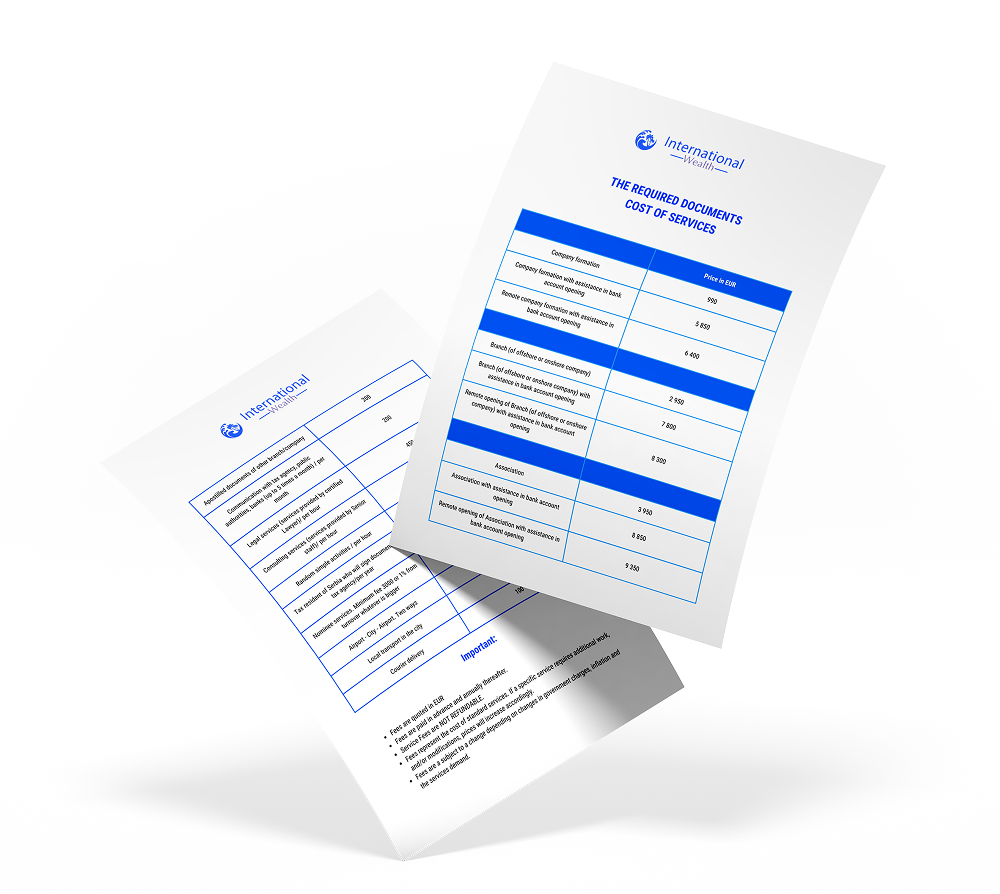
Documents Required for Cook Islands Trust Registration
Wondering how to set up a trust in the Cook Islands? A clean KYC and due diligence file may be the first practical step. A licensed trustee can only proceed after the source of funds, source of wealth, identity, and structure have been properly reviewed.
For a settlor, protector, beneficiary, UBO, corporate settlor, or asset-holding company, the usual documents include:
For Individuals
Certified copy of a valid passport
Certified proof of residential address, such as a utility bill or bank statement not older than 3 months
CV or brief professional profile
Bank reference letter or professional reference letter, where required by the trustee
Proof of source of funds and source of wealth, such as bank statements, tax returns, sale agreements, inheritance documents, or business records
For Corporate Participants
Certificate of Incorporation or equivalent
Constitutional documents, such as Memorandum & Articles, Operating Agreement, or equivalent
Register of Directors and Shareholders or Members
Certificate of Good Standing issued within the last 6 months
KYC on all ultimate beneficial owners and controlling persons
Offshore Pro Group will double-check your package of documents before the start of registration and explain what notarization, apostille, certification, and translation requirements must be met.
Our 4-Step Cook Islands Trust Formation Process
In most cases, you can complete the process online. The timeline depends on how complex your trust deed is and whether an underlying company is required, as well as on the due diligence and bank onboarding.
Client Questionnaire and Structure Design
A detailed questionnaire and strategy review come first. We do our best to understand the settlor’s objectives and family situation, as well as risk profile and potential creditor exposure. This is the stage at which we define the trust type and its participants, think about the protector’s role and possible beneficiaries, and work on the asset transfer plan and distribution logic.
Document Preparation and KYC Review
We prepare and review the Trust Deed and the operating memorandum, as well as the letter of wishes and supporting documents. In parallel, we also plan an LLC or holding company if required. The trustee reviews KYC, AML/CTF, source of funds, source of wealth, professional background, and banking profile.
Trust Registration and Asset Transfer
Once due diligence is approved and the Trust Deed is ready, the licensed trustee starts the process of Cook Islands trust registration. After that, assets are transferred. This may include an initial cash settlement, share transfers, assignment of IP rights, or restructuring ownership through a company held by the trust.
Ongoing Trust Administration
Once the trust has been registered, the trustee starts its administration under the Trust Deed by taking care of accounting records and annual renewal, as well as trustee resolutions and distributions. Offshore Pro Group can help if you need a tax adviser in the settlor’s or beneficiaries’ country of residence.
Tax Treatment and Compliance for Cook Islands Trusts
A Cook Islands trust can be tax-neutral locally, but it must be compliant. Therefore, make sure your reporting obligations and banking expectations, as well as CRS and FATCA requirements, have been reviewed before you fund the trust.
No Local Tax on Foreign-Source Income
International trusts in the Cook Islands are generally not subject to local tax on foreign-source income, capital gains, or dividends. However, the structure still has recurring costs, including registration, trustee remuneration, and administration.
Home Jurisdiction Tax Obligations
A settlor or beneficiary may still have tax and reporting obligations in their country of residence. CFC or PFIC rules, CRS-related reporting, inheritance tax, or personal tax filings may apply depending on the client’s circumstances.
CRS and FATCA Reporting
The Cook Islands is a party to international tax transparency frameworks. If your trust qualifies as a financial institution or holds certain types of assets, it may have CRS reporting obligations. FATCA may also be relevant for U.S.-connected clients.
Accounting and Recordkeeping
Standard international trusts are generally not required to publicly file financial statements. Still, the trustee must keep internal records showing real transactions, asset movements, distributions, and administrative decisions.
To be on the safe side, seek tax advice before you start trust formation or transfer any major assets. Proper recordkeeping protects the structure and helps with banks and investment platforms.
Legal Framework — Cook Islands Trust Law
The Cook Islands trust operates under a mature framework that works well for international trust planning and creditor-resistant asset protection.
Key legal instruments include:
-
International Trusts Act 1984. The core law that governs international trusts in the Cook Islands is the International Trusts Act 1984, as amended. It contains the main features related to asset protection, such as limits on foreign judgment enforcement and creditor-claim limitation rules. It also supports flexible trust structuring, including discretionary trusts, fixed interest trusts, and self-settled arrangements.
-
International Companies Act 1981–1982. If you set up a company to be owned by the trust, the International Companies Act 1981–1982 will apply. This is a common arrangement if a trust holds real estate, investment portfolios, or other assets using an underlying corporate structure.
-
Trustee Companies Act 2014. The Trustee Companies Act 2014 regulates trustee companies in the Cook Islands. Only properly licensed providers who are duly supervised by the Financial Supervisory Commission can engage in trustee business.
Where an underlying company is used, the company will ensure asset holding or operations, while the offshore trust Cook Islands structure will provide ownership and protection.
This is important because the trustee is the structure’s key player. You will not benefit from a premium trust jurisdiction unless it is credible and compliant.
Why Choose Offshore Pro Group for Your Cook Islands Trust?
A premium trust structure should not be assembled from disconnected providers, so Offshore Pro Group coordinates everything, from legal structuring to ongoing administration.
End-to-End Trust Structuring
We will take care of the whole process, starting with the first risk review and up to trustee coordination and trust registration, as well as asset transfer and annual maintenance. As a result, work will be structured as a single plan rather than just random steps.
Practical Experience with Cook Islands Structures
We form international trust structures for clients from different jurisdictions. We plan the structure taking into account real banking expectations and trustee requirements, as well as compliance standards and asset transfer mechanics.
Cross-Border Compliance
Trust law is only one part of the picture, and we know that well. We carefully consider CRS, FATCA, and CFC rules, as well as tax residence and reporting obligations in each case. We can also engage external tax counsel and specialist advisors if needed.
Banking and Post-Formation Support
We assist with trust bank accounts and additional corporate structures, as well as annual renewals and ongoing trust maintenance. If you expect your trust to hold active investment portfolios or multi-jurisdiction assets, this support becomes vital.
Start Your Cook Islands Trust Registration
A Cook Islands trust is a serious planning tool that we recommend to those who need creditor-resistant asset protection and succession planning.
In most cases, you can establish the structure remotely. However, it should be carefully planned before risk escalates or any major assets are moved. A Cook Islands trust vs Nevis trust comparison is useful when the client is choosing between premium, long-established asset protection and a more cost-effective structure that can be paired with a Nevis LLC.
Frequently Asked Questions
How long does it take to register a Cook Islands International Trust?
A Cook Islands International Trust usually takes about 3 weeks after KYC approval. The timeline may be longer if the structure includes corporate participants, bank account opening, or other additional services.
Do I need to visit the Cook Islands to set up a trust?
A structure is usually set up online by engaging a licensed trustee company in the Cook Islands. No personal presence is typically required.
What is the difference between a revocable and an irrevocable Cook Islands Trust?
In the case of a revocable trust, the settlor can amend or terminate it, but the structure usually provides weaker creditor protection. In the case of an irrevocable trust, you benefit from stronger separation because the settlor formally gives up direct ownership of the transferred assets.
The majority of Cook Islands asset protection structures are designed as irrevocable or strongly restricted for this reason.
Can I be a beneficiary of my own Cook Islands Trust?
Yes. Cook Islands law allows self-settled trusts, where the settlor may also be a beneficiary.
This is one of the important Cook Islands trust benefits, but make sure to carefully draft the structure to avoid excessive settlor control.
How does a Cook Islands Trust protect assets from creditors?
No foreign judgment can be automatically enforced in the Cook Islands. A creditor will have to bring the case locally and meet Cook Islands legal standards.
A Cook Islands asset protection trust is strongest if you create it before a claim arises and fund it with properly documented assets.
Does the trust pay taxes in the Cook Islands?
International trusts that hold foreign-source assets are generally not subject to local Cook Islands tax. Still, make sure to carefully review tax obligations in the settlor’s or beneficiaries’ country of residence.
Is my information kept confidential?
The names of the settlor, beneficiaries, trustee, and protector are not recorded in a public registry. Only the licensed trustee and relevant service providers have access to trust details.
Still, the level of confidentiality may be limited by lawful requests or AML/CTF rules, as well as CRS or FATCA.
What are the ongoing obligations of a Cook Islands Trust?
Ongoing obligations include annual registration renewal, trustee administration, registered office support, accounting records, KYC updates, as well as CRS/FATCA reporting where applicable.
The trustee must also respond to regulatory and bank requests when required.
Can I replace the trustee or change the trust structure later?
Yes, you can do so if there are lawful grounds for the change and your Trust Deed allows it. The protector often has the right to replace the trustee.
However, make sure to carefully review each amendment so it does not weaken the trust’s asset protection purpose.
Can I open a bank account for my Cook Islands Trust?
Yes. Trust bank accounts are usually opened outside the Cook Islands, including with selected Caribbean, European, Swiss, or Liechtenstein banks, or with EMI/fintech providers.
Banking approval depends on the settlor, trustee, source of funds, asset profile, as well as intended transaction activity.