Singapore Company Formation
Singapore is one of the most attractive jurisdictions in Asia for forming a company, especially for international founders, startups, trading businesses, consultants, fintech operators, and entrepreneurs who want a reputable structure with strong global recognition. It is widely known for its efficient registration process, transparent legal system, developed banking sector, strategic location, and business-friendly tax framework. A Singapore company can often be formed quickly once the structure is agreed and the required information is ready, although a locally resident director is required.
Excellent 4,6 out of 5

Key Advantages of a Singapore
Company
Singapore structures are designed as practical vehicles for international projects that need a respected Asian business base, stable regulation, relatively low bureaucracy, access to banking and counterparties, and a jurisdiction with a strong international reputation.

Prestige and Stability
Singapore is widely regarded as one of the most stable and predictable business environments in the world. Its strong rule of law, low corruption, efficient administration, and international credibility make it attractive to investors, banks, partners, and clients. This reputation is one of the main reasons founders choose Singapore when they want more than just a low-cost registration.
Tax Efficiency and Startup Reliefs
Singapore’s corporate income tax rate is 17%, but the system includes tax exemption schemes for qualifying new startups and partial exemptions for other companies. This makes the effective tax burden lower than the headline rate for many small and growing businesses, especially in the early years. GST registration is generally compulsory once taxable turnover exceeds SGD 1 million.
Access to Asian Markets
Singapore is often chosen as a base for companies expanding into Asia. Its location, infrastructure, treaty network, and strong reputation make it attractive for businesses involved in regional trade, technology, finance, logistics, and international coordination. For many founders, Singapore serves not just as a place of incorporation, but as a strategic platform for growth across the region.
Developed Banking and Fintech Environment
Singapore has a highly developed banking ecosystem supported by major international banks and a strong fintech sector. That makes it an appealing jurisdiction for founders who want access to multi-currency banking, payment solutions, and a serious compliance-oriented financial environment. In practice, account opening is often one of the most important reasons clients choose Singapore.
Government Support and Business Infrastructure
Singapore offers a sophisticated business environment with strong infrastructure, efficient state systems, and support mechanisms for innovation, startups, and internationally oriented companies. For founders who want a jurisdiction that feels operationally serious rather than merely convenient on paper, this is a major advantage.
Strong Talent and Business Ecosystem
Singapore is especially attractive for companies planning to build an operational presence, hire qualified staff, or work within a larger innovation and startup ecosystem. It is often used for technology, finance, asset management, and international service businesses that benefit from access to skilled professionals and a globally connected commercial environment.
Singapore Private Limited Company (Pte. Ltd.)
A Singapore Private Limited Company (Pte. Ltd.) is the standard structure most international entrepreneurs choose when entering the Singapore market. It is flexible, commercially respected, and suitable for technology businesses, fintech, consulting, cross-border trade, logistics, holding activities, and a broad range of service-based business models.
Benefits

Recognized and reputable legal form for international business
Corporate income tax rate of 17% with available startup and partial tax exemptions
Strategic access to Asian and global markets
Strong banking and fintech ecosystem
100% foreign shareholding is commonly used in practice
Suitable for startups, trading companies, service businesses, and holding structures
Strong legal and corporate framework that inspires confidence among banks and counterparties
Singapore companies are typically chosen for international trade, technology, consulting, fintech, holding activities, and other structures where reputation, banking access, and operational credibility are essential.
Key Features

Legal form: separate legal entity with limited liability for shareholders
Ownership: at least one shareholder; foreign shareholders are permitted
Management: at least one director who is locally resident in Singapore is required
Capital: minimum paid-up capital is typically SGD 1
Company secretary: mandatory and must be appointed within 6 months of incorporation
Registered office: mandatory in Singapore
Formation document: incorporation through the Singapore company registration system with constitutional documents
Internal governance: governed by the company constitution and corporate resolutions
Annual maintenance: annual filings, accounting, tax compliance, and local statutory maintenance obligations apply
Cost of Singapore Company Formation
Singapore companies must maintain a local compliance framework, and international founders typically use a service provider to handle incorporation, resident-director arrangements where needed, company secretary, legal address, and banking support. Our packages are structured so clients can choose between basic formation, formation plus professional support, or a more complete setup with account opening assistance.
Standard
Typical timeframe: 1–3 days from receipt of data and payment
Best for entrepreneurs who want to launch a business in Singapore efficiently, do not plan to open a local bank account immediately, and want a lower-cost entry point.
Package Includes:
Registration of the company
Legal address for 1 year
Company secretary for 1 year
Professional Singapore resident director for 1 year
Company documents
Professional
Typical timeframe: 3–5 days
Ideal for startups and small businesses that need a stronger support package, including certified corporate documentation and more structured post-incorporation readiness.
Package Includes:
Apostille and notarization of supporting documents
Registration of the company
Legal address for 1 year
Company secretary for 1 year
Professional Singapore resident director for 1 year
Incorporation documents
Courier delivery
Premium
Typical timeframe: from 10 days
Best for entrepreneurs who want a more complete Singapore setup, including company registration and support with opening a corporate account.
Package Includes:
Apostille and notarization of accompanying documentation
Registration of the company
Legal address for 1 year
Company secretary for 1 year
Professional Singapore resident director for 1 year
Incorporation documents
Courier delivery
Corporate account opening support
Our 4-Step Singapore Company Incorporation Process
To make the process predictable, Singapore company formation can be broken into four clear stages.
Consultation, KYC, and Structure Selection
We first clarify the purpose of the company: technology startup, consulting, SaaS, e-commerce, international trade, logistics, asset holding, or another business model. We also determine whether Singapore is the right fit and what package is appropriate. At this stage, the KYC and due diligence review begins, and the founder’s identity, address, and structure are checked.
Name Reservation and Document Preparation
You provide the core information needed for incorporation. We check name availability, reserve the company name where appropriate, define the shareholder and director structure, confirm the registered office, prepare the constitutional and incorporation documents, and organize the resident-director and company-secretary framework if required.
Filing and Registration
We file the company registration documents through the Singapore system and obtain the registration result. Straightforward applications may be processed very quickly, while regulated or more sensitive activities may require additional review. After registration, the company receives its basic incorporation documents and registration details.
Corporate Pack Delivery and Banking Support
After incorporation, you receive the company documents and, where applicable, apostilled or notarized papers. If your package includes account-opening support, the next stage usually involves bank or fintech compliance review, business-description assessment, expected transaction analysis, and source-of-funds checks. In practice, banking often takes longer than incorporation itself.
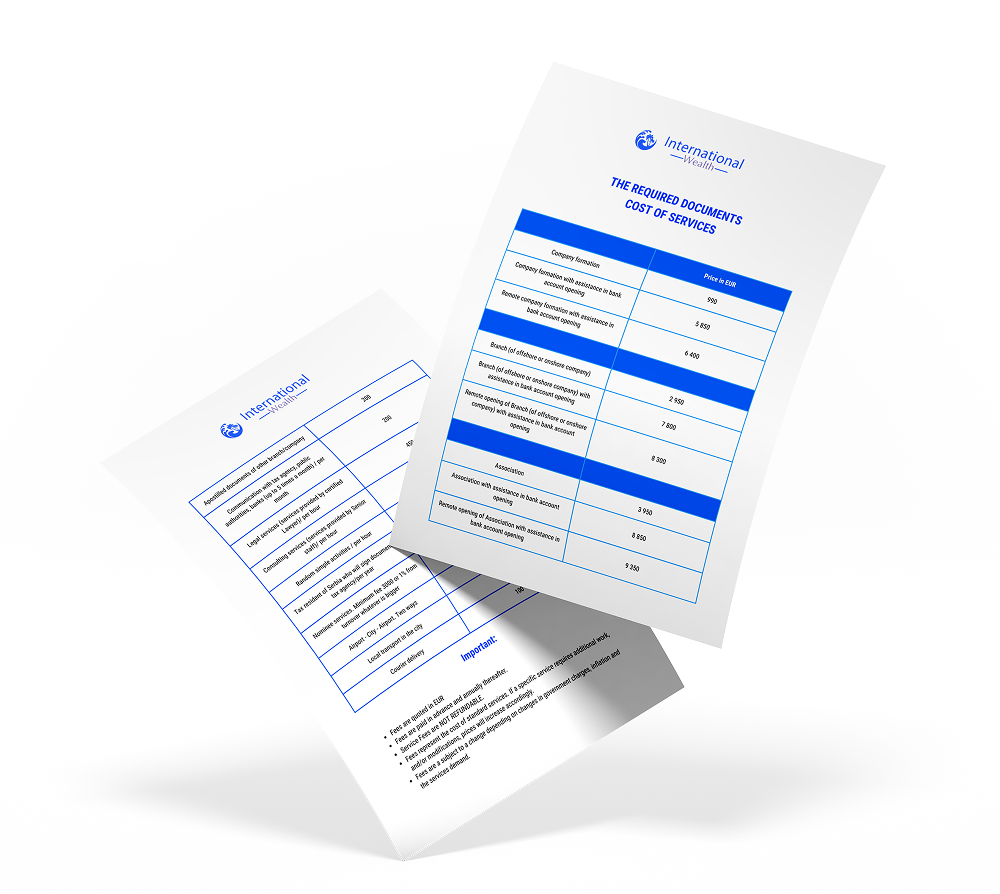
Documents Required for Singapore Company Formation and Banking
The exact document list depends on the ownership structure and the bank chosen, but in practice the following items are commonly requested.
For Individuals
Valid passport or government-issued ID
Proof of residential address
KYC forms and personal background information
Business profile or short description of planned activity
Source-of-funds documents, especially for banking and compliance
For Corporate Owners or Controllers
Certificate of incorporation or registration
Constitutional documents
Register of directors and shareholders or equivalent corporate records
Registered address of the corporate shareholder
Board resolution or similar authority document where required
Documents confirming the representative’s authority to act
For banking, institutions usually want not only the company documents, but also a clear description of the business model, counterparties, expected payment flows, projected turnover, and supporting evidence showing where the business funds come from.
Additional Information
Why Singapore Is Often Chosen over Other Jurisdictions
Singapore is frequently compared with classic offshore jurisdictions and with larger corporate centers. Unlike a classic offshore structure, Singapore offers international respectability, transparent regulation, developed banking, and a strong legal environment. It is often chosen by founders who care not only about tax planning, but also about reputation, counterparties’ trust, long-term scalability, and actual operational use. For startups, technology companies, trading groups, and regional holding structures, Singapore often feels more commercially serious and globally usable than a low-substance offshore jurisdiction.
Resident Director Requirement
Every Singapore company must have at least one director who is locally resident in Singapore. This is not optional. A foreign founder may own shares and may also serve as a foreign director, but the company must still satisfy the local resident-director rule. This is one of the most important practical differences between Singapore and remote-friendly jurisdictions that do not impose local management requirements.
Annual Return and Good Standing
Singapore companies must maintain ongoing compliance through accounting, tax, and corporate filings. For non-listed companies, the AGM must generally be held within 6 months after the financial year end, and the annual return must generally be filed within 7 months after the financial year end. Failure to maintain these obligations can lead to breaches, penalties, and loss of clean compliance status.
Accounting, Audit, and Tax Filing
Singapore companies are expected to keep accounting records and file tax returns. Estimated Chargeable Income is generally filed within 3 months after the financial year end unless an exemption applies, and the corporate tax return is filed later under IRAS procedures. Audit is not mandatory for all private companies: small companies may qualify for audit exemption if they meet the applicable thresholds.
Opening a Bank Account for a Singapore Company
A Singapore company can access local banking, but account opening is often one of the most compliance-heavy parts of the process. Banks and fintech institutions usually assess whether the company has a credible business model, realistic turnover expectations, clear counterparties, and properly documented source of funds. Traditional banks may still ask for an in-person meeting, while some alternative institutions may offer more flexible onboarding. This is why the banking stage often requires more preparation than the company registration stage itself.
Ongoing Maintenance
To keep a Singapore company in good standing, you generally need to:
-
Maintain the local resident-director requirement
-
Maintain the company secretary
-
Maintain the registered office
-
Keep proper accounting records
-
Hold the AGM where required
-
File the annual return on time
-
Submit the relevant tax filings to IRAS
-
Comply with audit requirements if the company does not qualify for exemption
Why Choose Offshore Pro for Your Singapore Company Formation?
Setting up a Singapore company is straightforward on paper, but choosing the right structure, meeting local statutory requirements, and planning the banking and compliance side properly makes a major difference in practice. We help you build a Singapore company that is not only registered quickly, but also aligned with your real commercial goals.
Individual, Goal-Driven Structuring
We look at your actual business model — startup, consulting, SaaS, fintech, logistics, trade, holding, or another format — and determine whether Singapore is the right fit for your objectives.
End-to-End Support
From company registration to legal address, local director, company secretary, apostille support, and banking coordination, you work with one coordinated team instead of trying to assemble the process yourself across different providers.
Transparent Pricing
Our packages clearly distinguish between simple incorporation, professional documentation support, and a more complete setup with banking assistance.
Compliance and Practical Accuracy
We focus not only on getting the company registered, but also on helping it work in practice — with proper KYC handling, local compliance support, realistic banking expectations, and ongoing maintenance guidance.
Launch Your Singapore Company
A Singapore company can be a highly practical tool for startups, international trade, consulting, fintech, technology businesses, and regional holding structures. It combines strong reputation, access to banking, professional credibility, and a predictable legal framework in one of Asia’s most respected business jurisdictions.
FAQ on Singapore Companies
What type of Singapore company do non-residents usually form?
In practice, international founders usually choose a Private Limited Company (Pte. Ltd.). It is the standard structure for doing business in Singapore and is suitable for startups, consulting, technology, trade, and holding activities.
How long does it take to register a Singapore company?
A straightforward company may be incorporated very quickly once the documents and checks are ready. In the package model provided, the basic package is positioned at 1–3 days, while more complex packages involving notarization or banking support take longer.
Do I need to travel to Singapore?
Not necessarily for incorporation itself. However, depending on the bank chosen, personal attendance may still be requested during the account-opening process.
Can a foreigner own the company?
Yes. Foreigners can own shares in a Singapore company, but the company must still have at least one locally resident director.
Is a Singapore company tax-free?
No. Singapore is not a tax-free jurisdiction. The corporate income tax rate is 17%, although tax exemptions and reliefs may reduce the effective burden for qualifying companies.
What is the GST rate in Singapore?
The GST rate is 9%. Businesses generally must register if taxable turnover exceeds SGD 1 million, or if they expect it to exceed that threshold in the next 12 months.
Are there startup tax benefits?
Yes. Singapore has a startup tax exemption scheme for qualifying new companies and a partial tax exemption framework for others.
What annual filings does a Singapore company have?
In practice, the company must maintain accounting records, make annual corporate filings, and comply with tax-return obligations. For non-listed companies, the AGM is generally within 6 months after FYE and the annual return within 7 months after FYE.
Does a Singapore company need audited financial statements?
Not always. Small private companies may qualify for audit exemption if they meet at least two of the following thresholds: revenue of SGD 10 million or less, total assets of SGD 10 million or less, and 50 or fewer employees, subject to the applicable rules. (beta.acra.gov.sg)
When is the tax filing due?
Estimated Chargeable Income is generally due within 3 months after FYE unless an exemption applies, and the corporate income tax return is filed later according to IRAS deadlines.
Does the company need a local director?
Yes. Every Singapore company must have at least one locally resident director.
Do I need a company secretary?
Yes. A company secretary must be appointed within 6 months of incorporation.
Do I need a registered office?
Yes. The company must maintain a registered office in Singapore.
Can a Singapore company open a bank account?
Yes. That is one of the main reasons many founders choose Singapore, especially when they want access to a respected banking environment.
Can the account be opened remotely?
Sometimes, but not always. Some providers may allow remote onboarding, while traditional banks may require personal attendance depending on the case.
What documents do banks usually request?
Usually the incorporation documents, passports, proofs of address, business description, expected payment flows, and source-of-funds documentation.
Can I scale the company later?
Yes. A Singapore Pte. Ltd. is suitable not only for small private business activities, but also for companies planning to grow, hire staff, enter regulated markets, or attract partners and investors.
How do I keep my company in good standing?
Maintain the resident director, registered office, and company secretary; keep proper accounting records; file annual and tax obligations on time; and comply with audit rules where applicable.
What happens if I ignore the company?
That usually ends the way all neglected compliance does: not with cinematic thunder, but with notices, penalties, breaches, and administrative irritation. Singapore is efficient — including when it reminds you that deadlines are not decorative.
Discuss Your Singapore Structure with a Specialist
Contact us for a no-obligation consultation. We’ll analyze your goals, confirm whether Singapore is the right fit, explain the difference between the basic, professional, and premium packages, and provide a clear checklist of documents, timelines, and costs so you can move from idea to a working Singapore company with confidence.
Contact an ExpertUliana Syva
Consultant for company registration, bank account opening, residency, and citizenship.
1000+
successful cases
13+
years of experience


Other Offshore Company Formation Services
Other Services We Offer