


Gibraltar Offshore Company Formation
Gibraltar is a niche European jurisdiction that combines British common law, proximity to the EU, and a territorial tax system that taxes only income accrued in or derived from Gibraltar. Foreign-source profits of a properly structured non-resident company can remain untaxed in Gibraltar, while the jurisdiction still offers a modern regulatory framework and a business-friendly environment.
Excellent 4,6 out of 5

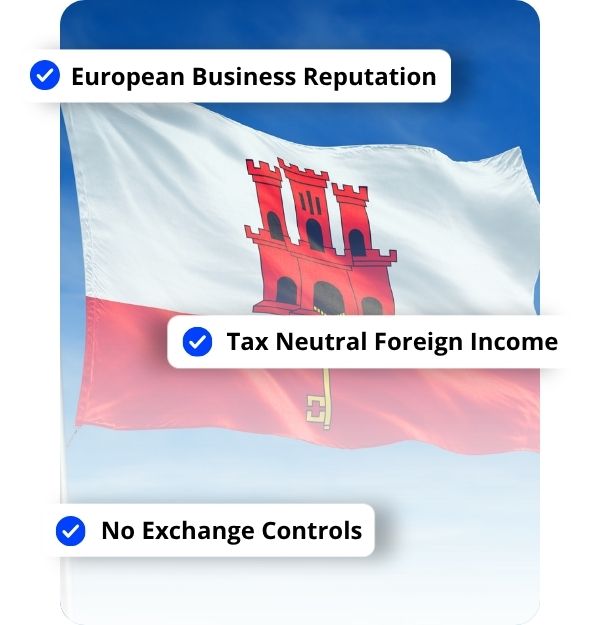

Key Advantages of a Gibraltar Offshore
Company
Gibraltar structures are designed for international entrepreneurs, investors, and HNWIs who need European credibility, tax-efficient treatment of foreign income, and access to EU/UK financial markets.

Tax Advantages on Foreign-Source Income
Gibraltar applies a territorial corporate tax system. Only income accrued in or derived from Gibraltar is subject to corporate income tax (15% from 1 July 2024), while foreign-source income of a non-resident company is generally outside the local tax net.
Reputable European Jurisdiction
Gibraltar is a British Overseas Territory with a legal system based on English common law. It is viewed by many counterparties as a “white-list” jurisdiction, making it suitable for holdings, IP structures, and trading companies that must pass stricter compliance checks.
Modern Regulation and AML Standards
Financial services, banks, and investment firms are supervised by the Gibraltar Financial Services Commission (GFSC), which enforces AML/CFT rules in line with international standards. The jurisdiction has implemented transparency measures to meet OECD and EU expectations.
No Exchange Controls
Gibraltar does not operate foreign-exchange controls. Companies can freely move funds in and out of the jurisdiction and hold multi-currency accounts, which is important for cross-border trade, investment flows, and asset-protection structures.
Strong Banking and Deposit Protection
Local banks are regulated by the GFSC and participate in a statutory deposit-guarantee mechanism that broadly mirrors EU-style schemes for eligible depositors, adding another layer of security for operational and treasury funds.
Streamlined Incorporation
The incorporation process is standardized and typically takes from 3–5 to 15–20 business days, depending on the package and bank-account opening. All steps can be handled remotely through a licensed corporate services provider, with no need to travel to Gibraltar.
Gibraltar Non-Resident Company
The recommended vehicle for foreign clients is the Gibraltar Non-Resident Company—usually a private company limited by shares, structured so that its income is derived exclusively from outside Gibraltar.
Benefits of a Gibraltar Non-Resident Company

0% Gibraltar corporate tax on profits that are not accrued in or derived from Gibraltar, subject to proper structuring and substance.
Recognized European jurisdiction using English common law—good for working with EU and UK partners.
No exchange controls; convenient for multi-currency operations.
Access to regulated banking with deposit protection and EU-style compliance standards.
Reputation as a cooperative jurisdiction implementing OECD and FATF standards, rather than a “black-list” tax haven.
Simplified maintenance for smaller non-resident companies that fall below audit thresholds.
Best suited for: IT and online businesses, international consulting and trading, asset-holding structures, wealth-planning vehicles for HNWIs, and investment or financing platforms that need a European legal base with tax-neutral treatment of foreign income.
Key Features

Legal Form: Typically a private company limited by shares (Ltd), with separate legal personality and limited liability for shareholders.
Tax Residence: Structured as non-resident in Gibraltar; income must arise outside Gibraltar to qualify for 0% local corporate tax.
Ownership: One or more shareholders; individuals or entities of any nationality. Bearer shares are not used in practice due to AML rules.
Management: At least one director (individual or corporate). Directors can be non-residents; many clients use local professional directors to support substance.
Capital: No strict minimum paid-up share-capital requirement; standard incorporations use a modest authorized capital in any major currency.
Meetings: Shareholder and board meetings may be held anywhere or may be replaced by written resolutions, unless the Articles specify otherwise.
Confidentiality: Public registries show limited information; beneficial-owner data is collected under AML rules but is not freely searchable by the general public.
Law: Governed by the Gibraltar Companies Act and related regulations, applying English-style corporate concepts.
Cost of Gibraltar Company Formation
Gibraltar law requires that companies be formed and maintained through licensed local providers. You cannot register directly with the Companies House as a private individual. Our packages bundle local agent services, government fees, and essential services, so you receive a ready-to-use non-resident company without having to deal with the bureaucracy yourself.
Standard
Typical timeframe: 3–5 business days after application approval
A cost-effective starting point when you need a Gibraltar company quickly and plan to add banking and extra services later.
Package Includes:
Registration of a Non-Resident Company with TIN
Registered office address in Gibraltar
Corporate secretary for 12 months
Professional
Typical timeframe: 5–10 business days after application approval
Ideal when you want a fully documented Gibraltar company that is ready for later bank onboarding and KYC reviews.
Package Includes:
Registration of a Non-Resident Company with TIN
Registered office address in Gibraltar
Corporate secretary for 12 months
Courier delivery of corporate documents
Notarization and apostille of core corporate documents
Registrar-certified company profile for banks and counterparties
Premium
Typical timeframe: 15–20 business days after application approval
A turnkey solution for international companies that want incorporation, a verified company profile, and a working banking arrangement for cross-border operations or asset protection.
Package Includes:
Registration of a Non-Resident Company with allocation of a Tax Identification Number (TIN)
Provision of a registered office address in Gibraltar
Corporate secretary for 12 months
Courier delivery of corporate documents
Notarization and apostille of core documents
Registrar-certified company profile (commonly required for account opening)
Assistance with opening an account in an online bank or EMI supporting international operations and asset-protection structures
Our 4-Step Gibraltar Company Incorporation Process
To keep the project transparent and predictable, we organize Gibraltar company formation into four stages.
Consultation and Name Check
We begin with a detailed consultation to clarify your business model and main revenue sources, whether Gibraltar’s non-resident structure is appropriate for your tax profile, the expected ownership and management structure, and banking and compliance priorities (jurisdictions, currencies, transaction volumes). At the same time, we check the availability of your preferred company names in the Gibraltar Companies House register and their compliance with local naming rules.
Document Collection and Review
You provide the required KYC and corporate documents. We verify that passports, proof of address, and corporate papers meet Gibraltar’s AML/KYC standards, prepare incorporation forms, the Memorandum and Articles of Association, and shareholder/director registers, and coordinate any notarization, translation, or apostille that may be required by the registrar or future banks.
Filing and Registration
We submit the application to the Gibraltar Companies House through a licensed agent and monitor the process. Once the company is registered, you receive the Certificate of Incorporation, Memorandum and Articles of Association, internal registers of shareholders and directors, and confirmation of the allocated Tax Identification Number (TIN). At this point, the company is ready for bank-account opening and international operations.
Delivery of the Corporate Pack
We finalize the structure and send you a complete corporate pack by secure courier, including:
-
Original corporate documents and certified copies
-
Registrar-certified company profile
-
Apostilled documents where requested
-
Any additional resolutions or powers of attorney agreed upon in advance
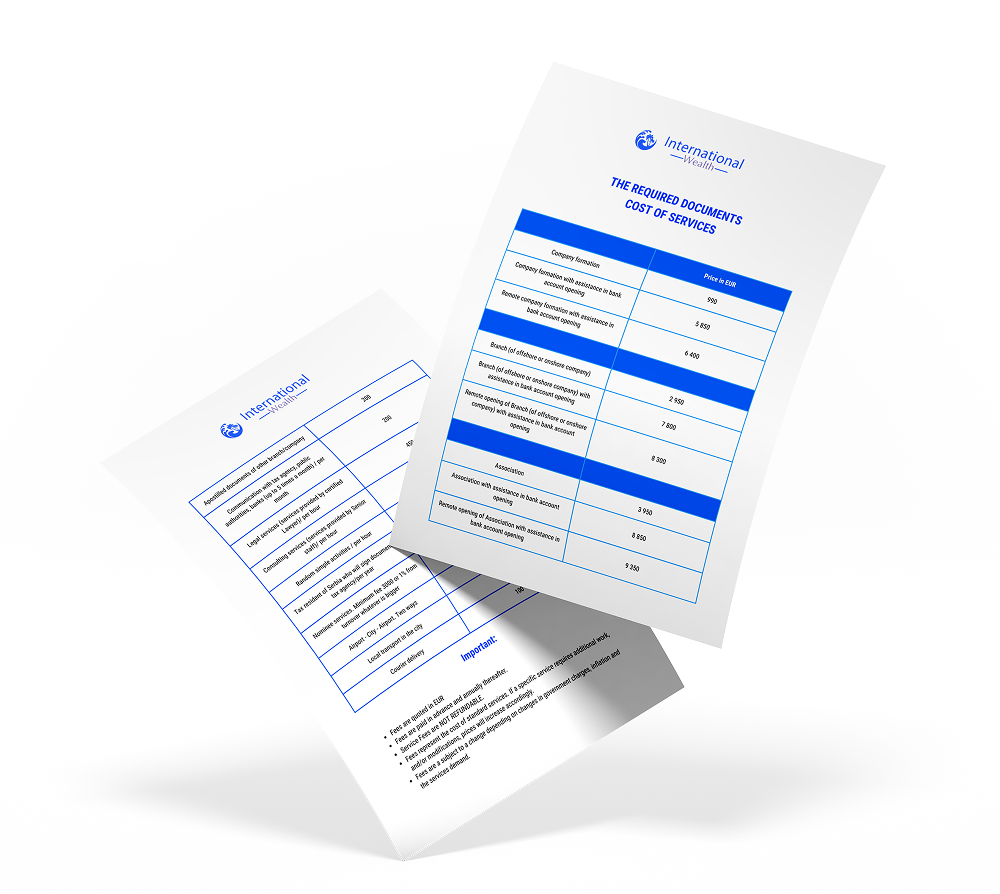
Documents Required for Gibraltar Company Formation
We tailor the checklist to your structure, but a typical non-resident company requires the following.
For Individual Shareholders and Directors
Completed application/brief questionnaire with key company details and business description
Clear copy of passport or other government-issued ID (certified where required)
Proof of residential address (utility bill, bank statement, or similar, not older than 3 months)
Short CV or professional profile (often requested by banks)
Evidence of source of funds/source of wealth (bank statements, contracts, sale agreements, tax returns, etc.)
For Corporate Shareholders or Controllers
Certificate of Incorporation/registration
Constitutional documents (Memorandum and Articles, or local equivalent)
Register of directors and shareholders
Recent certificate of good standing (or equivalent)
Proof of registered office
Documents confirming the authority of the representative signing on behalf of the company
Additional documents may be requested depending on your business sector, ownership chain, and chosen bank. We clarify all requirements in advance to avoid delays.
Additional Information
Taxation and Reporting
-
Gibraltar’s territorial tax system means companies are taxed only on income accrued or derived in or from Gibraltar. Non-resident companies that fully operate abroad and have no Gibraltar-source income can pay 0% corporate tax locally.
-
From 1 July 2024, the standard corporate tax rate on taxable income is 15%, reflecting recent changes to align with international minimum-tax initiatives.
-
Gibraltar adopted the Global Minimum Tax Act 2024 to implement elements of the OECD Pillar Two 15% global minimum tax for multinational groups with consolidated revenue above EUR 750 million. Smaller and medium non-resident companies typically fall outside this regime, but should monitor developments.
-
Non-resident companies below certain size thresholds (turnover, balance-sheet total, and number of employees) can file simplified accounts and may be exempt from mandatory audit, provided they have no taxable Gibraltar-source income.
Even when no local tax is due, companies must:
-
Maintain proper accounting records
-
File an Annual Return and basic financial information
-
Keep beneficial-owner and KYC data up to date with the registered agent in line with AML rules
Banking and Payment Solutions
Gibraltar’s banking sector is supervised by the GFSC and operates under a statutory deposit-guarantee framework broadly aligned with EU-style coverage levels.
For account opening, banks and EMIs usually require:
-
Full set of corporate documents (including certified profile)
-
KYC for all directors, shareholders, and beneficial owners
-
Proof of address and source-of-funds documentation
-
Clear business description, projected turnover, and main counterparties
-
Professional references (from another bank, accountant, or employer), where requested
Depending on your profile, we may recommend:
-
A Gibraltar bank account (if you have local ties, assets, or investors)
-
Foreign accounts in the EU, UK, or other reputable jurisdictions
-
EMI/payment-institution solutions for online projects and high-volume payments
Registered Agent and Annual Maintenance
Every Gibraltar company must maintain:
-
A licensed registered agent
-
A registered office address in Gibraltar
-
Corporate secretary services (often provided by the agent)
To remain in good standing, your company must:
-
Pay annual government fees and service-provider charges
-
File the Annual Return and any required financial information
-
Keep internal registers, accounts, and KYC information current
Most clients delegate these functions to us under an annual maintenance arrangement.
Who Benefits from a Gibraltar Non-Resident Company?
Gibraltar is particularly attractive for:
-
IT, SaaS, and online businesses that sell globally and want a European legal base with tax-neutral treatment of non-Gibraltar income
-
Cross-border trading and consulting where contracts and clients are located outside Gibraltar
-
Holding and IP structures for shares, real estate, or intangible assets, where EU-compatible governance is important
-
HNWI wealth-planning and asset-protection structures needing a reputable jurisdiction, modern AML compliance, and flexible banking options
Why Choose Offshore Pro Group for Your Gibraltar Company Formation?
20+ Years of Gibraltar Experience
We have assisted clients with Gibraltar structures for more than two decades, covering trading companies, holdings, and complex wealth-planning projects. We understand how local law and regulatory practice work in real life.
Turnkey, End-to-End Support
From initial feasibility analysis to incorporation, bank account opening, and ongoing compliance, you work with one coordinated team instead of juggling multiple service providers.
Direct Work with Licensed Local Providers
We cooperate with licensed Gibraltar-registered agents, banks, and specialists. This avoids unnecessary intermediaries, shortens timelines, and keeps costs predictable.
Compliance-First, Reputation-Safe Approach
Our structures are designed to satisfy modern KYC/AML, tax transparency, and substance requirements from day one. This reduces future risks such as account closures, regulatory queries, or reputational concerns.
Launch Your Gibraltar Company
A Gibraltar Non-Resident Company offers a blend of a European reputation, British legal certainty, and tax-neutral treatment of foreign income, backed by modern AML standards and a robust regulatory environment. Incorporation is fully remote, and our team handles the details so you can focus on your business.
FAQ on Gibraltar Companies
What is a Gibraltar Non-Resident Company?
It is typically a private company limited by shares, structured so that its income is not accrued in or derived from Gibraltar. In legal terms, it uses the same Companies Act framework as other Gibraltar companies, but its tax position is based on the territorial system and non-resident profile.
How long does it take to register a Gibraltar company?
Standard incorporations usually take 3–5 business days once KYC is approved and the name is cleared. More complex projects with notarization, apostilles, or banking may take 15–20 business days overall.
Do I need to visit Gibraltar in person?
No. Incorporation and maintenance are handled entirely remotely through a licensed registered agent. All documents are exchanged electronically and via courier.
Can the company have a single shareholder and director?
Yes. Gibraltar allows single-member companies and one-person boards. The same individual or corporate body can act as both shareholder and director.
Are Gibraltar non-resident companies tax-free?
They can pay 0% Gibraltar corporate tax on profits that are not accrued in or derived from Gibraltar. If the company has Gibraltar-source income (e.g., local clients, staff, or assets), that income may be subject to the standard 15% corporate tax rate.
What is the Global Minimum Tax Act of 2024, and does it affect me?
The Act implements elements of the OECD 15% global minimum tax for multinational groups with consolidated revenue above EUR 750 million. Smaller independent non-resident companies are usually outside its scope, but larger groups should review their position with professional advisers.
Do Gibraltar companies need audited accounts?
Companies that meet small-company thresholds (turnover, balance-sheet total, and employees) and have no taxable Gibraltar-source income can often file simplified accounts without a full statutory audit. Larger or regulated entities and companies with local operations may require audits.
What ongoing filings are required?
All companies must file an Annual Return, keep accounting records, and ensure beneficial-ownership information is maintained under AML rules, even where no corporate tax is due.
Can a Gibraltar company open a local bank account?
Yes, provided the business model and KYC profile meet bank expectations. Local banks are cautious but open to well-structured non-resident companies with clear, legitimate activity.
Can I open accounts outside Gibraltar?
Many Gibraltar companies use accounts in other European or international jurisdictions or EMIs, especially for online businesses and global payment flows.
What documents do banks usually require?
Typically:
-
Full set of corporate documents (including registrar-certified profile)
-
KYC documents for shareholders, directors, and beneficial owners
-
Business description and projected turnover
-
Source-of-funds and source-of-wealth evidence
-
Professional references, where requested
We help prepare and package this information in accordance with each institution’s requirements.
Is information about shareholders and UBOs public?
Gibraltar maintains beneficial ownership information in line with European AML directives, but it is not freely accessible to the general public. Public registries show limited basic company data; detailed ownership information is available only to competent authorities and, in practice, to banks and regulated intermediaries as part of KYC.
How strict are Gibraltar’s AML/CFT rules?
Financial institutions and corporate-service providers must comply with robust AML/CFT regulations supervised by the GFSC. Expect detailed KYC, source-of-funds checks, and ongoing monitoring.
What does annual maintenance involve?
You must pay annual government and service-provider fees, file the Annual Return, keep registers updated, and maintain accounting records. Most clients delegate these responsibilities to their registered agent under a service agreement.
Can I change shareholders or directors later?
Yes. Changes are made through internal resolutions, updated registers, and notifications to the Companies House within statutory deadlines. We prepare the documents and handle filings on your behalf.
How do I properly close a Gibraltar company?
The cleanest route is a formal voluntary liquidation or strike-off process, in which outstanding obligations are settled, and the company is removed from the register in good standing. Simply abandoning a company can result in penalties and future problems if you later need evidence of proper closure.
Discuss Your Gibraltar Structure with a Specialist
Contact us for a no-obligation consultation. We’ll review your goals, confirm whether Gibraltar is the best fit (or recommend alternatives), and provide a clear checklist of documents, timelines, and costs so you can move from idea to a functioning, compliant offshore structure with confidence.
Contact an ExpertUliana Syva
Consultant for company registration, bank account opening, residency, and citizenship.
1000+
successful cases
13+
years of experience










-matt.webp)
.webp)