


Offshore Corporate Bank Account Opening
Opening the right offshore corporate bank account is not about chasing a generic “bank account abroad.” It is about choosing a practical banking solution that fits your business model, your company structure, your target markets, and your compliance profile. At Offshore Pro Group, we help clients evaluate the options, prepare the file, and move from assessment to application with a clear strategy.
Excellent 4,6 out of 5

Offshore Banking Solutions Tailored to Your Business Structure
There is no single bank that works for every international company.
The right solution depends on how your business operates, where your clients are located, what currencies you use, how often you send or receive payments, and whether your company needs a traditional bank or a modern EMI.
With Offshore Pro Group, the goal is not simply to open an account, but to select the right banking format for your business model and long-term operational needs.
Traditional Offshore Banks
Traditional offshore banks are usually the right fit for companies that value stability, reputation, and classic banking infrastructure.
 Ideal for handling larger balances and building a stronger institutional image.
- Suits international trading, holding activities, and asset protection structures.
- Provides direct SWIFT access and familiar banking relationships for partners.
- Involves stricter compliance checks and detailed documentation.
EMI Solutions
EMIs are often a better answer for digital businesses, remote teams, and fast-moving international operations.
- Quicker onboarding without demanding a large minimum deposit.
- Flexible payments, multi-currency support, and simpler online access.
- Practical for service businesses, SaaS, and e-commerce projects.
- Focuses on speed, debit cards, and easy day-to-day account management.
Offshore Banking for International Companies, Digital Businesses, and Cross-Border Operations
A suitable bank account can support an offshore company across a wide range of international business models. In practice, the best offshore business bank account depends on the transaction pattern, jurisdictions involved, and sector:
-
Trading and Global Commerce
-
Consulting, Services, and Remote Businesses
-
Digital and International Structures
-
E-commerce and Online Sales
-
IT, SaaS, and Platform Businesses
-
Holding and Investment Structures
-
IP Holding and Licensing
-
Agencies, Freelancers, and International Contractors
Talk to a Business Setup Expert
Get personalized guidance on the best corporate banking solution for your business. Our specialists help you choose the right bank or EMI, prepare your documents, and streamline the application process.
Contact an ExpertUliana Syva
Consultant for company registration, bank account opening, residency, and citizenship.
1000+
successful cases
13+
years of experience


Key Advantages of an Offshore Corporate Bank Account
The practical value of an offshore banking solution is not about secrecy myths or tax fairy tales. It is about making international business easier to manage, easier to scale, and easier to separate into a clean corporate structure.

Multi-Currency Banking for International Transactions
A multi-currency bank account allows a company to hold and use different currencies such as USD, EUR, and GBP without constant double conversion. That matters for businesses with international clients, overseas suppliers, or payment obligations in different markets.
Faster Cross-Border Payments
A good offshore bank or EMI can improve the speed and clarity of cross-border payments. That means faster settlements, better timing for supplier payments, and fewer operational delays for the business.
Online Banking and Corporate Card Access
Modern online banking gives directors and finance teams 24/7 access to balances, transfers, approvals, and payment history. Many solutions also offer corporate debit cards for travel, software subscriptions, ad spend, and operating expenses.
Greater Flexibility for International Business Growth
As a company expands into new markets, it may need a better banking setup for new currencies, new counterparties, or a new legal structure. A strong offshore account can support that growth more easily than a purely domestic setup.
Better Control Over Global Financial Operations
A separate corporate bank account helps a company organize incoming and outgoing flows more clearly. It can improve financial control, support internal segregation of funds, and make group-level planning easier.
Banking Risk Diversification Across Jurisdictions
Relying on a single domestic banking system can create unnecessary operational risk for an international company. An offshore corporate bank account helps diversify that risk by giving the business access to a separate banking channel in another jurisdiction.Offshore Banking Options by Jurisdiction and Business Needs
Different jurisdictions offer different strengths, and different banking formats solve different problems. The goal is to match the jurisdiction and the bank account to the company’s real activity, not to force the business into a random template.
Offshore Bank Options for Corporate Clients
Traditional offshore bank options are usually considered by clients who want a more established banking relationship, stronger institutional reputation, or a solution that fits a higher-value company profile. The right jurisdiction depends on the company’s activity, ownership structure, expected volumes, and source of funds.
| JURISDICTION | VISIT | REG. TIME | CURRENCIES | CARDS | MIN. DEPOSIT | FEE | ACTION |
|---|---|---|---|---|---|---|---|

Belize |
Not required |
1 month |
USD, EUR, CAD, GBP, CHF |
Prepaid Visa |
2,000 per currency |
3,999 EUR |
See More |

Cyprus |
Required |
1 month |
– |
Business Debit/Credit |
– |
3,999 EUR |
See More |

China |
Required (for CNY) |
2-4 weeks |
CNY, USD, EUR + 14 more |
Mastercard, UnionPay |
– |
7,500 EUR |
See More |

Liechtenstein |
Not required |
1-2 months |
CHF, EUR, USD, GBP, JPY |
– |
5,000 CHF |
3,999 EUR |
See More |

Panama |
Not required |
1 month |
USD |
Visa Debit, Purchasing |
10k – 50k USD |
4,225 EUR |
See More |

Saint-Lucia |
Not required |
1-2 months |
Multicurrency |
Visa Credit |
5,000 EUR |
3,999 EUR |
See More |

Serbia |
Optional (Remote via POA) |
1 month |
EUR, USD |
Visa Classic |
– |
Depends on case |
See More |

Singapore |
Not required |
1 month |
SGD, USD, GBP, EUR, Crypto |
Visa |
– |
From 2,999 USD |
See More |

USA |
Not required |
1 month |
EUR, USD |
Visa Classic |
– |
6,000 EUR |
See More |

Switzerland |
Not required |
2-4 weeks |
– |
UnionPay, Visa, MC |
100k – 500k CHF |
From 3,999 EUR |
See More |

Montenegro |
Not required |
1 month |
EUR, USD |
Visa Classic |
– |
3,999 EUR |
See More |
Belize
Cyprus
China
Liechtenstein
Panama
Saint-Lucia
Serbia
Singapore
USA
Switzerland
Montenegro
EMI Options for International Business Operations
EMI solutions are often a practical choice for modern international businesses that need faster onboarding, flexible payment tools, and efficient multi-currency operations. The table below can compare suitable EMI options by onboarding style, currencies, card availability, and business fit.
| JURISDICTION | REG. TIME | CARDS | FEE | ACTION |
|---|---|---|---|---|

Canada |
1-3 days |
Visa (Virtual & Physical) |
From 3,000 EUR |
See More |

United Kingdom |
1-10 days |
Visa, Mastercard |
From 3,000 EUR |
See More |

Lithuania |
1-7 days |
Visa, Mastercard |
From 3,000 EUR |
See More |

Hong Kong |
1-7 days |
Visa (Virtual & Physical) |
From 3,000 EUR |
See More |

Kazakhstan |
3-7 days |
No Cards (Crypto/SWIFT) |
From 3,000 EUR |
See More |
|
Singapore |
1-7 days |
Visa (Virtual & Physical) |
From 3,000 EUR |
See More |

Czech Republic |
1-5 days |
Visa (Virtual) |
From 3,000 EUR |
See More |

Mauritius |
5-10 days |
No Cards |
From 3,000 EUR |
See More |
|
USA |
1-5 days |
Visa, Mastercard |
From 3,000 EUR |
See More |

Netherlands |
3-5 days |
Visa (Physical) |
From 3,000 EUR |
See More |

Estonia |
1 day |
Visa (Virtual & Physical) |
From 3,000 EUR |
See More |

Mexico |
1-3 days |
Mastercard |
From 3,000 EUR |
See More |
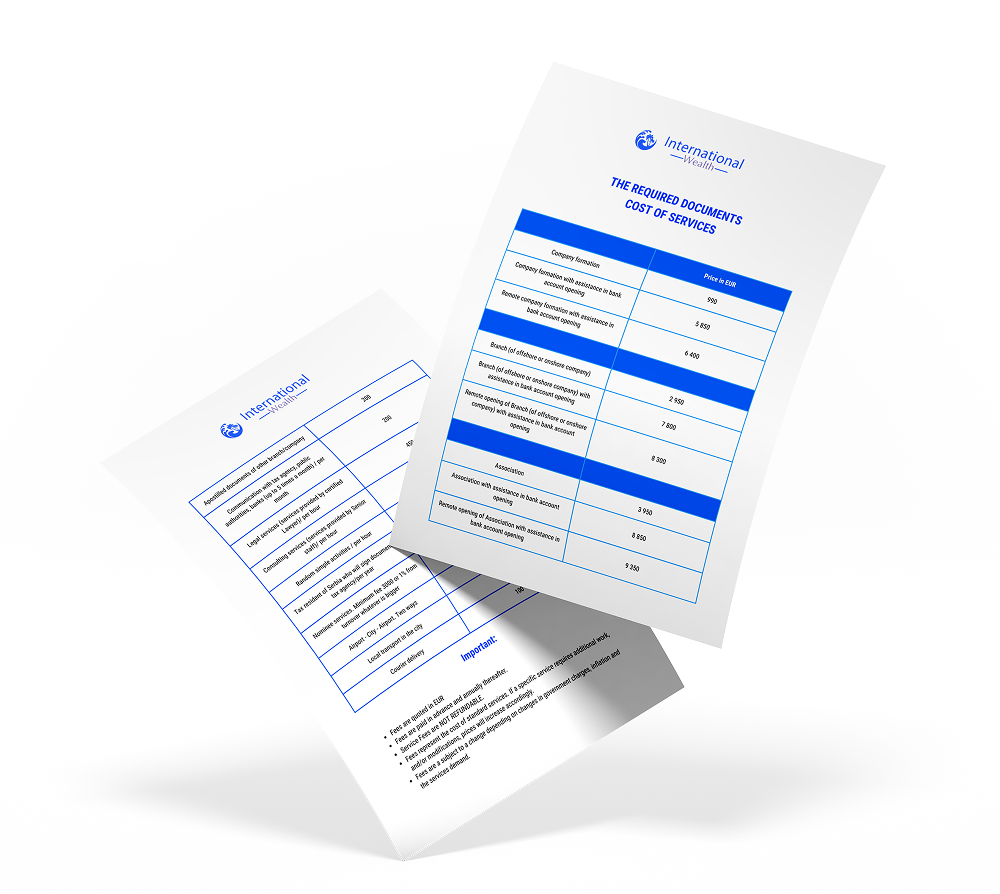
Compliance and Document Preparation for a Stronger Application
Banks and EMIs now apply much stricter KYC and AML checks than they did years ago. That is simply the reality of modern banking. A successful application depends not only on the jurisdiction or the bank, but also on the strength, clarity, and consistency of the company file.
In most cases, the required documents include:
Corporate registration papers
Constitutional documents
Information on directors, shareholders, and beneficial owners
Certified copies of passports
Proof of residential address
Source of funds or source of wealth information
Business description, website, or business plan
Invoices, contracts, transaction forecasts, and other supporting documents related to the company’s counterparties
If the documents are incomplete, inconsistent, or poorly explained, the application may be delayed or declined. If the documents clearly show what the company does, where the money comes from, and why the chosen bank account makes commercial sense, the chances improve significantly.
This is why preparation matters. A polished file is not decoration. It is part of the approval strategy.
A Clear 5-Step Process from Assessment to Account Opening
We keep the process structured and practical so the client understands what happens at each stage.
Business and Compliance Review
We review the company profile, business activity, jurisdictions involved, ownership structure, and expected transactions. This first stage helps identify risks early and avoid wasting time on banks that are unlikely to accept the application.
Bank or EMI Matching
Based on the review, we shortlist two or three realistic options. This may include a traditional offshore bank, an EMI, or both. The idea is to recommend the right business offshore bank account setup for the client’s actual operational needs.
Corporate and KYC File Preparation
We help prepare the corporate file, organize the KYC package, and check whether additional documents or translations are needed. If certification or legalization is required, that is addressed before submission rather than after the bank starts asking uncomfortable questions.
Application Submission and Coordination
Once the file is ready, the application is submitted and communication begins with the bank or EMI. We help coordinate follow-up questions, clarify business activity, and keep the process moving.
Approval and Account Activation
After approval, the company receives account details, online access, and any available card or payment tools. At this point, the account becomes operational and ready for business use.
Remote Account Opening and In-Person Banking Scenarios
Some banking solutions allow remote onboarding, while others require a personal visit. The exact format depends on the bank, the jurisdiction, and the profile of the company.
Remote Application
-
Opened remotely with many EMIs and selected banks
-
Application and KYC documents submitted online
-
Online verification or a video call may be required
-
Convenient for international businesses operating across borders
In-Person Application
-
Required by certain traditional and private banks
-
A personal meeting with the bank may be requested
-
Physical signing or presentation of original documents may be needed
-
Usually applies in more selective banking cases
Why Businesses Choose Offshore Pro Group for Banking Support
Choosing the right banking partner is not just about finding a bank that says yes once. It is about selecting a solution that the company can actually use safely and sustainably.
Strategic Matching Instead of One-Size-Fits-All Solutions
We do not push the same jurisdiction or the same bank account on every client. Each company is assessed individually, and the banking solution is matched to the real structure and business model.
Practical Guidance on Compliance and Documentation
Compliance is where many applications fail. We help clients prepare the right documents, present the business clearly, and avoid weak points that can trigger delays or rejection.
Better Alignment Between Banking Choice and Business Needs
A company that receives software subscription revenue has different banking needs from a trading company or holding structure. A strong match between the bank account and the business activity reduces future problems.
Support Focused on International Operations and Long-Term Use
The real goal is not only approval, but a useful account that supports international operations over time. We look at how the company will use the account after opening, not just how to get it approved this week.
Get the Right Offshore Banking Solution for Your Business
We help international companies choose the right jurisdiction, prepare the right file, and apply with a stronger compliance position. Contact Offshore Pro Group for a professional review of your case and a realistic assessment of the best options for your business.
Frequently Asked Questions
How do I open an offshore corporate bank account?
The process usually starts with a review of the company structure, business activity, jurisdictions involved, and compliance profile. After that, a suitable bank or EMI is selected, the documents are prepared, and the application is submitted.
Can I open an offshore corporate bank account online?
In many cases, yes. A large number of EMI providers and some offshore banks support remote onboarding, especially for straightforward business models with strong documentation.
Do I need to visit the bank in person?
Not always. Many accounts can be opened remotely, but some banks may require an in-person meeting depending on the jurisdiction, risk level, or type of banking relationship requested.
How long does it take to open an offshore corporate bank account?
Timing varies. Some EMI applications move relatively quickly, while traditional banks may take longer because of deeper compliance checks and document review.
What does the offshore corporate bank account opening process include?
It typically includes a pre-check, bank or EMI selection, preparation of corporate and KYC documents, application submission, compliance follow-up, and final activation.
What is the difference between an offshore bank and an EMI?
A traditional offshore bank usually offers a more conventional banking relationship, while an EMI focuses on payment services, faster onboarding, and modern online functionality. The right choice depends on the business model.
Which jurisdiction is best for an offshore corporate bank account?
There is no universal answer. The best jurisdiction depends on the company’s activity, ownership structure, transaction profile, and the practical requirements of the bank.
Can I open an offshore corporate bank account in a different jurisdiction from where my company is registered?
Yes, this is often possible. Many businesses register the company in one jurisdiction and open the account in another, provided the structure makes commercial and compliance sense.
Can I get online banking, debit cards, or credit cards with an offshore corporate account?
Many banking solutions offer online banking and debit cards. Availability depends on the bank or EMI, the jurisdiction, and the company profile.
How do I choose between offshore banks and EMIs for my business?
The choice depends on expected transaction volume, currencies, counterparties, required reputation level, card needs, onboarding speed, and average balance. A careful case review usually makes the answer much clearer.
What documents are required to open an offshore corporate bank account?
Most banks ask for corporate documents, passports, proof of address, business descriptions, and evidence supporting the source of funds. Additional documents may be required depending on the business.
How much does it cost to open an offshore corporate bank account?
Costs vary depending on the jurisdiction, the bank or EMI, the complexity of the company structure, and the amount of support needed for file preparation.
Is there a minimum deposit or minimum balance requirement?
Some banks require a minimum opening deposit or ongoing balance, while many EMI providers are more flexible. This should be checked before applying.
Can approval be guaranteed?
No. No serious advisor should promise guaranteed approval. Final acceptance always depends on the bank’s internal compliance decision.
Why can an offshore corporate bank account application be delayed or declined?
Common reasons include weak or inconsistent documents, unclear business activity, unsupported source of funds, high-risk jurisdictions, or a mismatch between the company profile and the selected bank.