Setting up an offshore company has the reputation of being much more difficult than it really is. Most people believe that setting up an offshore company will be expensive and subject to many regulatory rules with vague definitions and numerous confusing legal obligations. On the other hand, several jurisdictions around the world have made it possible for individuals to establish companies quickly, inexpensively, and without facing as many regulatory hurdles.
However, just because one jurisdiction may appear to offer the lowest-cost option on paper does not mean it is the least costly when all additional expenses (banking fees, compliance fees, document preparation, and annual renewal fees) associated with operating an entity are considered. The total cost of establishing and maintaining an offshore entity can vary dramatically from one jurisdiction to another, depending on how the entity will operate.

In this article, we will present several lower-cost jurisdictions for registering an offshore company in 2026. We will also provide a comparison of each jurisdiction and discuss a couple of common errors that could unnecessarily increase long-term costs.
Key Takeaways
- The most affordable way to form an offshore corporation is not just about the first year of setting up the company — the ongoing expenses associated with maintaining it will ultimately be equally important.
- Some low-cost offshore corporations can be established quickly but may later pose challenges for their users when opening bank accounts and processing payments.
- Each jurisdiction differs greatly in tax laws, regulatory compliance requirements, and the privacy it offers.
- Therefore, what makes one structure a “cost-effective” approach is determined on the basis of Total Cost Of Ownership (TCO) — rather than merely the registration or incorporation fees paid at the time of establishment.
- In practical terms, having ready access to banking services and being compliant with applicable regulations are generally far more significant factors than the speed of establishing a company.
- It is therefore possible to locate a viable, low-cost offshore company and a corresponding bank account arrangement that works — but you need to plan accordingly from the beginning.
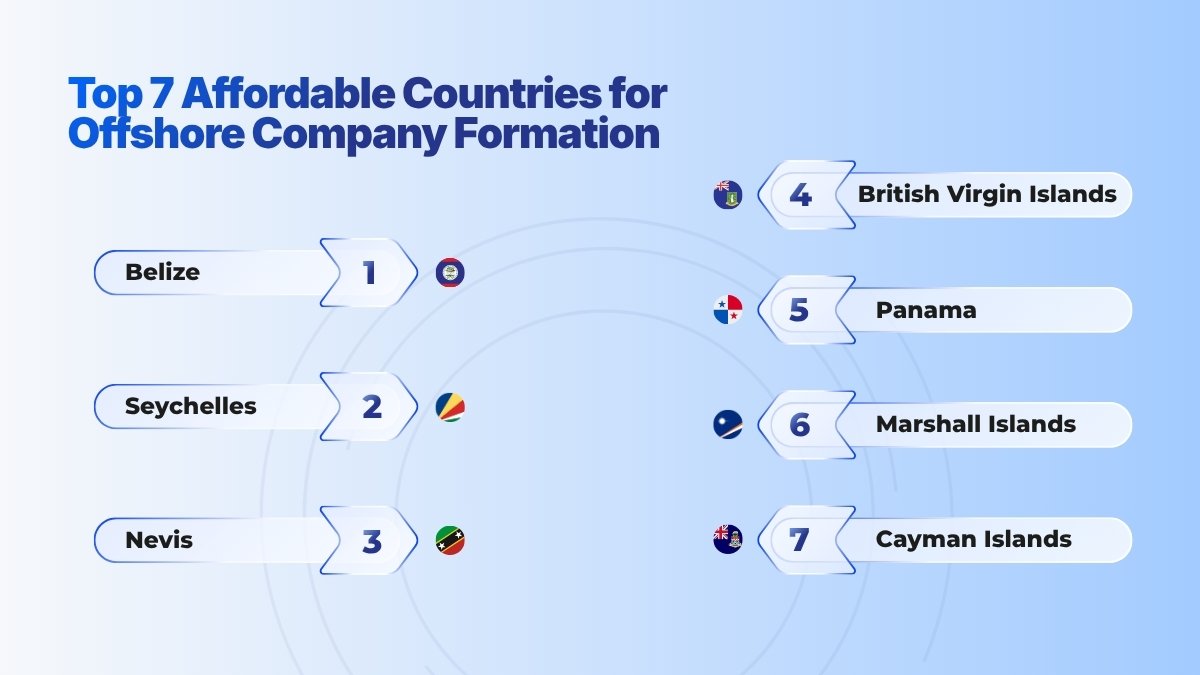
Top 7 Cheapest Countries to Start an Offshore Company in 2026
The following jurisdictions are commonly used for cheap offshore company registration. It’s usually the case because they balance affordability, privacy, and administrative simplicity.
1. Seychelles: Best Balance of Price and Speed
Seychelles is still one of those places people turn to when they want something offshore that doesn’t take forever or cost a fortune. It’s particularly common among online founders and traders who just need something set up without a long process around it.
Quick Facts
- Company Type: IBC (International Business Company)
- Setup Cost: from $3,350+
- Annual Renewal: from $1,999+
- Tax on Foreign Income: 0% tax on foreign-sourced income
- Setup Time: 24–48 hours
- Public Register: No public register of directors, shareholders, or beneficial owners
- Annual Audit: No annual audit requirement
- Best For: Online entrepreneurs, international e-commerce, digital nomads, cross-border consulting businesses
Why Choose Seychelles?
One reason this structure is used by many entrepreneurs is that the creation and ongoing administration of a Seychelles International Business Company (IBC) are relatively inexpensive. There are a few required documents; there are typically fewer people involved in the formation process than in other types of entities, and, generally speaking, they remain low-maintenance once created.
Companies using a Seychelles IBC also enjoy 0% tax on all foreign earnings, no capital gains tax, no withholding tax, and the ability to maintain confidentiality of their beneficial owners, provided the structure is properly set up. Another plus for companies choosing to use a Seychelles IBC is that they do not have to perform an annual audit on their standard offshore company. Thus, maintaining your Seychelles IBC will likely cost you less over time than if you were required to prepare audited financials annually, as you would in some other countries.
One downside of forming a Seychelles IBC is that you may have difficulty opening a bank account for your business. Banks generally tend to be more cautious about lending to businesses incorporated in offshore jurisdictions such as the Seychelles.
Key Considerations
While Seychelles offers one of the fastest formation options available in 2026, some tier-1 banking institutions may have enhanced due diligence processes. Companies wishing to bank with Tier-1 banks must ensure their KYC and AML documentation is properly prepared prior to commencement.
2. Belize: Ultimate Privacy and Low Maintenance
Belize is often chosen for its strong privacy features and relatively simple setup, which is why it remains a common option for cheap offshore companies.
Quick Facts
- Company Type: IBC (International Business Company) or LLC (Limited Liability Company)
- Setup Cost: from $3,250+
- Annual Renewal: from $2,650+
- Tax on Foreign Income: 0% tax on foreign-sourced income
- Setup Time: 24–48 hours
- Public Register: No public register of directors, shareholders, or beneficial owners
- Annual Audit: No annual audit requirement
- Best For: Asset holding, intellectual property holding, international e-commerce, cross-border service businesses
Why Choose Belize?
The formation process for Belize is relatively simple; there is also generally high confidence in confidentiality (with respect to private information), thereby making Belize a viable option for individuals desiring low-maintenance structures.
Belize offers tax-free treatment of foreign-earned income and one of the most comprehensive privacy laws among affordable offshore jurisdictions. Additionally, Belize operates under the English Common Law system, providing a widely recognized legal framework for numerous international investors and business owners.
Tax neutrality, no capital gains tax, no withholding tax, and high-level beneficial ownership confidentiality are just a few of the advantages both Belize IBCs and Belize LLCs offer to entrepreneurs. As such, this flexibility allows entrepreneurs to choose the appropriate corporate structure for achieving their operational objectives.
Key Considerations
Banking may take longer than expected for your institution to verify you. This could occur if institutions perceive your jurisdiction (and therefore perform additional checks), although you are 100% compliant.
If you expect to transact large amounts of money or plan to bank with major financial institutions, you will need a well-defined source-of-funds documentation package and a clear business model ready for your banker.
3. Marshall Islands: Zero Tax and High Confidentiality
The Marshall Islands is often chosen by people looking for a relatively low-cost setup with no local tax and a bit more privacy compared to more mainstream jurisdictions.
Quick Facts
- Company Type: IBC (Non-Resident Domestic Corporation)
- Setup Cost: from $2,750+
- Annual Renewal: from $1,750+
- Tax on Foreign Income: 0%
- Setup Time: 1–3 business days
- Public Register: No
- Annual Audit: Not required
- Best For: Shipping holding company structures, ship registry ownership, international trading, and holding companies
Why Choose The Marshall Islands?
It is a function-first approach. This is why you typically find it used when creating a shipping structure, an entity to hold companies across different countries, or when creating cross-border trading arrangements where the need for flexibility outweighs concerns about appearance.
The Marshall Islands have been very successful in the maritime sector, with their ship registry recognized by all other nations. International shipping companies will often use entities created under the Marshall Islands’ legal system as their holding entities, given the jurisdiction’s tax neutrality and its ability to create flexible corporate structures.
Income received from foreign sources does not pay taxes. Additionally, there are no withholding taxes or capital gains taxes, making this jurisdiction attractive for businesses with international operations.
Key Considerations
A significant portion of the focus will be on banking. Approval processes may take longer than expected, and/or approval may not always be predictable.
Entrepreneurs and corporate entities who wish to create efficient structures without worrying too much about public perception of “mainstream” markets would likely benefit most from using this jurisdiction.
4. Nevis: Strong Asset Protection Focus
Nevis is often chosen less for its cost and more for its legal advantages. It has a reputation for strong asset-protection rules, which is why it’s commonly used for holding structures and long-term wealth planning.
Quick Facts
- Company Type: LLC (Limited Liability Company)
- Setup Cost: from $3,300+
- Annual Renewal: from $2,850+
- Tax on Foreign Income: 0% tax on foreign-sourced income
- Setup Time: 2–4 business days
- Public Register: No (strong privacy protections)
- Annual Audit: No annual audit requirement
- Best For: Asset protection trusts, family wealth planning, private investment structures, multi-generational wealth preservation
Why Choose Nevis?
A key factor that differentiates Nevis from many other offshore locations is not price; rather, it is the legal framework. Generally speaking, offshore companies are formed by individuals to shield their ownership (equity) and to provide a more stable operating model. In some cases, the main purpose for forming an offshore company is simply to have a base of operation to collect fees on income earned from activities denominated in US dollars; however, Nevis Companies provide significantly more flexibility than the traditional corporate law models used in other jurisdictions.
Due largely to the widely publicized “charging order” protections available to shareholders/owners of Nevis Limited Liability Companies (LLCs), these entities are frequently cited as one of the strongest forms of offshore asset protection. By preventing outside creditors from making a claim against your personal assets using an LLC, you can enjoy a level of comfort and security that is rare in other jurisdictions.
In addition to offering the significant asset protection attributes mentioned above, Nevis LLCs also provide several other benefits, including:
- No taxes paid on foreign-sourced income;
- No capital gains taxes;
- No withholding taxes;
- Complete anonymity regarding the identity of the owner(s);
- Flexible management rules and regulations.
When combined with the previously mentioned attributes, these characteristics make Nevis a particularly attractive jurisdiction for high-net-worth individuals and international investors who need long-term asset protection strategies.
Key Considerations
Banking is possible in all offshore jurisdictions. However, banking in an offshore location will be determined by both the quality and clarity of the overall structure presented to financial institutions and by how you choose to present it.
Nevis LLCs are best suited for those who have primary goals of asset protection or estate planning. Secondary factors, such as banking convenience or cost savings when establishing a company, are less important compared to primary objectives.
The BVI is among those jurisdictions that repeatedly appear in offshore structures for a good reason. They’ve been around for over three decades, and most banks, attorneys, and corporate services providers now understand how they function. As a result, the overall experience should typically feel much easier in practice.
Quick Facts
- Company Type: BC (Business Company)
- Setup Cost: from $3,950+
- Annual Renewal: from $2,950+
- Tax on Foreign Income: 0% tax on foreign-sourced income
- Setup Time: 2–5 business days
- Public Register: Restricted (BOSS register is non-public)
- Annual Audit: Not required (annual financial return required)
- Best For: Holding companies, joint ventures, private equity structures, international investments
Why Choose BVI?
While the BVI does not market itself as the least expensive option, it has positioned itself as an alternative that strikes a balance between easy incorporation and a certain level of prestige or recognition that is missing from many low-cost alternatives.
The BVI Business Company (BC) remains one of the most popular international corporate vehicles. The BVI BC combines a very neutral tax environment with a robust legal system based on the principles of English Common Law, creating an environment that is relatively easy for international investors, banks, and professional advisers alike to understand.
Benefits to companies:
- No taxes on foreign earnings;
- Capital gains are also exempt from taxation;
- There is no withholding tax;
- High level of privacy;
And yet, the BVI has a higher level of international acceptance than many other lower-cost offshore jurisdictions.
Key Considerations
In reality, few people select BVI because of the cost. Most choose the BVI to avoid problems down the road.
6. Panama: Cost-Effective for Asset Protection and Foundations
Panama has long been a familiar name in offshore company formation, mainly because of its well-developed corporate law system and long history of international use.
Quick Facts
- Company Type: Sociedad Anónima (Corporation) / Private Interest Foundation
- Setup Cost: from $3,950+
- Annual Renewal: from $2,950+
- Tax on Foreign Income: Territorial taxation – 0% on foreign-sourced income
- Setup Time: 3–7 business days
- Public Register: Directors public, shareholders private
- Annual Audit: Not required for offshore activity
- Best For: Latin American business structures, private interest foundations, asset protection planning, international holding companies
Why Choose Panama?
Many foreign individuals and companies use Panama as an intermediary jurisdiction to hold their property and to set up private interest foundations or other types of entities (e.g., corporations) as vehicles for their overall company structure, primarily in South America.
The territorial tax system in Panama has many advantages. Income earned by foreign nationals (and/or corporations) outside Panama typically is not subject to tax in Panama. This makes it a very attractive destination for international businesspersons who operate globally and conduct business across multiple countries/jurisdictions.
Private Interest Foundations (“PIFs”) are extremely popular among investors who want to protect their assets. Many investors incorporate PIFs into their overall corporate structures to develop a strategy for managing their wealth over time.
Key Considerations
What most people love about Panama is that it’s not simply “cheap”. The laws in Panama are well-established and recognized worldwide, which can be a significant benefit to entrepreneurs doing business in Central & South America and the Caribbean.
7. Hong Kong: High Credibility Offshore-Onshore Hybrid
It’s not just about lower costs – Hong Kong has also been recognized internationally as one of Asia’s top business hubs. When compared to many traditional offshore centers, there is no other location that offers a more modern banking system and greater international recognition, along with being strategically positioned for major markets across Asia.
Quick Facts
- Company Type: Private Limited Company
- Setup Cost: from $2,950+
- Annual Renewal: from $1,950+
- Tax on Foreign Income: 0% on qualifying foreign-sourced income (offshore claim); 8.25–16.5% on local profits
- Setup Time: 5–7 business days
- Public Register: Yes
- Annual Audit: Required
- Best For: Active trading companies, China-facing business, fintech startups, international service providers
Why Choose Hong Kong?
Typically active companies (especially those involved in trading or fintech activities, international consulting services, technology services, etc.) receive better banking options than in traditional offshore centers.
Key Considerations
However, always remember, expectations are higher in Hong Kong.
Businesses operating out of Hong Kong must maintain accounting records, submit annual audits, and meet local reporting requirements. So entrepreneurs who want the most ease with their administrative tasks — and do not care about anything else — will typically find their ideal location among the more traditional “offshore” jurisdictions.
Onshore Alternative: UK Limited Partnership (UK LP)
Although the focus of this guide is on offshore companies, there exists one onshore structure that should be considered in 2026, the UK Limited Partnership (UK LP), which includes the Scottish Limited Partnership (SLP).
The key difference between a standard offshore IBC and a UK LP is that a UK LP will be operating in one of the world’s top-tier legal systems and, if structured correctly, will also allow for tax transparency.
Quick Facts
- Company Type: Limited Partnership (LP)
- Structure: General Partner + Limited Partner
- Setup Cost: from $2,500+
- Annual Maintenance: from $1,500+
- Tax Treatment: Partners taxed individually
- UK Tax on Foreign Income: Potentially 0% for non-resident partners with no UK-source income
- Public Register: Yes (PSC and Companies House filings apply)
- Annual Filing: Confirmation Statement required
- Best For: International trading, investment structures, and businesses needing a stronger reputation than a traditional offshore IBC.
Why Choose a UK LP?
Some entrepreneurs find their greatest challenge isn’t the tax implications; it’s others’ perception. An offshore jurisdiction can create an additional layer of scrutiny from banks, payment providers, suppliers, and counterparties.
A UK limited partnership can provide an alternative with equal credibility but higher tax efficiency. In general, because an LP is tax-transparent, profits are usually taxed at the individual partner level rather than at the partnership level.
As such, a UK limited partnership can be extremely advantageous for international trading companies, cross-border investment activities, and entrepreneurs seeking greater jurisdictional recognition.
When Is a UK LP Better Than an Offshore IBC?
A UK LP may be preferred where you require:
- Easier bank acceptance and higher levels of international reputation.
- Your counterparty conducts enhanced due diligence.
- Access to a reputable legal system whilst retaining your tax efficiencies.
Key Limitations
One of the major differences between a UK LP and many other offshore jurisdictions is that the UK LP offers less confidentiality. With public registration requirements, PSC disclosure and annual reporting requirements, etc., the overall level of discretion available to you is lower than what would be available to you in jurisdictions like Belize, Seychelles, or Nevis.
Company Structure Options: IBC vs LLC vs IC vs BC
Entrepreneurs usually spend most of their time researching countries where they can establish a company. However, choosing the correct type of company is equally important, if not more so, than establishing it in that particular country. Two companies established in the same jurisdiction but with different legal forms will operate similarly, whereas two companies based in the same jurisdiction but with different legal forms will have significant differences in taxes, regulatory compliance, and other areas. The four most popular forms of offshore companies are the International Business Company (IBC), Limited Liability Company (LLC), International Company (IC), and Business Company (BC).
Understanding the differences among these options will help you ensure that your initial decision about the company’s form supports your business objectives.
International Business Company (IBC)
Jurisdictions where available: Seychelles, Belize, Marshall Islands, British Virgin Islands
Despite being among the least popular offshore entities, international business companies (IBCs) remain widespread worldwide today.
IBCs were created primarily to conduct international business outside the jurisdiction of incorporation. In general, IBCs are characterized by simple administrative procedures, low maintenance requirements, and tax-free status on foreign-source income.
Benefits
- A simple organizational structure
- Minimum expenses for annual maintenance
- Foreign income: no taxation in many jurisdictions
- In most offshore centers there are no auditing obligations
- High level of protection of privacy
- Quick registration process
Drawbacks
- Enhanced bank due diligence for some jurisdictions
- Increased scrutiny of compliance by some jurisdictions
- Not always suitable for regulated business
Recommended for trading abroad, internet commerce, companies providing consulting services, and structures of holding assets
Limited Liability Company (LLC)
Jurisdiction where available: Nevis, Belize (optional), Wyoming, Delaware
An LLC combines features of corporate liability protection with flexible rules regarding who manages and owns the business.
One of the main advantages of using an LLC is the separation of personal and business liabilities, along with great flexibility in managing the business. Some LLC jurisdictions offer additional asset protection, such as Nevis.
Benefits
- Protection against loss of assets
- Flexible managerial system
- Protections by charging orders in some jurisdictions
- For investments, a suitable option
- Understood by banks and advisors worldwide
Drawbacks
- More complicated than other entities; need to create operating agreements
- Taxation varies per jurisdiction
- Additional reports to authorities may be necessary
Recommended for protection of assets, family wealth planning, investment structures, and private property.
International Company (IC) — Samoa
While less well known than the IBC, the Samoa IC offers several advantages over the more common structure.
The Samoa IC was developed in conjunction with trusts and foundations because Samoa has effective legislation protecting assets. This structure is useful for international business and long-term wealth preservation because it combines tax neutrality with an international law structure.
Benefits
- Very good secrecy
- Often utilized when creating a trust or foundation
- Tax neutral
- Flexible ownership structures.
Drawbacks
- Less recognized in the international community
- Small financial sector
- Fewer service providers than in larger jurisdictions.
Recommended for protection of assets, planning a trust, preservation of wealth for the long term, and international business.
Business Company (BC) — St. Vincent and the Grenadines
A company that operates under a business company (BC) is considered an advancement over the international business company (IBC).
BC legislation typically affords its users greater flexibility than the IBC model; however, it retains most of the same tax benefits common to offshore entities.
Advantages
- Flexibility in corporate governance
- Suits regulate commercial activities
- Generally tax efficient
- Widely used globally by businesses
Drawbacks
- May require additional licensing
- Banking reviews may be more detailed
- Dependent upon activity, compliance requirements vary
Ideal for forex brokers, fintech projects, VASPS (virtual asset service providers), and international payment companies
Quick Comparison of Offshore Company Structures
| Structure | Liability Protection | Tax Treatment | Privacy Level | Best Use |
|---|---|---|---|---|
| IBC | High | Tax-neutral | High | Trading, e-commerce, consulting |
| LLC | Very High | Flexible / pass-through | High | Asset protection, investments |
| IC | High | Tax-neutral | Very High | Trust planning, wealth preservation |
| BC | High | Tax-neutral | Medium-High | Forex, fintech, VASP businesses |
The most suitable structure ultimately depends on the business model, banking requirements, and long-term objectives. In many cases, choosing the right structure from the beginning can prevent costly restructuring later.
Asset Protection and Privacy: Do Cheap Jurisdictions Still Deliver?
A common misconception is that lower-cost jurisdictions automatically mean weaker protection or less privacy. In reality, that’s not always the case.
Most cheap offshore companies still come with a solid legal framework that can include:
- A reasonable level of privacy protection, depending on the jurisdiction
- Clear legal separation between ownership and control of assets
- Flexible corporate structures that can be adapted to different needs
- In some cases, reduced tax exposure depending on how the structure is used
That said, a cheap offshore company registration doesn’t automatically guarantee anonymity or smooth banking access. These outcomes depend much more on how the company is structured and documented than on price alone.
In practice, choosing the right jurisdiction should always align with the actual business model, tax residency position, and long-term planning goals, rather than cost alone.
Risks of Choosing the Cheapest Offshore Jurisdiction
Choosing the cheapest offshore company can sometimes create long-term issues that outweigh initial savings.
Increased Regulatory Scrutiny (FATF, ESR, CRS)
Increased regulatory scrutiny, including FATF, economic substance regulations (ESR), and automatic exchange of information via the OECD’s CRS, is forcing companies operating offshore to comply with a multitude of new reporting requirements.
The Financial Action Task Force (FATF) issues “grey lists” of countries subject to increased monitoring. Banks will implement enhanced due diligence (“EDD”) when a company incorporates in a jurisdiction listed on a FATF grey list.
As a consequence, companies may need to provide more documentation to open a bank account, may experience extended onboarding timelines, and/or be limited in their ability to obtain services from top-tier banks. In addition, the mere existence of a company in a FATF-listed jurisdiction may raise additional questions from the bank.
Jurisdictions have implemented economic substance regulation (“ESR”) to ensure that companies that incorporate in those jurisdictions engage in actual economic activities. Jurisdictions may differ in which types of companies are affected by ESR. The types of businesses that may be impacted include holding companies, financing operations, shipping businesses, and intellectual property structures.
Additionally, the OECD’s CRS allows participating tax authorities to automatically share financial information about participating taxpayers. Therefore, the concept of “offshore” has shifted from a focus primarily on secrecy to a tool for compliance and international business.
Therefore, when considering the use of a low-cost offshore jurisdiction, regulatory sustainability needs to be given equal weight to the cost of setting up. Although a structure may cost a little more upfront, its long-term acceptability and compliance viability could ultimately make it less costly over time.
Reputational Damage and Banking Rejections
While individuals who form companies often focus on forming the company quickly and correctly, they fail to consider the potential impact of their choice of jurisdiction on their future dealings with banks, EMIS, other counterparties, etc. Many jurisdictions used by companies seeking low-cost setups are viewed negatively by banks and compliance officers. As a result, the legitimate company itself becomes subject to the same scrutiny as the jurisdiction. This can lead to operational difficulties.
Examples of the kinds of things that banks will scrutinize when dealing with legitimate companies established in high-risk jurisdictions include:
- What does the business really do?
- How transparent is the company’s ownership structure?
- Are all necessary supporting documents available, accurate, and consistent?
- What level of risk is posed by the company’s jurisdiction?
- Has the company’s jurisdiction been placed under FATF monitoring?
- What kind of transactions is the company likely to generate?
There are two general ways that banks treat jurisdictions. Some banks have automated processes for corporate account applications based on a predetermined risk score. Other banks will require additional due diligence steps to take place before opening an account. Examples of these additional due diligence steps include requesting additional source-of-funds documentation, requiring additional interviews with the bank officer, and requiring independent legal advice to confirm whether the bank officer’s concerns regarding jurisdiction were reasonable.
These additional steps can cause what is known colloquially as “a reputation tax.” The “reputation tax” refers to the indirect operational expense resulting from the decision to establish an entity in a very low-cost jurisdiction. Although the cost of establishing the entity was low, the operational challenges in the banking sector led to delayed onboarding, legal costs incurred in obtaining documentation, and/or delayed completion of transactions.
Other counterparties may also be affected. Companies whose entities are formed in high-risk jurisdictions may also experience difficulties engaging with counterparties. For instance:
- Suppliers may conduct internal due diligence on customers;
- Payment processors may perform internal due diligence on merchants;
- Marketplaces may perform internal due diligence on sellers;
- Fintech platforms may perform internal due diligence on merchants;
If an entity is formed in a jurisdiction viewed by another counterparty as high-risk, then that counterparty may view the merchant with suspicion even if the merchant has complied with all applicable laws. In extreme circumstances, the counterparty may decide not to approve the customer’s application for access to its platform.
Even if a company establishes an entity in a fully compliant manner, it may still face increased scrutiny solely because of the jurisdiction selected.
“As many clients concentrate solely on finding the lowest possible cost for registering a company, they ignore the reality that unless sufficient KYC documentation is prepared beforehand and sufficient compliance assistance is offered, the total cost of maintaining an entity can increase threefold in a matter of six months due to fines and/or restrictions on accessing accounts.”
That is why our staff assists our clients in selecting jurisdictions not only according to the cost of establishment but also with regard to long-term banking recognition, operational feasibility, and general reputation reliability.
Most offshore jurisdictions appear to be straightforward to manage at first glance. However, it is easy to misunderstand or overlook continuing compliance obligations, particularly for first-time users of offshore business ventures.
Although lower-maintenance jurisdictions still require annual renewal submissions, government filings, registered agent updates, and compliance-related recordkeeping, missing such deadlines can prompt penalties quickly.
For instance:
- Failure to file BVI annual reports may result in BVI late-filing penalties exceeding $5,000, depending on the time elapsed since the last filing and the nature of the breach.
- Failure to submit Belize annual reports may result in Belize penalties exceeding $1000 for missed annual obligations.
- Restoration fees frequently apply after administrative strike-off.
Administrative Strike-Off Risks
Failure to comply with compliance obligations can also result in administrative strike-off — removal of the entity from the public register. After administrative strike-off:
- The entity loses its legitimacy;
- Banking access is restricted/frozen;
- Contracts may become unenforceable;
- Costs associated with Restoration may be excessive;
- Counterparties may no longer wish to deal with you;
Restoring an administratively struck-off company can be expensive; generally, substantially more so than originally spent on creating it.
KYC / AML Liability Risks
Compliance breaches can impact more than the company.
Directors, shareholders, and beneficial owners may be personally liable in specific instances if they deliberately or negligently ignore/submit inaccurate KYC/AML information or documents to banking institutions.
Increasingly, banks now ask for:
- Source-of-funds documents
- Proof of business operation
- Source-of-wealth explanations
- Customer invoices/contracts
- Corporate group structure documents
Documentary inadequacies are consistently cited as a primary cause of account rejection/refusal, or freezing.
An additional issue that entrepreneurs often neglect is tax residence exposure.
Merely forming an entity overseas does not entirely avoid tax responsibilities in one’s home country. Depending on where you live and how you control/manage your venture, tax-residence laws, CFC legislation, and management & control tests may still apply.
Therefore, offshore structuring should always be tied to international tax planning rather than merely treated as a means of reducing registration costs.
Many of these hidden obligations become apparent only after an entity has been created. Therefore, knowing what the entire long-term maintenance entails is at least as important as initially determining how much to pay for establishing it.
Unethical Service Providers and Ready-Made Company Scams
Dangerous practices by poor-quality service providers & shell company schemes
Notwithstanding the quality of the jurisdiction itself, one of the largest risks facing entrepreneurs wishing to utilize offshore structures is poor-quality service providers.
The reason for this lies in aggressive marketing practices by service providers, largely online, which have led many entrepreneurs to use unlicensed intermediaries, anonymous shell-company sellers/resellers, or providers promising extremely low setup costs without warning about potential risks.
Warning Signs of Unreliable Incorporation Agents
Some common signs of unscrupulous agents include:
- Extremely low advertised prices with hidden upselling
- No physical office address
- No evidence of licensing or regulatory history
- No demonstrable corporate history
- Pressure to buy “urgent” ready-made companies
- Promising guaranteed anonymous bank accounts
- Not providing a proper onboarding process for client compliance
Normally, reputable providers will follow strict KYC guidelines before registering an entity. Conversely, an agent willing to bypass compliance guidelines may endanger their client with long-term legal and banking risks.
Ready-Made / Shelf Company Risks
Shelf companies (also known as ready-made companies) are pre-established corporations sold to new clients. While not inherently unlawful, shelf companies pose numerous compliance risks if their prior history is unknown.
Possible risks include:
- Unknown historical liabilities
- Prior banking activity
- Prior sanctions exposure
- Uncertain beneficial ownership history
- Red flags during the due diligence process
Banks increasingly examine previous ownership histories and prior corporate activity during applicant screening. If an applicant provides incomplete or contradictory documentation regarding their prior corporate history, banking acceptance can become a problem immediately.
Fake Documentation and Corporate Identity Risks
Providing false documentation can have serious consequences. More severe examples exist whereby dishonest providers deliver less than they promise, such as:
- Improperly issued apostille
- Unverifiable nominee arrangements
- Fake proof-of-address documentation
- Recycled corporate documents
- Misleading beneficial ownership structures
Delivery of false documentation can result in the rapid closure of client bank accounts, subsequent investigation by relevant authorities, and adverse reputational effects.
How to Verify an Offshore Provider
Before providing any money to establish your entity, you need to check:
- Your entity’s registration details
- Whether they have the requisite licenses
- Do they possess a physical office location?
- Have they been in operation for years?
Are there independent client testimonials? - Are they recognized by international banks?
- Do they offer professional compliance support?
Check your provider’s D-U-N-S, registered office address, license status, and operational history before completing your offshore registration.

At face value, the cost of establishing an inexpensive offshore corporation may appear too good to pass up. While the incorporation fee will typically be the most publicized price tag, it will hardly represent your last expense after forming the corporation.
Registered Agent and Office Fees
In nearly all cases, foreign jurisdictions require corporations to have some form of representation (a registered agent) and a physical location (registered office). The registered agent and registered office charges are ongoing – there are annual fees to maintain them, as well as the required registered office itself.
Nominee Services
Depending on how a corporation is structured, there may be nominees (usually for anonymity or administrative purposes), which, in certain circumstances, can be valuable; however, nominees do incur an annual fee. In addition to incurring additional costs, nominee service arrangements increase scrutiny from banks and/or compliance departments when they investigate corporate ownership and control further.
Notarization and Apostille
When a corporation operates internationally, documents relating to financial transactions, contractual obligations, etc., will generally require certification (notarizing), authentication via an apostille (or both), especially prior to opening accounts with a bank, signing contracts, etc. Each individual process may take little time and money by themselves but collectively contribute to increased time and overall costs associated with using an offshore corporation.
Costs Comparison Table
To allow for better comparison of different countries, we have included the entire cost to be incurred by each country when setting up an incorporated business in 2026, which will include set-up, renewal (annually), tax implications, and compliance obligations.
| Jurisdiction | Company Type | Setup Cost | Annual Renewal | Tax on Foreign Income | Setup Time | Public Register | Annual Audit |
|---|---|---|---|---|---|---|---|
| Seychelles | IBC | from $3,350+ | from $1,999+ | 0% | 24–48 hours | No | Not required |
| Belize | IBC / LLC | from $3,250+ | from $2,650+ | 0% | 24–48 hours | No | Not required |
| Marshall Islands | IBC | from $2,750+ | from $1,750+ | 0% | 1–3 days | No | Not required |
| Nevis | LLC | from $3,300+ | from $2,850+ | 0% | 2–4 days | No | Not required |
| BVI | BC | from $3,950+ | from $2,950+ | 0% | 2–5 days | Restricted | Not required (annual financial return only) |
| Panama | Corporation / Foundation | from $3,950+ | from $2,950+ | Territorial | 3–7 days | Partial | Not required for offshore activity |
| Hong Kong | Ltd | from $2,950+ | from $1,950+ | Offshore claim possible | 5–7 days | Yes | Required |
The listed figures are full-service incorporation packages and do not include a separate government fee. The full-service packages include the following: registered agent, registered office, AML/KYC onboarding, corporate documents, and a banking introduction.
Thus, comparing the true cost of running an operation as opposed to the headline price, with no additional services.
Step-by-Step Process of Low-Cost Company Registration
Setting up a low-cost offshore company is usually not complicated, but it does generally follow a clearly defined compliance and incorporation process.
Step 1: Choose Your Jurisdiction — [~1 day]
This is the first and most important decision you make when creating your corporation.
The choice of jurisdiction will affect the amount of tax that will be charged on your profits, the requirements of how to comply with the regulations of your chosen country, what type of access to banking that you have available to you, and overall, the ease with which you can use your new corporation over time.
In this initial phase, entrepreneurs will normally evaluate factors such as the costs of setting up the corporation in each country compared with others; the stability of the regulatory environment in each country; and whether banks will accept deposits in their name.
From this evaluation process comes the selection of a jurisdiction and type of corporate structure (IBC, LLC, BC, etc.) based on the nature of the business and the risk tolerance of its management.
Step 2: Submit KYC Documents — [1–2 days]
Once an entrepreneur has decided where they want to form their corporation, they need to provide basic know your customer (KYC) and anti-money-laundering (AML) information to the person or organization that will act as their registered agent.
Typically, this involves:
- Copy of passport
- Document showing proof of current residence
- Descriptive document outlining planned business activities
- Information about the source of funds/wealth
Depending on the jurisdiction, there may also be additional compliance checks for businesses with higher risk and/or more complex ownership structures.
The outcome of this step is an approved compliance file by the registered agent, allowing them to continue with the incorporation process.
Step 3: Pay Setup Fee — [instant to 1 day]
With all necessary KYC approvals in place, the entrepreneur must pay the incorporation fee and related service costs to either the registered agent or the incorporation provider.
Normally, these steps involve paying all required government filing fees; the costs for the services provided by the registered agent, and preparing all corporate documentation needed for registration.
Once payment is processed, the incorporation filing is officially initiated with the local authority responsible for registering corporations in the chosen jurisdiction.
The outcome of this step is a payment confirmation receipt, and a corporate filing has been submitted to register the company.
Step 4: Receive Incorporation Documents — [2–5 business days]
Once a corporation is approved and registered in a jurisdiction, the official corporate documents are prepared and delivered to the entrepreneur by the authorities of that jurisdiction.
Typical corporate documents include:
- Certificate of incorporation
- Memorandum and articles of association
- Directors register
- Shareholders register
- Resolutions by corporate board members (if applicable).
All of these documents formally confirm the creation of a corporation and must be used to open a corporate bank account, enter into contracts, and complete all other necessary compliance processes to begin operating.
Outcome: a legally recognized corporation with a full documentation package.
Step 5: Open a Corporate Bank Account — [2–6 weeks]
After a corporation is created, the next requirement for operation is to open a corporate bank account or an electronic money issuer (EMI) account to enable international transaction processing.
By far, this is the longest period spent during the incorporation process. Financial institutions review compliance independently from corporate registration.
Financial institutions typically review:
- Type of business model & expected transactions
- Ownership structure & beneficial owners
- Source of funds & wealth
- Risk profile of the chosen jurisdiction
- Commercial documentation supporting the application.
The timeframe for approval varies based on institution, industry & complexity of proposed corporate structure.
Outcome: fully functional corporate bank or EMI account to process international transactions.
Step 6: Set Up Ongoing Compliance — [ongoing]
Following the successful completion of all prior steps, maintaining ongoing compliance obligations is essential to maintain “good standing” status for your corporation. This requires:
- Renewal of annual filings
- Maintenance of registered agent services
- Bookkeeping/accounting (where required)
- Reporting economic substance requirements (when applicable)
- Maintaining accurate ownership information.
Failure to fulfill continuing compliance obligations can lead to fines, banking difficulties, or even administrative dissolution of your corporation.
Outcome: a compliant, functioning corporation maintained in “good standing” status over time.
How to Open a Bank Account for a Low-Cost Offshore Company
Opening a bank account is often the most challenging part of setting up a low-cost offshore company, and in many cases, it takes longer than the incorporation itself. Even if the company is registered through a fast offshore company registration jurisdiction, banks will still apply their own independent due diligence process.
Traditional Offshore Banks vs. EMIs (Electronic Money Institutions)
When setting up an offshore company, banking usually comes down to two main options: traditional offshore banks or EMIs (Electronic Money Institutions). Let’s break both down in more detail.
Traditional offshore banks are more cautious and detailed. They usually want full documentation, which will include things like ownership structure, business activity, and sometimes proof that the company is actually operating. Because of that, approvals can take time, especially for cross-border or more complex setups.
EMIs are generally faster and easier to get started with. That’s why they’re often used by startups or smaller international businesses that just need payment access without long delays. They’re still regulated, so compliance checks are always part of the process.
In practice, many businesses start with an EMI for speed and later add a traditional bank once the structure is more established and they need more stability or wider financial services.
Meeting KYC and AML Compliance Requirements
Regardless of the provider or jurisdiction, the most important part of the process is being ready for compliance checks. Banks and EMIs don’t just look at the company itself; they assess the people behind it and how the business is expected to operate.
Typically, they will review things like:
- Identity and address verification for directors and shareholders
- Clear explanations of the source of funds and the source of wealth
- A description of the business activity and how money is expected to flow
- The jurisdiction’s overall risk profile and any prior company registration services used
- Supporting documents, such as contracts or invoices, if they are already available
Weak or inconsistent information is one of the main reasons applications are rejected. Even the cheapest offshore company formation structure must be presented as a real, transparent foreign company with a clear operational purpose.
Proper preparation of the compliance file significantly improves approval chances and reduces onboarding time.
Regulatory Risks: FATF, ESR, and International Compliance
Even the cheapest offshore company formation must operate within an increasingly strict global regulatory environment. Over the past decade, international organisations and regulators have tightened rules around transparency, tax reporting, and cross-border business activity. This means that offshore structures are no longer “set and forget”; they require ongoing attention to compliance.
Frameworks such as FATF (Financial Action Task Force) guidelines and Economic Substance Regulations (ESR) are designed to prevent misuse of offshore companies. In practice, this affects how your company is structured, how it reports activity, and whether it can demonstrate a real business purpose. Jurisdictions that were once considered purely “low-cost” are now expected to meet international standards, which has raised the bar for even cheap offshore companies.
For business owners, this means that choosing a low-cost offshore company is not just about price; it’s about whether the structure can withstand regulatory scrutiny over time.
Conclusion: How to Choose the Most Cost-Effective Structure
When people think about the cheapest offshore company formation, they often focus only on the initial setup fee. But in reality, many hidden costs can surface later, so it’s important to question whether the structure will remain practical in the long term.
A genuinely cost-effective setup is one that balances affordability with real-world functionality. Choosing the absolute cheapest option can sometimes backfire, leading to higher expenses later on when you need to fix documentation, resolve banking issues, or adjust the structure to meet regulatory expectations.
In most cases, it’s much easier (and ultimately cheaper) to build the structure correctly from the beginning rather than trying to correct it once problems have already appeared.
Why Choose Offshore Pro Group
Using the correct jurisdiction can be a good first step; however, using the correct provider will ultimately determine whether your offshore company functions as intended. Offshore Pro Group has been assisting entrepreneurs, investors, and multinational corporations create offshore companies that are compliant, bankable, and functional since 2008. Our staff has extensive experience in corporate governance, banking, and law throughout Europe, the Caribbean, Latin America, and Asia. We provide assistance to you at every stage of creating an offshore company, including selecting a jurisdiction, preparing KYC documents, coordinating the incorporation process, establishing bank or EMI accounts, and meeting ongoing compliance requirements under 2026 standards.
Offshore Pro Group operates in a completely open manner. Therefore, we recommend only those jurisdictions that provide long-term stability for the client’s offshore company and allow the client to establish a banking relationship. Unlike other providers that establish “cheap on paper” structures that eventually cannot meet regulatory compliance obligations and/or are denied approval by a bank to open a new account, Offshore Pro Group provides only structures that work in practice.
Here are six key factors that explain why clients select Offshore Pro Group:
- 15+ years of cross-border corporate experience.
- Banking-first approach — our top priority is establishing bank accounts for clients.
- Compliance-driven methodology (FATF, ESR, CRS) when forming offshore companies.
- All costs associated with services provided by Offshore Pro Group are clearly visible, with no hidden charges.
- Renewal filing assistance and support are available to clients exclusively from our team.
- A truly global organization that is multi-lingual with local knowledge in each region.
Whether you are developing an international online commerce business, structuring an investment opportunity, or developing a personal asset-protection plan, Offshore Pro Group ensures your offshore company is established properly from day one and continues to remain compliant for many years thereafter.
Frequently Asked Questions
What is the cheapest offshore company registration in 2026?
In most cases, Seychelles and Belize are considered among the most affordable options for setting up the cheapest offshore company registration, especially when focusing on basic structures.
Is it legal to use a low-cost offshore structure?
Yes, it is legal as long as the company is properly declared and complies with international tax reporting and regulatory requirements.
What are the ongoing costs of offshore companies?
Beyond incorporation, there are usually annual renewal fees, registered agent costs, accounting, and general compliance expenses that keep the company in good standing.
Can I open a bank account for a cheap offshore company?
Yes, but approval is not automatic. It largely depends on how well the structure is prepared, including documentation and clarity of business activity.
Are cheap offshore companies tax-free?
Not necessarily. Tax treatment depends on both the jurisdiction and the tax residency rules of the company’s owners.
Can I register an offshore company myself?
In most cases, no. Offshore incorporation usually requires a licensed incorporation agent to handle the process correctly.
Why is a registered agent required?
It’s mostly a legal requirement. Most jurisdictions need a local registered agent so there’s always an official point of contact for the authorities, along with a proper registered presence in the country where the company is set up.
How long does offshore incorporation take?
Timeframes vary, but most jurisdictions complete incorporation within 1 to 5 business days.