If you’ve ever looked into international business or tax planning, you’ve probably come across the term offshore company. It’s often associated with global operations, asset protection, and complex corporate structures; but in reality, the concept is more practical (and more regulated) than most people expect.
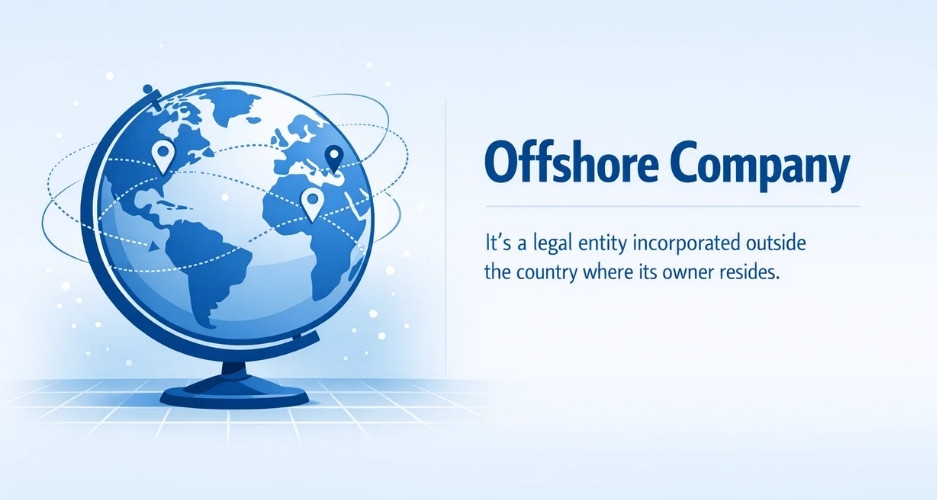
In simple terms, what is an offshore company? It’s a company registered in a different country from where its owners live or operate, typically used for international business, holding assets, or structuring cross-border operations. While fully legal, these structures must comply with modern regulations, including KYC, AML, and tax reporting rules.
Key Takeaways
- Owning an offshore company is legal when compliant with international tax laws and reporting obligations
- Offshore business structures are used for asset protection, global trade, and expansion
- The modern offshore world requires strict compliance, transparency, and economic substance
- Opening a bank account is often more complex than incorporation itself
- Choosing the right jurisdiction is critical for long-term usability and banking success
What Exactly Is an Offshore Company?
At its core, the offshore company meaning is straightforward: it’s a legal entity incorporated outside the country where its owner resides.
In other words, if you live in one country but register a company in another – that’s an offshore registered company.
This type of structure is commonly used for:
- International trade
- Holding investments or intellectual property
- Structuring cross-border operations
- Protecting assets
So when people ask what does offshore company mean, the answer is less about secrecy and more about geography and structure.
Offshore vs. Onshore vs. Midshore: Key Differences
When people try to understand the offshore in business meaning, it usually helps to stop thinking in isolation and instead compare it with other types of jurisdictions. In practice, there isn’t a single “right” model – each one sits somewhere on a spectrum between cost, compliance, and credibility.
To understand offshore in business meaning, it helps to compare it with other types of jurisdictions:
| Criteria | Onshore (UK, USA) | Midshore (Singapore, HK) | Offshore (BVI, Nevis) |
|---|---|---|---|
| Taxation | High | Territorial / Low | Zero or minimal |
| Transparency | Public registers | Semi-transparent | Higher confidentiality |
| Reputation | High | Very high | Varies |
| Compliance | Standard | Strict | Moderate (increasing) |
| Office requirement | Mandatory | Required (substance) | Minimal |
Why “Offshore” Does Not Automatically Mean Illegal
There’s still a common assumption that offshore companies operate outside the law or exist in some kind of grey area. In reality, that’s an outdated view.
Today, offshore structures are fully part of international compliance systems and must follow strict reporting and transparency rules. They typically include:
- KYC (Know Your Customer) procedures
- AML (Anti-Money Laundering) controls
- CRS (Common Reporting Standard) reporting
- Economic Substance Rules in relevant jurisdictions
Rather than existing outside the system, offshore structures now operate within it. The term “offshore” mainly refers to a company being registered outside the owner’s country of residence – nothing more, nothing less.
How Does an Offshore Company Work in Practice?
Understanding how offshore companies work is less about theory and more about how they function day-to-day. At a basic level, an offshore entity acts like any other company, but operates internationally.
The Basic Operating Model
A typical structure looks like this:
- The company is registered in an offshore jurisdiction
- It enters contracts, owns assets, or provides services globally
- Income is generated from outside the incorporation country
- Profits are managed based on applicable tax laws and regulations
This model is often used for:
- International consulting or services
- E-commerce and digital businesses
- Investment holding structures
Every offshore corporation has a defined structure:
- Shareholders → owners of the company
- Directors → responsible for management decisions
- Beneficial owner (UBO) → the real individual controlling the structure
- Registered agent → required local intermediary in many jurisdictions
This separation allows for flexible corporate structuring and efficient management.
How Control and Management Are Structured
Control doesn’t always sit where people expect.
In many cases:
- Ownership may be held via another entity or trust
- Directors may be appointed for operational purposes
- Decision-making can be centralised or distributed
This is why the offshore corporate structure needs to be carefully designed – especially for compliance and banking.
Case Study 1
Transitioning an EU-Resident Company to a New Corporate Provider
An EU-based client got in touch after their Panama service provider started shutting down operations. At first, it was just small things: slower replies, missing documents, things not being updated properly. But pretty quickly it started to feel like it could turn into a bigger issue, especially around the bank side of things.
So instead of just swapping one provider for another, we basically had to go back and look at everything properly. Over about four weeks, we rebuilt what was missing, checked the registry data against how the company was actually being run, and cleaned up inconsistencies. Governance was also tightened – including bringing in professional directors so the structure was more stable and easier to defend from a compliance point of view. On top of that, we put together a proper document pack for the bank so there were no gaps or surprises.
We made sure the company kept running the whole time, without any pauses or interruptions.
By the end of it, the client was back in control, things were no longer “fragile”, and the structure was in a much safer place from both a banking and compliance perspective.
Case Study 2
Helping a European E-commerce Brand Enter the US Market
A European e-commerce founder preparing to launch on Amazon US ran into a key issue: the platform wouldn’t approve the seller account without a US company, an EIN, and a local bank account. Even though the product and logistics were ready, the structure wasn’t in place to actually go live.
We put together a setup tailored for Amazon requirements – forming a Wyoming LLC, securing an EIN directly from the IRS, and opening a US fintech bank account suitable for receiving Amazon payouts. Alongside this, we prepared a clear explanation of the business model and transaction flow to support both bank and platform verification.
Within five weeks, everything was in place, and the store went live. Payments started coming in smoothly in USD, costs from conversions were reduced, and the client had a structure that could scale as the business grew.
Common Types of Offshore Business Structures
Not all offshore companies are the same. The structure you choose depends on your goals.
| Structure | Purpose | Key Feature | Tax Treatment |
|---|---|---|---|
| IBC (International Business Company) | Trading | Flexible and simple | Often tax-exempt locally |
| Offshore LLC | Services, consulting | Separation of ownership/management | Pass-through |
| Holding Company | Asset/IP ownership | Dividend collection | Tax optimisation |
| Trust/Foundation | Wealth protection | No direct ownership | Depends on beneficiaries |
International Business Company (IBC)
This is probably one of the most commonly used offshore setups. It’s often chosen for international trade or service-based businesses, especially where operating across borders is part of the day-to-day.
Offshore LLC
A lot of online or digital businesses lean towards this option. It’s fairly flexible in how it’s set up and tends to be easier to manage from a tax and operational point of view compared to more traditional company structures.
Offshore Holding Company
This type of structure is usually used to hold assets rather than run day-to-day operations. That could be shares, intellectual property, or investments, and it often plays a role in broader asset protection planning.
Trusts and Foundations
These are not companies in the traditional sense but are powerful tools for long-term wealth planning and confidentiality.
Why People Use Offshore Companies (Strategic Benefits)
There’s no single reason people choose offshore businesses; it’s usually a combination of strategic advantages.
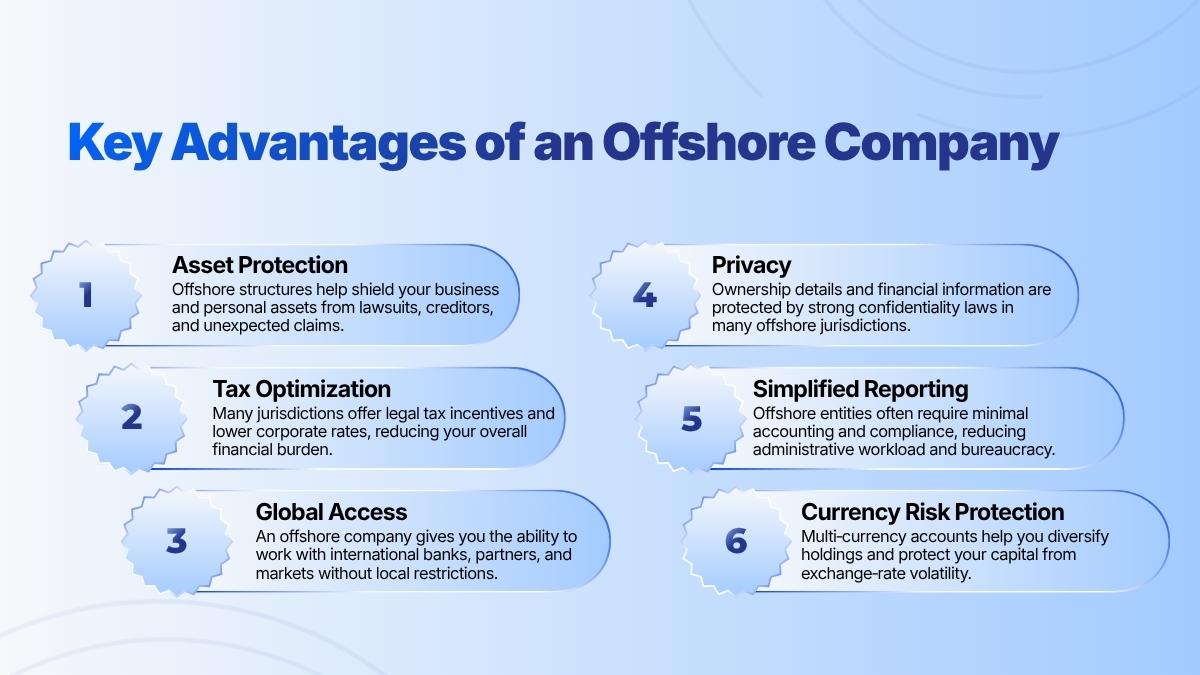
- International Trade and Global Operations: An offshore business allows companies to operate across borders more efficiently.
- Holding Investments or Intellectual Property: IP structures are often separated into an offshore entity to manage licensing and revenue streams.
- Asset Protection and Wealth Planning: One of the biggest advantages is asset protection – separating personal wealth from operational risk.
- Business Expansion Abroad: An offshore company can act as a gateway to international markets.
- Crypto and Digital Business Use Cases: Many online businesses use offshore structures for flexibility and cross-border operations.
Who Should (and Should Not) Use an Offshore Company
Not every business benefits from going offshore.
Ideal Profiles
- Digital entrepreneurs
- Global traders
- High-net-worth individuals
- Remote-first businesses
Poor-Fit Profiles
- Businesses operating only locally
- Those with limited budgets
- Companies unwilling to manage compliance
3 Questions to Ask Before You Start
- Will your business operate internationally?
- Can you maintain compliance and reporting?
- Do you need asset protection or tax structuring?
Choosing the Right Jurisdiction
Not all jurisdictions are created equal, and the choice isn’t just a box-ticking exercise. Where you set things up can have a knock-on effect on quite a few areas: from how you’re taxed and what you need to report, to how easy it is to open a bank account or work with partners.
What tends to get overlooked is that the “best” option on paper isn’t always the best in practice. The jurisdictions that look great in headlines don’t always line up with how your business actually operates. In most cases, it comes down to fit – how well the jurisdiction works with your setup, the regions you’re active in, and the expectations of banks and counterparties you’ll be dealing with day to day.
Key Factors
When you’re comparing jurisdictions, it’s easy to get distracted by headline perks. But what really matters is how things actually work once you’re up and running.
A few things tend to make the biggest difference in practice:
- Reputation – how banks, regulators, and partners tend to view that jurisdiction
- Banking accessibility – how realistic it is to open (and keep) a corporate account
- Legal framework – whether the rules are stable and predictable over time
- Compliance requirements – what you’ll need to file, report, and maintain on an ongoing basis
| Jurisdiction | Tax | Banking Difficulty | Setup Time | Reputation |
|---|---|---|---|---|
| BVI | 0% | Medium–High | 3–5 days | Strong |
| Singapore | 0% (foreign income) | High | 1–2 days | Premium |
| UAE | 0–9% | Medium | 7–14 days | Stable |
| Cayman Islands | 0% | High | 5–7 days | Institutional |
| Seychelles | 0% | Medium | 2–3 days | Budget |
When you look at the table, a clear pattern starts to emerge: there’s almost always a trade-off involved. Jurisdictions that are cheaper or quicker to set up in tend to attract more attention from banks and compliance teams, while the ones with stronger reputations usually come with higher costs and more demanding setup requirements.
In reality, two companies with identical structures can have very different outcomes simply because they are incorporated in different jurisdictions – especially when it comes to banking and counterparty trust.

How to Set Up an Offshore Company: A 6-Step Process
Setting up an offshore company is relatively straightforward; maintaining it is the real work.
- 1
Choose the right jurisdiction
The first step is deciding where to incorporate the company. This goes beyond just looking at cost. In practice, factors like banking access, regulatory reputation, reporting obligations, and tax treatment tend to matter much more, especially if the company will operate internationally. - 2
Select a legal structure
Once the jurisdiction is chosen, the next step is picking the right type of entity. This could be an International Business Company (IBC), an LLC, a holding structure, or another format depending on what the business is actually doing – whether that’s trading, holding assets, or managing intellectual property. - 3
Prepare incorporation documents
At this stage, standard compliance documents are required. This usually includes identity verification (KYC), proof of address, and a short description of the business activity. In most cases, a registered agent handles the actual filing and submission to the authorities. - 4
Appoint directors and shareholders
Every company needs a clearly defined governance structure. Directors are responsible for managing the company’s operations, while shareholders hold ownership rights. Depending on the setup, additional arrangements such as nominee directors or more layered governance structures may also be used. - 5
Open a bank account
This is often the most sensitive step. Banks will review the company’s structure, ownership, and business model before approving an account, so having clean and consistent documentation is essential. - 6
Maintain annual compliance
After setup, the company must stay in good standing. This includes paying renewal fees, submitting any required reports, and keeping corporate records up to date.
In practice, the setup itself can take a few days to a few weeks. But maintaining a clean, functional structure is what determines whether the company actually works long-term.
Risks, Limitations, and Modern Compliance (YMYL Pillar)
The offshore world in 2026 is highly regulated.
Economic Substance Regulations (ESR)
In many jurisdictions, companies are expected to demonstrate that they are not just “on paper” entities. This means showing real economic activity, such as having operations, decision-making presence, or relevant business functions in place where required.
Banking Challenges
Opening and maintaining a corporate bank account has also become more demanding over the years. In most cases, banks will want to see a clear and complete picture of the business, which usually includes:
- Full KYC (Know Your Customer) documentation
- A clearly explained and realistic business model
- Verified ownership and control information
The overall focus is less on the legal registration itself and more on whether the structure makes sense in practice and is properly supported by documentation.
Global Transparency
International reporting systems such as CRS (Common Reporting Standard) and FATCA have significantly increased transparency across jurisdictions. Information about account holders and company ownership can be shared between tax authorities, meaning offshore structures are no longer isolated or invisible.
As a result, modern offshore planning requires careful structuring and proper compliance from the outset to ensure the company remains functional in real-world use.
When to Get Professional Advice
Offshore structures can quickly become quite layered, especially when they involve more than one jurisdiction. Tax rules, cross-border regulations, and ongoing compliance requirements don’t always align neatly, and they can differ quite a bit depending on how and where the company is set up.
Because of that, even small decisions made early on can have unintended consequences later; whether that’s with banking, reporting obligations, or how the structure is viewed from a tax perspective. Having the right guidance at the beginning helps make sure everything is set up in a way that is clear, consistent, and aligned with your actual goals.
In reality, the value of professional input goes beyond just avoiding mistakes. It’s about making sure the structure is workable in day-to-day use and doesn’t create unnecessary friction as the business grows.
Conclusion
An offshore company can be a useful way to manage international operations or hold assets, especially when things are spread across different countries. When it’s set up with a clear structure in mind, it can make cross-border work a lot more manageable and flexible.
At the same time, it’s not just about setting it up and leaving it there. Ongoing compliance, reporting, and how the structure is maintained all make a real difference in practice: from banking to everyday use. When everything is put together properly, it tends to run smoothly; when it isn’t, the cracks usually show up fairly quickly.
Frequently Asked Questions
What is an offshore company in simple terms?
It’s a company registered in a country different from where its owner lives, usually set up to support international business activity, holding structures, or cross-border operations.
How do offshore companies work?
They function as independent legal entities that can sign contracts, hold assets, and carry out business internationally. In practice, they often sit between different jurisdictions to help organise operations more efficiently.
Is owning an offshore company legal?
Yes, as long as the company complies with relevant tax rules, reporting obligations, and international regulations.
What is the difference between an offshore company and a foreign company?
A foreign company is simply any business operating outside its country of incorporation, while an offshore company is typically structured specifically for international use and cross-border arrangements.
What are offshore companies used for?
They are commonly used for international trade, asset protection, business expansion, and in some cases structured tax planning within legal frameworks.
Can an offshore company reduce taxes legally?
In certain situations, yes, depending on how the structure is set up and the tax laws of the relevant jurisdictions.
Who owns and controls an offshore company?
Ownership usually sits with the shareholders or beneficial owner, while day-to-day control is handled by directors or appointed managers, depending on the structure.