Why is it hard to choose the best countries for offshore trusts? Well, a jurisdiction worth considering should combine not only political stability and mature trust law but also reasonable confidentiality and clear rules on how foreign creditor claims are treated.
What happens if a creditor (or a former spouse/business opponent) tries to reach the assets? This is the main question if we are talking about serious wealth preservation. The strongest offshore trust countries are typically assessed by their asset protection laws and non-recognition of foreign court judgments, as well as statute of limitations and trustee quality.
An offshore trust is used as a legitimate structure for asset protection and estate planning. It should not be perceived as a way to hide assets or move property after a claim has been filed. A safe structure is usually created early and supported by clear documents.
Key Standards for Evaluating Offshore Trust Countries
Offshore trust countries offer a different level of protection: some boast strong creditor-resistant legislation, while others have a high court reputation and professional trustee infrastructure.
The first standard is non-recognition of foreign court judgments. If the trust jurisdiction is really strong, a foreign judgment cannot be automatically enforced against trust assets. A creditor usually has to start a new case locally and hire local counsel, which deters many of them.
The second standard is the statute of limitations for fraudulent transfer or fraudulent conveyance claims. If a creditor has limited time to challenge a transfer into trust, it becomes much harder to attack it once that period passes. (It should be noted, though, that a trust you create after a claim has been filed will still be vulnerable).
The third standard is trustee control. The trust will only be recognized as real if the trustee is independent enough. Otherwise, the trust may be legally challenged as a purely paper arrangement.
The fourth standard is practical administration. A jurisdiction may look strong on paper, but its banking will still be difficult, and trustee administration may turn out to be weak. In that case, your trust will be inconvenient to work with.
The fifth standard is fit for purpose. If a family has long-term inheritance goals, it may need a different jurisdiction than an entrepreneur who faces litigation risk. Jersey or Guernsey may be excellent for a UHNW family office, and a client who sets maximum creditor resistance as the first priority may opt for Nevis or the Cook Islands.
Top Global Jurisdictions for Maximum Asset Protection
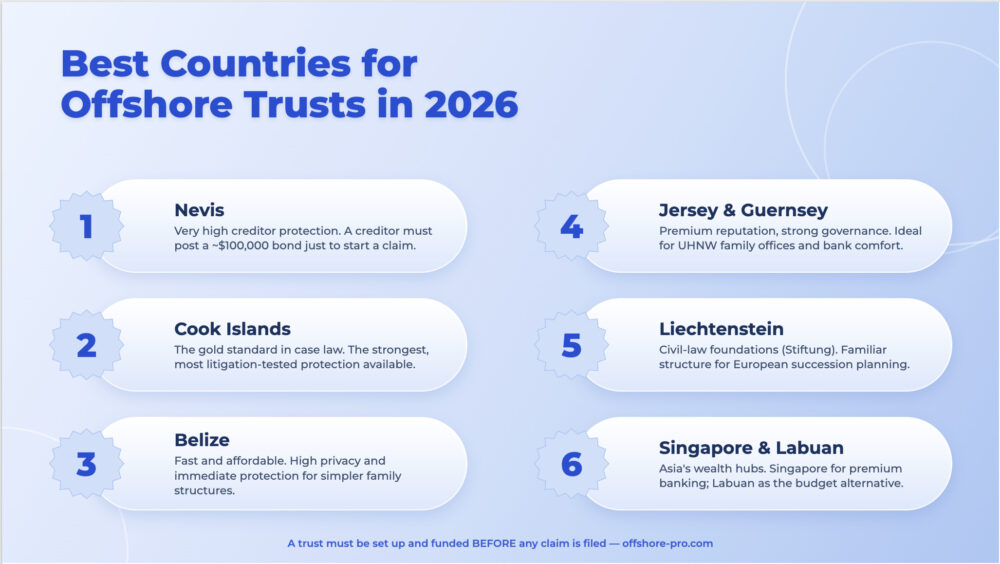
If we engage in a serious discussion about offshore trusts, the three strongest jurisdictions will inevitably be mentioned: Nevis, the Cook Islands, and Belize. These rank first in terms of creditor protection and litigation resistance, and also long-term wealth preservation.
Nevis: The Ultimate Fortified Trust
A Nevis asset protection trust is often considered to be one of the strongest options in the market. The jurisdiction offers creditor-resistant laws and confidential structures, and its practical legal framework for international families and entrepreneurs is highly appreciated.
The barrier that Nevis sets against foreign creditor action is one of its main advantages. A creditor cannot enforce a foreign judgment against a Nevis trust in a straightforward manner; they will need to start proceedings locally and satisfy local legal requirements. All this results in delays and additional costs.
Creditor bond requirement is another obstacle: a significant amount (around $100,000) needs to be deposited just to start the proceedings. This is the reason why business owners, investors, professionals with liability exposure, as well as families planning for long-term protection, usually choose Nevis.
The statute of limitations also effectively deters creditors, as they don’t have much time to challenge transfers into a trust. This does not make fraudulent transfers valid, but it helps properly planned structures become more stable with time.
Nevis is an ideal place if you want to combine strong asset protection laws and confidentiality with a structure that can be paired with a Nevis LLC, bank account, or investment holding vehicle.
If you are comparing top jurisdictions, Nevis trust formation is usually among the first options to consider.
Cook Islands: The Gold Standard in Case Law
The Cook Islands are a premium jurisdiction where you can set an offshore trust if litigation risk is high and you want to opt for the country’s long history of use in international asset protection planning.
The destination’s strong trust legislation and creditor-resistant case history are especially highly appreciated. Even if a foreign creditor has an outside court order, it can only be used to initiate proceedings in local courts (often under strict limitation periods and a demanding burden of proof).
All the factors above make the Cook Islands attractive for high-net-worth individuals, business owners in industries where lawsuits are frequent, as well as families that need a stronger layer of protection than ordinary estate planning can provide.
There is a trade-off, though: a trust in the Cook Islands is more expensive to establish and maintain than many alternatives. Budget can also be increased by bank onboarding, trustee administration, legal drafting, and sometimes compliance.
The Cook Islands are not suitable for small portfolios; the asset value should be substantial to justify premium administration. Also, this is a perfect choice for serious litigation exposure as the creditor protection framework offered by the jurisdiction is among the strongest available.
Belize: Fast and Affordable Protection
If you need an affordable offshore trust jurisdiction, Belize is definitely the answer. Its legal framework ensures reliable protection from foreign pressure for your trust assets, and it will cost less than the Cook Islands.
If you need legitimate asset protection but the premium image or long litigation history (like in the Cook Islands) are not that important, Belize could be the right choice. Customers who need family planning, inheritance structuring, private ownership, and lower-complexity asset protection often opt for this affordable jurisdiction.
Belize offers high-level confidentiality: trust details will not be publicly available. And if speed is important, the destination is also an excellent choice.
If Belize is the right fit for your banking, tax, and compliance profile, it is definitely worth considering. However, expect more questions in comparison with Jersey, Guernsey, or Nevis. While this may be manageable for some customers, others may put reputation and bankability higher than lower fees.
Belize offers the right balance between affordability and protection and works best when the structure is simple and the asset plan is clear.
Best Offshore Trust Countries in Europe
The best offshore trust countries in Europe are usually those that offer reputation and trustee quality (as well as overall legal maturity and political stability) rather than aggressive creditor-deterrence rules.
Certain European and Crown Dependency jurisdictions may give moderate protection against aggressive litigation, but their reputation in the international wealth planning is high. As a result, banks, advisors, and counterparties will ask fewer questions about these destinations than in the case of Belize, for instance.
Jersey, Guernsey, the Isle of Man, and Liechtenstein are the main European players.
Jersey and Guernsey
Jersey and Guernsey are the jurisdictions with a deep professional infrastructure where trusts are traditionally set up. Wealthy individuals use them for succession planning and investment holding, as well as employee benefit trusts and institutional arrangements.
Jersey’s long-standing trust law framework boasts quite a sophisticated court system. If you need a high-quality trustee and strong governance along with a structure that banks and investment managers understand, this is an excellent option.
The respected trust jurisdiction of Guernsey has developed modern trust legislation and experienced fiduciary providers; its firewall rules have been specially designed to protect Guernsey trusts from certain foreign-law interference.
The main value of Jersey and Guernsey is high reputation and professional execution, as well as long-term stability. However, don’t expect these premium jurisdictions to be cheap: trustee administration, legal drafting, and ongoing compliance can be quite costly.
Jersey and Guernsey are much more suitable for clients with large family assets, international portfolios, or regulated investment structures, than low-cost island options. However, if you are mainly worried about hostile creditor claims, opt for a more aggressive protection model (Nevis or the Cook Islands).
Isle of Man
The Isle of Man is yet another Crown Dependency that has long been used to establish trusts and international holding structures. Its tax framework and financial services sector, as well as its own legal system are highly valued.
If you need a reputable common-law jurisdiction that boasts close practical connections to the UK and Europe, this is an ideal solution. Families that have UK-linked advisors or European assets, or simply want to take care of their succession planning needs, may find it very attractive.
Once again, the Isle of Man is not the top option if you are focused on aggressive creditor protection; however, its stability and high trustee quality, as well as recognized legal infrastructure, make it worth considering.
Liechtenstein
Liechtenstein is a civil-law jurisdiction, which makes it different from the classic common-law trust destinations we discussed above. It is known for foundations, especially the Stiftung; it also recognizes trust-like wealth planning structures.
A foundation established in Liechtenstein has a separate legal personality, and it can be structured to meet private family needs. It is typically used for wealth preservation and family governance, as well as inheritance planning and long-term holding.
Clients from civil-law countries may find Liechtenstein more attractive as a foundation simply looks more familiar than a common-law trust. The destination’s strengths include political stability and high-quality professional administration; in addition, it is a respected European financial center.
Drawbacks do exist, though, and they include cost and complexity. Opt for Liechtenstein if you need a premium European structure and you are ready to pay for high-quality administration. If cost is an issue, better options can be found.
If you set strong creditor resistance as the main goal, please compare Liechtenstein carefully with trust jurisdictions. Still, it can become a top option for family wealth and succession planning.
Best Offshore Trust Countries in Asia
The best offshore trust countries in Asia are those that provide good banking access and wealth management infrastructure and ensure proximity to Asian business interests.
If your assets or family members are in Asia, you may find it easier to manage an Asian trust jurisdiction than a Caribbean or European structure. The two most popular destinations are Singapore and Labuan.
Singapore
Singapore, known for political stability and strong banking infrastructure (and highly appreciated for a sophisticated legal environment and high-quality trustees), is Asia’s leading wealth management hub.
UHNW families and entrepreneurs, as well as family offices and investors with Asian assets, often opt for Singapore trusts. If you want your trust to work with private banks or family office structures, the Asian jurisdiction may become the most reasonable choice.
Singapore is a premium jurisdiction, so trustee administration and other expenses can be quite high. Still, the jurisdiction is a convenient choice if your business or family interests are based in Asia.
The trust structure is an ideal solution for estate planning and investment holding, as well as succession planning and intergenerational wealth transfer. However, if your main concern is litigation resistance against foreign claims, Nevis or the Cook Islands may be a better choice.
If cost is not that important and you first of all need a reputable jurisdiction with excellent banking and Asian wealth-management infrastructure, opt for Singapore.
Labuan, Malaysia
Labuan is often discussed as a more cost-conscious Asian alternative. This Malaysian international financial center offers a regulated framework for those who need trust and foundation structures.
If you want to set up an Asian structure at a lower cost than in Singapore, Labuan is a perfect choice. A trust established here can be used for asset preservation and protection, as well as income distribution and succession planning.
Labuan has regulatory requirements and licensed service providers, so it is not “just another cheap offshore option.” It is definitely more affordable than Singapore while offering a comparable legal and financial environment.
If you have Asian business interests or family members in the region, Labuan is a good choice. It will work equally well if you have assets that you want to manage closer to Malaysia, Singapore, or broader Southeast Asia.
Need aggressive creditor-protection planning? We will help you carefully compare Labuan with Nevis and the Cook Islands. Still, if you need an Asian wealth planning structure that will not require high costs, Labuan is the first option to consider.
Expert Insight: Real-World Jurisdiction Strategy
In real cases, we rarely choose a jurisdiction just because its reputation is high. It is important to take into account the location of assets and the settlor’s tax residence, as well as potential creditors and how aggressive their future legal attacks might be.
David, an Offshore Pro Group structuring advisor, explains the difference this way:
“If you need a reputed destination that will work well for family governance and bank comfort, Europe is fine. However, if strong protection against possible aggressive litigation is important, Nevis and the Cook Islands (and similar classic island jurisdictions) will offer much more practical resistance. The question is not which jurisdiction sounds better. The question is where a creditor will face the hardest legal road.”

Let’s imagine a founder who sells a business and expects possible claims from former partners. A Jersey trust will look more familiar to private banks. A trust in Singapore is a good option if assets are managed in Asia. However, if you want to make creditor litigation expensive and difficult, you will hardly find a better solution than Nevis or the Cook Islands.
Does it mean that every client should choose Nevis or the Cook Islands? By no means. A family with a European investment portfolio that will never be subject to litigation exposure will find Jersey, Guernsey, or Liechtenstein more attractive. And if a family office manages assets in Asia, Singapore can be a preferred option.
The right approach is choosing a jurisdiction that matches your risk rather than trying to define “one best country for everyone.”
Summary Table: Comparing Offshore Trust Countries
| Country / Jurisdiction | Confidentiality Level | Speed of Formation | Creditor Protection | Best Use Case |
|---|---|---|---|---|
| Nevis | High | Medium | Very high | Litigation resistance, creditor protection, asset holding |
| Cook Islands | High | Medium | Very high | Premium asset protection, high-risk clients, large portfolios |
| Belize | High | Fast | High | Affordable protection, simpler family structures |
| Jersey | High | Medium | Medium to high | UHNW planning, family office, institutional trust work |
| Guernsey | High | Medium | Medium to high | European wealth planning, trustee governance, succession |
| Isle of Man | High | Medium | Medium | UK/EU-linked estate planning and trust administration |
| Liechtenstein | High | Medium | Medium to high | Civil-law families, foundations, European succession planning |
| Singapore | High | Medium | Medium to high | Asian wealth management, family office, private banking |
| Labuan | Medium to high | Medium | Medium | Cost-conscious Asian structuring and succession planning |
The table shows why we cannot rank offshore trust countries by just one factor. While Nevis and the Cook Islands will be the top choice for those who need creditor resistance, Jersey, Guernsey, and Liechtenstein are ideal if you need European reputation and governance. Singapore and Labuan, in their turn, are compelling choices if we are going to deal with Asian assets.
Conclusion: Next Steps in Structuring Your Wealth
So, what are the best countries for offshore trusts? The right choice depends on the client’s risk profile and asset type, as well as tax residence and long-term goals.
If you need the strongest possible creditor protection, look at Nevis and the Cook Islands. Opt for Belize to enjoy an affordable jurisdiction that ensures a high privacy level. Jersey, Guernsey, the Isle of Man, or Liechtenstein will work well if you need European reputation along with sophisticated trustee administration. Last but not least, Singapore and Labuan definitely deserve your attention if your assets are concentrated in Asia.
Never select a trust jurisdiction just by looking at the price, reputation, or habit. You will need to review asset protection laws and banking needs, as well as the statute of limitations and claims that may be potentially filed against you.
Contact Offshore Pro Group for a confidential consultation and compare the strongest jurisdictions before you establish your offshore trust structure.
Frequently Asked Questions
Which country is universally considered the safest for an offshore trust?
The “safest” depends on the risk, which is the reason why we cannot give a universal answer. Nevis and the Cook Islands set considerable barriers to foreign enforcement, which explains why they are considered very strong in terms of protection against creditor claims.
In a practical banking sense, Jersey, Guernsey, or Singapore may be much safer if you need reputation and family governance. Still, Liechtenstein may be safer for civil-law families as a foundation is a more familiar structure than a common-law trust.
What is the best offshore trust jurisdiction for US or UK citizens?
US citizens should be very careful about the choice as US tax reporting can be very strict for those who own a trust abroad. Nevis and the Cook Islands may be excellent asset protection options, but you will need to coordinate the structure with US tax counsel.
Legal familiarity and professional trustee infrastructure of Jersey, Guernsey, and the Isle of Man make them attractive destinations for UK-connected persons. Still, make sure to review tax residence and domicile rules, as well as reporting, and anti-avoidance regulations before you set up the structure.
How do European trust jurisdictions compare to classic island options?
European trust jurisdictions are usually associated with stronger reputation and professional administration and offer more bank comfort. If your needs include long-term family governance or inheritance planning, a trust in Europe will be useful.
Nevis, the Cook Islands, and other traditional island options make it much harder for creditors to win cases. If you expect aggressive litigation or simply want to make sure potential adversaries will face serious obstacles trying to reach your assets, this is a good choice.
Can an offshore trust be established completely remotely?
We cannot say “yes” in 100% of cases, but many offshore trusts can be established remotely. You will need to choose a professional provider and submit documents, including KYC documents and proof of address, as well as source-of-funds information and trust instructions.
However, don’t expect compliance to be light if you set up remotely. Trustees will still verify a lot of aspects, including beneficiaries and source of wealth, as well as the legality of the asset transfer and purpose of the structure.
What happens if a foreign court orders the seizure of assets in an offshore trust?
A foreign court order cannot be automatically enforced in a strong trust jurisdiction: the creditor will have to start proceedings in the respective jurisdiction and satisfy the legal standards set locally.
This is where non-recognition of foreign court judgments, statute of limitations, as well as local asset protection laws, acquire special importance. If you create a trust properly and fund it before any claims are filed against you, the process will be quite expensive and burdensome for the creditor.