A Nevis LLC is an offshore limited liability company formed under Nevis law and widely used for asset protection, international structuring, and cross-border planning. Its main strengths are flexible management, strong creditor barriers, privacy, and tax-neutral treatment for properly structured non-resident operations. This guide explains how a Nevis LLC works in practice for protection, compliance, banking, and international use.
Key Takeaways
- A Nevis LLC is a separate legal entity that can be member-managed or manager-managed
- Nevis LLC asset protection is one of its strongest features, including charging-order protection, fraudulent-transfer limits, and a creditor bond before litigation
- A Nevis LLC registered agent and registered office in Nevis are required, and formation is completed through Articles of Organization filed with the Registrar
- Nevis LLC taxation is commonly described as tax-neutral for non-resident, foreign-sourced operations, but home-country tax and reporting rules still apply
- A Nevis LLC bank account is possible, but in practice provider selection and compliance remain the main challenge
What Is a Nevis LLC?
A Nevis Limited Liability Company (LLC) is a flexible offshore structure used for asset protection, international business, and long-term wealth planning. Its value becomes clearer when you look at how the entity is formed, managed, and used in practice.
Definition in plain English: How the structure works
What is a Nevis LLC? It is a limited liability company formed in Nevis under a dedicated LLC ordinance. Like other LLCs, it combines a separate legal entity with flexible internal governance. In practice, it can hold assets, enter contracts, run business operations, or support a wider asset protection or estate planning strategy. What makes an LLC in Nevis distinctive is the jurisdiction’s strong privacy and debtor-protection framework.
How a Nevis limited liability company is structured
A Nevis limited liability company must have at least one member, and that member may also act as manager. The structure can be member-managed or manager-managed, and either individuals or legal entities may serve in those roles. No initial capital is required, and the operating agreement remains the main internal governance document, while formal existence begins with the filing of Articles of Organization.
Who typically uses a Nevis LLC
A Nevis offshore LLC is commonly used by international entrepreneurs, investors, families planning succession, and clients holding cross-border assets or crypto. It is also often combined with a trust for stronger planning, control, and layered asset protection.
Why Nevis Is the Gold Standard for Asset Protection
Nevis is widely respected for asset protection because its legal framework makes creditor action significantly harder than in many other jurisdictions.
One of the strongest elements of Nevis LLC asset protection is that creditor remedies are tightly limited by statute. The law channels claims into a charging-order framework and, in section 61-style cases, treats that remedy as exclusive. In practice, this sharply limits what a creditor can do even after obtaining a judgment elsewhere.

The $100,000 Creditor Bond: The ultimate barrier to frivolous lawsuits
The law also requires a creditor to post a bond before pursuing the relevant action. Although the amount is set by the High Court, the widely cited benchmark is $100,000, which acts as a major deterrent to speculative or nuisance litigation.
Foreign Judgments & 2-Year Fraudulent Transfer Rule (Statute of Limitations)
The statute provides that transfers made more than two years after the creditor’s cause of action accrued are not treated as fraudulent under section 61. If a transfer occurs within that period, the claim must still be brought within one year of the transfer. The law also states that foreign judgments on the statutory remedy are not recognized or enforced by the High Court in Nevis.
Nevis does not maintain a public register of members or beneficial owners in the way many clients expect. Public filings focus mainly on formation details and the registered agent or office. At the same time, privacy is not invisibility: service providers still collect due diligence, and banks still require compliance review.
providers still collect due diligence, and banks still require compliance review.
Domestic Enforcement: What U.S. Courts Can and Cannot Do
For U.S. readers, the practical question is not only how Nevis law protects an LLC. The harder question is this: if the owner lives in the United States, can a U.S. court still try to reach the membership interest?
The short answer is that a Nevis LLC creates strong barriers, but a standalone structure may still carry domestic enforcement risk. This is why serious offshore asset protection planning often combines a Nevis LLC with an offshore trust.
The core question: where does a U.S. court’s jurisdiction end?
A membership interest in a foreign LLC may be treated by a domestic court as intangible personal property. In some cases, courts may look at where the debtor resides and ask whether the membership interest can be reached under domestic enforcement rules.
This creates a jurisdictional conflict. Nevis law may say that a creditor’s remedy is limited to a charging order under the Nevis LLC Ordinance, while a creditor in the United States may ask a domestic court to treat the membership interest as property connected to the debtor.
The case law is not perfectly uniform. Some courts have emphasized that enforcement should happen in the jurisdiction where the entity was formed. Others have been more willing to consider domestic remedies against a debtor’s intangible rights. This uncertainty is exactly why the structure must be planned carefully.
Why a standalone Nevis LLC carries domestic exposure
If a U.S. resident owns a Nevis LLC directly, the creditor may attempt to attack the debtor’s membership interest in a U.S. court. This does not mean the attack will automatically succeed. It means the creditor may try to bypass Nevis by focusing on the U.S.-based debtor rather than the Nevis entity itself.
This is the main limitation of a standalone Nevis LLC. Nevis LLC asset protection can be strong inside Nevis, but a direct U.S. owner may still face arguments based on domestic enforcement, foreclosure of membership interest, or other remedies available in the owner’s home jurisdiction.
For that reason, a Nevis LLC should not be presented as a universal shield against every creditor action. It is a powerful tool, but its protection depends on ownership, timing, funding, compliance, and the surrounding structure.
How combining with an offshore trust reduces this vulnerability
One common solution is a Nevis LLC trust combination. Instead of having the U.S. resident own the LLC directly, the membership interest may be held by an offshore trust, such as a Nevis Trust or Cook Islands Trust.
In that structure, the individual is no longer a direct member of the LLC. The trust owns the membership interest. This changes the enforcement analysis because the creditor is no longer dealing with an LLC interest directly owned by the debtor.
The logic is structural, not magical. A U.S. court may have personal jurisdiction over the debtor, but the debtor does not personally own the LLC membership interest. The creditor must now deal with the trust structure, foreign trustee control, foreign law, and the rules of the offshore trust jurisdiction.
This is why Nevis LLC creditor protection is often strongest when the LLC is not used alone. A Nevis LLC can provide the operating and asset-holding layer, while the offshore trust provides the deeper ownership and succession layer.
This type of planning should be reviewed by a qualified attorney. The right structure depends on timing, existing claims, tax residence, citizenship, asset type, and the client’s reporting obligations.
Proven Client Cases: How Our Experts Protect Assets with Nevis LLCs
A Nevis LLC works best as part of a planned structure, not as a last-minute reaction to risk. Here are two examples of how we use Nevis entities in practical, compliant, and effective asset protection strategies.
Case 1: Wealth Protection for a High-Net-Worth U.S. Client
Client situation
A high-net-worth client from the United States faced a business-partner dispute and parallel divorce pressure. The goal was to protect family wealth without creating a structure that would fail under compliance or home-country review.
What we did
- Assessed litigation exposure, family priorities, and cross-border assets
- Built a layered structure using a Nevis LLC together with a Nevis trust
- Added a Swiss banking element for operational privacy and control
- Structured ownership for long-term preservation rather than short-term concealment
- Kept the strategy aligned with home-country professional advice
Outcome
The client gained a stronger legal and operational barrier around family wealth while keeping the structure workable and compliant. The result was a practical asset protection framework designed to preserve wealth for the next generation.
Case 2: Cross-Border Asset Protection for an International Investor
Client situation
An investor with ties to Eastern Europe held assets across several jurisdictions and needed a structure that would reduce personal exposure, improve control, and support cross-border asset protection.
What we did
- Reviewed the client’s asset map, risk profile, and ownership structure
- Used a Nevis LLC as a core holding and protection vehicle
- Separated personal ownership more clearly from the underlying assets
- Built the structure with future banking and compliance in mind
- Focused on proactive planning before creditor pressure escalated
Outcome
The client received a clearer and more resilient ownership structure for international assets, together with a stronger protection framework. Just as importantly, the structure remained practical for banking, administration, and ongoing compliance.
Legal Foundation of a Nevis LLC
The legal strength of a Nevis LLC comes from a framework built for flexible management, separate legal personality, and strong asset protection.
Legal Basis: The Nevis Limited Liability Company Ordinance
The structure is governed by the Nevis Limited Liability Company Ordinance, including a 2023 amendment that recognizes electronic signatures and electronic filing. The law treats the LLC as a separate legal entity distinct from its members and managers, which forms the basis of its flexibility and liability protection.
Articles of Organization: Formal Registration Requirements
A Nevis LLC is formed by filing Articles of Organization with the Registrar of Companies through a licensed registered agent. The filing includes the company name, registered agent, registered office, management mode, company purpose, and organizer details.
Operating Agreement: Rights, Duties, and Governance
The operating agreement sets out the rights of members and managers, voting rules, transfer restrictions, profit allocation, and internal governance. Even though it is not publicly filed, it is the main control document of the Nevis limited liability company.
Enforcement Reality: How Nevis Courts Apply the Law in Practice
The law channels creditor disputes into Nevis under local rules, with strict burdens, limited remedies, and procedural barriers. This does not guarantee that every LLC defeats every claim, but it does make the legal environment materially more favorable to the LLC side than in many domestic jurisdictions.
Nevis LLC Registered Agent: Requirements, Role, and How to Choose
A Nevis LLC registered agent is not optional. A licensed registered agent is required for forming an LLC in Nevis, maintaining the registered office, and keeping the company connected to the Registrar of Companies in Nevis.
This requirement comes from the Nevis LLC framework itself. In practice, no foreign founder can properly open a Nevis LLC without a registered agent in Nevis.
What a Nevis LLC registered agent is required to do
The registered agent prepares and files the Articles of Organization in Nevis. These are the formation documents that bring the LLC into legal existence.
The agent also maintains the registered office in Nevis, receives official notices, and acts as the point of contact for the Registrar of Companies. In many cases, the agent also helps maintain basic corporate records, including the formation record, registered office details, and annual renewal information.
A good registered agent in Nevis will also explain what documents are needed before filing, how the company name should be checked, and what ongoing compliance steps are required after registration.
How the registered agent interacts with the Registrar of Companies
The Registrar of Companies is the public authority responsible for keeping the company register and processing corporate filings. The registered agent is the official channel between the Nevis LLC and the Registrar.
This means that company formation, registered office updates, amendments, and many corporate changes pass through the agent. If the LLC changes its management mode, registered office, internal records, or other core details that require filing, the registered agent coordinates the submission.
The registered agent also helps keep the company in good standing. Annual renewal reminders, changes in regulatory practice, and document updates are usually handled through this relationship.
What to look for when selecting a Nevis registered agent
When selecting an agent, start with licensing. The provider should operate in line with the requirements of the Nevis Financial Services Regulatory Commission, the official regulator for financial services activity in Nevis.
Other practical criteria include:
- a physical registered office in Nevis;
- experience with foreign beneficial owners;
- clear renewal and deadline reminders;
- ability to maintain corporate records;
- familiarity with Nevis LLC formation requirements;
- support with banking and compliance documents;
- clear communication on fees and annual maintenance.
A registered agent is not just a filing contact. For international clients, the agent often becomes the local compliance bridge between the Nevis LLC, the Registrar, banks, and professional advisors.
Registered Agent and Registrar of Companies: Roles and Responsibilities
A Nevis LLC registered agent is mandatory. The agent files the formation documents, serves as the official contact with the Registrar, and maintains the registered office in Nevis.
Enforcement Reality: How Nevis Courts Apply the Law in Practice
The law channels creditor disputes into Nevis under local rules, with strict burdens, limited remedies, and procedural barriers. This does not guarantee that every LLC defeats every claim, but it does make the legal environment materially more favorable to the LLC side than in many domestic jurisdictions.
Key Benefits of a Nevis LLC
A Nevis LLC is valued because it combines strong asset protection with highly flexible ownership and management options.
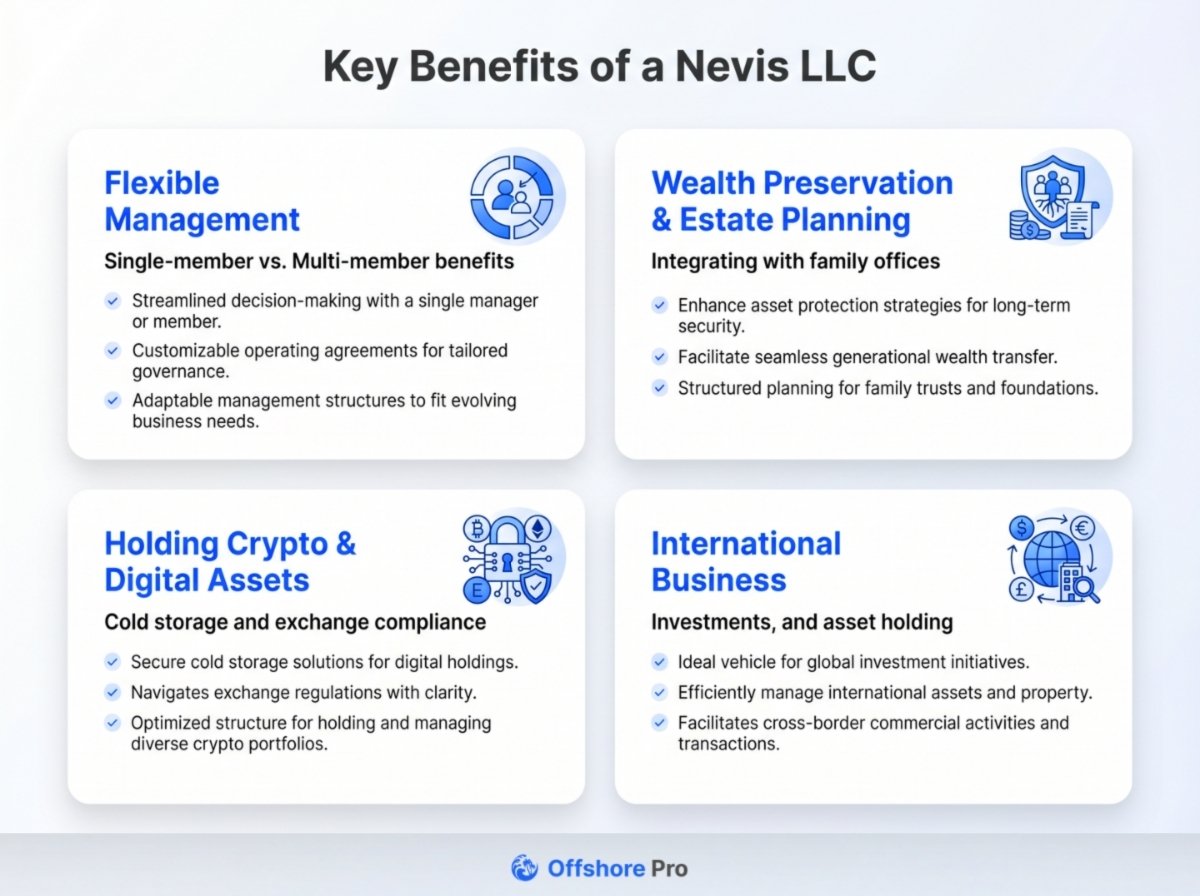
Flexible Management: Single-member vs. Multi-member benefits
A Nevis LLC can be single-member or multi-member, member-managed or manager-managed. Members may be individuals or legal entities of any nationality, which makes the structure adaptable to very different ownership models.
Wealth Preservation & Estate Planning: Integrating with family offices
A Nevis LLC can work well in family-office planning, succession design, and combined trust structures. It often serves as the controllable operating layer, while the trust handles deeper estate-planning goals.
Holding Crypto & Digital Assets: Cold storage and exchange compliance
The LLC can also hold digital assets, provided wallet control, exchange compliance, and beneficial-owner due diligence are handled correctly. The structure may help separate crypto holdings from the individual, but practical compliance still remains essential.
International business, investments, and asset holding
A Nevis offshore LLC is commonly used for international business, cross-border investments, real estate, private portfolios, and family holding structures. It can also be owned by another company, so the answer to “can a company own a Nevis LLC?” is yes.
Nevis LLC Formation: Step-by-Step
A strong Nevis LLC begins with the right setup, because formation decisions affect control, compliance, banking, and long-term asset protection.
Phase 1: Name Clearance & Planning the Management Structure
The process starts with name reservation and a decision on whether the LLC will be member-managed or manager-managed. This is where the structure is aligned with the client’s control, privacy, and practical use goals.
Phase 2: Due Diligence & KYC Documents
Although Nevis is privacy-oriented, formation still requires due diligence through the service provider. The usual package includes passport copy, proof of address, beneficial-owner details, and any additional checks required by the agent or future bank.
Phase 3: Filing & Approval Process
The licensed registered agent files the Articles of Organization with the Registrar of Companies. Once accepted, the formation record is issued. Electronic signatures and filing also help streamline the process.
In most standard cases, the formation record is typically issued within about 5–10 business days after complete document submission and approval of due diligence, although timing may depend on the registered agent, Registrar workload, and the complexity of the file.
The 2023 amendment to the Nevis LLC Ordinance, which recognizes electronic signatures and electronic filing, has made the process more practical for foreign clients. Physical presence in Nevis is not normally required because the entire filing process is handled remotely through the licensed registered agent.
Phase 4: Post-Formation Setup: EIN, internal resolutions, and seal
After registration, clients may need additional documents for banking, tax registration, internal resolutions, apostille, corporate seal, or operational proof. The exact package depends on how the LLC will be used.
Annual maintenance and ongoing compliance
To remain in good standing, the LLC must maintain annual renewals, registered-agent service, and orderly records. It is a relatively light structure, but it still requires ongoing attention.
Nevis LLC Formation Cost and Ongoing Fees
The cost of a Nevis LLC includes more than government fees alone. In practice, the total depends on the level of privacy, banking support, and ongoing maintenance required.
Formation cost categories
A full Nevis LLC formation package usually includes document preparation, company registration, apostille, courier delivery, registered agent service, and a legal address for the first year. More advanced options may also include nominee support or bank account opening assistance.
A standard setup typically starts from €3,300. With nominee support, the cost usually starts from €5,000. A more comprehensive package with company formation and corporate banking support generally starts from €8,000.
| Setup option | Starting price | What’s included |
|---|---|---|
| Basic registration | From €3,300 | Document preparation, company registration, apostille, courier delivery, government fees, registered agent, and legal address for the first year |
| Registration with nominee service | From €5,000 | Everything in the basic package, plus nominee director and/or shareholder services for the first year |
| Registration with bank account support | From €8,000 | Full formation support together with corporate bank account opening assistance |
Annual renewal and compliance costs
Keeping a Nevis LLC in good standing is relatively simple. The main recurring obligations are the annual government fee and renewal of registered agent services. In general, there is no requirement to file financial statements, submit audit reports, or file local tax returns if the company does not conduct business in Nevis.
In practice, annual maintenance is usually higher than the official renewal fee alone once registered agent service, registered office support, document handling, and basic administration are included. A realistic estimate commonly starts from around USD 1,000 per year, depending on the level of support required.
| Obligation | Required | Notes |
|---|---|---|
| Annual government fee + registered agent renewal | Yes | Commonly estimated from around USD 1,000/year including basic maintenance support |
| Financial statements | No | Not generally required if the company has no business activity in Nevis |
| Audit reports | No | Not generally required |
| Local tax returns | No | Not generally applicable for offshore operations |
Professional service and maintenance costs
Beyond formation, additional services may be needed depending on how the Nevis LLC will be used. The most common next step is corporate bank account opening, which may be arranged through offshore or onshore banks or payment institutions. Other optional services include nominee support, apostille, courier delivery, and KYC/compliance profile preparation.
These services are often what make the structure usable in practice for international banking and cross-border operations. As a result, the total cost of using a Nevis LLC internationally usually includes not only formation and renewal, but also a professional-service layer tailored to the client’s needs.
| Service | Cost | Notes |
|---|---|---|
| Corporate bank account opening | Included in €8,000 package | Remote opening may be available through offshore, onshore, or EMI solutions |
| Nominee director / shareholder services | Included in €5,000+ packages | Typically contracted annually; used to enhance privacy |
| Document apostille + courier delivery | Included in all formation packages | Usually required for international use of corporate documents |
| KYC / compliance profile preparation | Included with bank account support | May include corporate documents, KYC forms, and bank cover letter preparation |
Nevis LLC Bank Account: The 2026 Reality Check
The ability to open a Nevis LLC bank account depends less on the company certificate itself than on the owner profile, business activity, and overall compliance strength of the case.
Can a Nevis LLC open a bank account?
Yes, a Nevis LLC bank account is possible, but approval depends mainly on the beneficial owner, business model, jurisdictions involved, and expected transaction flows. In practice, banking is often treated as a separate step because the bank evaluates the full profile, not just the LLC itself.
EMI vs. Traditional Banks: Where to go if Tier-1 banks say “No”
In 2026, many Nevis LLC owners use a mix of EMIs, international payment systems, and more selective banks rather than relying only on Tier-1 institutions. For operational businesses, EMIs are often the practical first step. For wealth holding or larger portfolios, a traditional bank may still be the better fit if the compliance profile is strong.
Nevis LLC Taxation and Reporting
Tax treatment is one of the most misunderstood aspects of a Nevis LLC, so it is important to distinguish local Nevis rules from the owner’s home-country tax and reporting obligations.
How Nevis tax treatment is commonly described
Nevis LLC taxation is commonly described as tax-neutral for non-resident structures earning foreign-sourced income. Official guidance in St. Kitts and Nevis states that tax-resident companies are taxed on worldwide income, while non-resident companies are taxed only on income sourced within the Federation.
Why tax-neutral does not mean tax-free everywhere
This is where many clients go wrong. A tax-neutral LLC in Nevis does not remove tax obligations in the owner’s home country. CFC rules, beneficial ownership reporting, and local tax-residence analysis may still apply depending on nationality and residence.
U.S. Person Reporting Obligations: FBAR, Form 8858, and FATCA
For U.S. persons, Nevis LLC taxation must be analyzed separately from Nevis local tax rules. A single-member Nevis LLC owned directly by a U.S. citizen or U.S. resident is commonly treated as a foreign disregarded entity for U.S. federal tax purposes, unless a different classification election applies.
This means that the LLC does not usually block U.S. tax reporting. The income and expenses of the LLC may be reported by the owner on the owner’s U.S. tax return. The structure may help with asset protection and international structuring, but it does not remove U.S. worldwide income rules.
A U.S. person who owns a foreign disregarded entity may need to file Form 8858, Information Return of U.S. Persons With Respect to Foreign Disregarded Entities and Foreign Branches. Failure to file required international information returns can trigger penalties, commonly starting at $10,000, depending on the form, category, and facts. The current filing position should always be confirmed with a CPA or tax attorney.
FBAR is another major issue. If the Nevis LLC has foreign financial accounts and the aggregate value of the owner’s foreign accounts exceeds $10,000 at any time during the year, the U.S. person may need to file an FBAR/FinCEN Form 114 through the BSA E-Filing system. FBAR penalties can be significant, especially where a failure is treated as willful.
FATCA may also apply. U.S. taxpayers with specified foreign financial assets above applicable thresholds may need to file Form 8938 under FATCA. The threshold depends on filing status and whether the taxpayer lives in the United States or abroad.
If the Nevis LLC is owned by a foreign trust, the reporting chain becomes more complex. Forms 3520 and 3520-A may become relevant where a U.S. person transfers assets to, receives distributions from, or is treated as an owner of a foreign trust.
This is a specialist area of international tax compliance. Offshore Pro Group does not provide U.S. tax advice. U.S. clients should work with a CPA or tax attorney experienced in offshore LLC tax reporting before forming or funding the structure.
Home-country reporting and compliance considerations
A Nevis LLC may trigger reporting or tax analysis in the home country of the member, manager, or controlling person. This can include foreign-entity disclosure, anti-avoidance rules, or broader banking transparency obligations.
Recordkeeping, accounting, and practical administration
Even where local filing burdens are light, proper recordkeeping still matters. Ownership records, the operating agreement, accounting support, banking evidence, and transaction history are all part of using the structure safely and professionally.
Nevis LLC vs Other Structures
To see where a Nevis LLC works best, it helps to compare it with other common structures used for business, estate planning, tax planning, and asset protection.
| Criteria | Nevis LLC | Wyoming LLC | Trust | Corporation / IBC |
|---|---|---|---|---|
| Primary purpose | Asset protection, privacy, offshore structuring | Domestic business use, tax flexibility | Estate planning, wealth transfer | International trade, investment holding |
| Asset protection | Very strong — charging orders are the exclusive remedy; creditors cannot directly seize or control the company | Moderate — charging order protection exists, but U.S. court exposure remains | Strong — assets are legally owned by the trustee | Moderate — limited liability exists, but piercing risk is higher |
| Privacy | High — no public register of members, managers, or beneficial owners | Moderate — no public member disclosure at state level, but U.S. federal reporting applies | High — trust deed is usually private | Low to moderate — directors/shareholders are often disclosed or reportable |
| Taxation | Commonly described as tax-neutral for foreign-sourced income | Pass-through taxation; generally subject to U.S. federal tax | Depends on structure and jurisdiction | Often 0% on foreign income for IBCs; domestic corporations taxed locally |
| Reporting requirements | Minimal — no financial statements, audits, or local tax returns for offshore activity | Annual report + registered agent; U.S. tax filings apply | Varies by jurisdiction | Minimal for offshore IBCs; more extensive for domestic corporations |
| Formation cost | From ~€3,300 | From ~$100–500 | From ~$3,000–10,000+ | From ~$1,000–3,000+ |
| Annual maintenance cost | From ~$1,000/year | From ~$50–200/year | From ~$1,000–3,000+/year | From ~$500–1,500/year |
| Formation timeline | Up to 10 business days | 1–3 business days | 1–4 weeks | 3–10 business days |
| Remote formation | Yes | Yes | Usually yes | Yes |
| Management flexibility | High — members or appointed managers | High — member- or manager-managed | Limited — trustee controls assets | Moderate — directors and officers govern |
| Creditor statute of limitations | 2 years for fraudulent transfer claims, with an additional 1-year filing limit in some cases | Standard U.S. rules vary by state | Varies | Varies |
| Court deposit to sue | $100,000 creditor bond commonly cited | None | Varies | Varies |
| Suitable for U.S. persons | Yes, with FATCA, IRS, and home-country compliance | Yes — straightforward U.S. compliance | Yes, but often with additional trust reporting | Yes, though CFC / PFIC or similar rules may apply |
| Best for | Offshore asset protection, privacy, international structuring | Simple U.S. business operations | Multi-generational wealth transfer, succession planning | International trade, IP holding, investment vehicles |
Nevis LLC vs Wyoming LLC
A Wyoming LLC is usually simpler and cheaper for straightforward U.S. business. A Nevis LLC is generally stronger when the main goal is international asset protection and offshore structuring rather than domestic operations.
Nevis LLC vs trust
A trust is usually stronger for long-term succession and legal ownership separation, while a Nevis LLC offers more direct management flexibility. Used together, they often produce the strongest planning result.
Nevis LLC vs corporation / IBC
A corporation or IBC may work better for certain trading or investment uses, but the LLC is often preferred where clients want contractual flexibility, member-style governance, and stronger asset-protection logic.
When combining a Nevis LLC with a trust may make sense
A combined trust-and-LLC structure may be the best choice when the client wants both operational control and a deeper barrier between personal ownership and the assets. In practice, this model can strengthen both long-term control and asset protection.
When a Nevis LLC Makes Sense — and When It Does Not
A Nevis LLC is highly effective in the right context, but like any legal structure, it works best when its strengths match the client’s actual goals, timing, and compliance reality.
Good-fit scenarios
- asset protection planning before litigation arises
- international holding structures
- wealth preservation and succession design
- cross-border crypto or portfolio holding with proper compliance
- family-office style planning
Poor-fit scenarios
- purely local operating business with no international angle
- clients who expect the structure to erase home-country reporting
- situations where banking access is the only goal and the underlying profile is weak
- last-minute panic transfers after a creditor claim has already matured
Real estate and local-law limitations
A Nevis LLC can hold real estate, but local property law, lender requirements, and situs-jurisdiction rules still matter. Offshore ownership never overrides the mandatory law of the place where the property is located.
Common Mistakes to Avoid
Even a strong structure like a Nevis LLC can lose much of its value when clients misunderstand what it is designed to do — or expect it to solve problems it was never meant to fix.
- Confusing privacy with invisibility. Privacy in Nevis is real, but it is not total invisibility. The service provider, bank, and sometimes tax authorities in the home country may still need disclosure.
- Treating asset protection as universal protection. A Nevis LLC is a powerful tool, but not a shield against everything. Fraud, bad timing, weak compliance, and poor home-country planning can still damage the structure.
- Ignoring tax/reporting obligations. The most expensive mistake is assuming offshore structuring eliminates domestic reporting. It often does the opposite: it makes professional reporting more important.
Conclusion
A Nevis LLC remains one of the most compelling offshore structures for clients who care about asset protection, privacy, management flexibility, and international planning. It is especially strong when used proactively, documented properly, and paired with realistic banking and tax advice. The structure is not for everyone, but it remains a serious planning tool for the right client profile.
Frequently Asked Questions
What is a Nevis LLC?
A Nevis LLC is a limited liability company formed in Nevis under its own LLC ordinance. It is used for asset protection, international structuring, holding assets, and flexible cross-border planning.
Can a non-resident form a Nevis LLC?
Yes. Members may be individuals or entities of any nationality, and the structure is commonly used by non-residents.
Can a single person own a Nevis LLC?
Yes. A Nevis LLC can be single-member, and that member may also be the manager.
Can a company own a Nevis LLC?
Yes. The law and market practice allow legal entities to act as members or managers, so corporate ownership is possible.
How long does Nevis LLC formation take?
The formal registry step can be fast once due diligence is complete, but the practical timeline depends on document readiness, service scope, apostille needs, and any post-formation banking work.
What documents are needed to form a Nevis LLC?
Typically passport copy, proof of address, beneficial-owner details, and due-diligence forms through the licensed service provider. Additional documents may be needed for banking or more complex structures.
What is the role of a registered agent?
The Nevis LLC registered agent files the Articles, maintains the registered office link in Nevis, and acts as the official interface with the Registrar.
What is a charging order in Nevis?
It is the statutory remedy that allows a creditor to receive distributions tied to a member’s interest rather than seizing control of the LLC. Under the ordinance, the creditor’s remedy is tightly limited and foreign judgments on that remedy are not recognized by the High Court.
Does a Nevis LLC pay tax in Nevis?
For properly structured non-resident operations with foreign-sourced income, the structure is commonly described as tax-neutral in Nevis. But income sourced inside St. Kitts and Nevis or tax residence there changes the analysis.
Does a Nevis LLC remove tax reporting in my home country?
No. Home-country reporting can still apply, including foreign-entity rules, beneficial ownership reporting, or CFC-style analysis depending on your residence and nationality.
Can a Nevis LLC open an offshore bank account?
Yes, but actual success depends on the owner profile, activity, and banking strategy. The LLC is only one part of the file; the beneficial owner and business purpose matter just as much.
When does a Nevis LLC make sense compared with a domestic structure?
It usually makes sense when the goal is international asset protection, holding cross-border assets, wealth planning, or building a structure more resistant to creditor pressure than a domestic LLC.