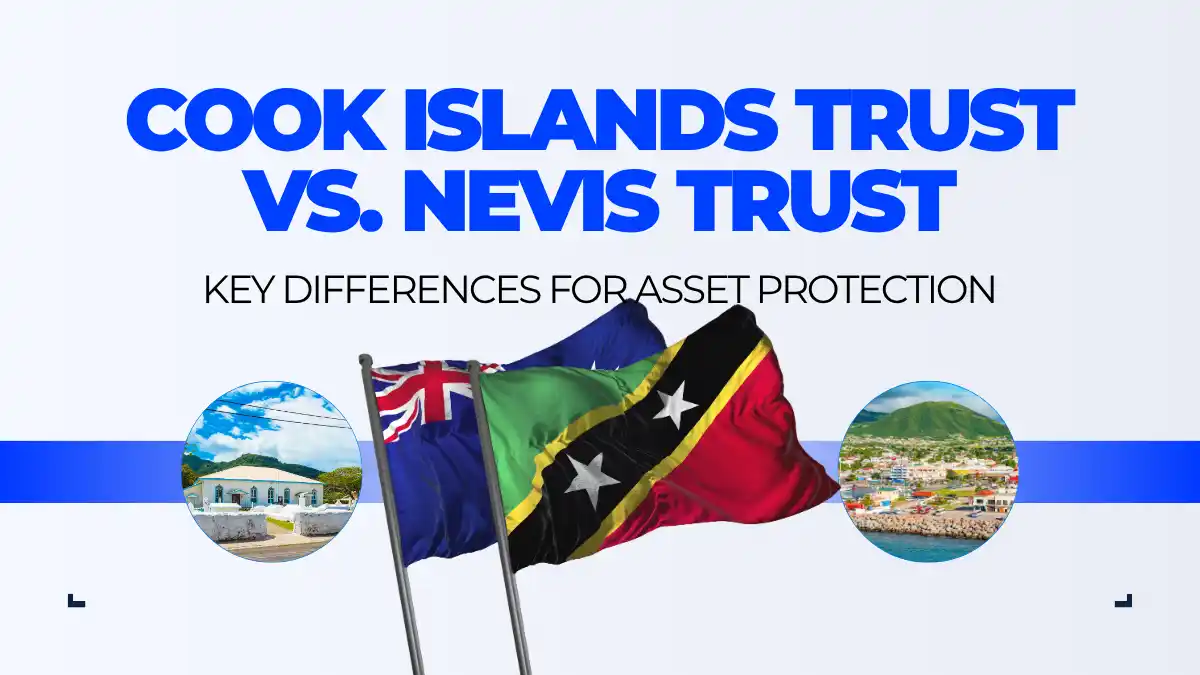
Suppose you have narrowed your choice of asset protection trusts down to two jurisdictions: the Cook Islands and Nevis. Which one should you choose?
Both have laws that make it difficult for foreign creditors to reach trust assets. However, the two jurisdictions have different advantages.
The Cook Islands has a longer history of litigation involving international trusts. Lawyers have more court decisions to study when assessing the potential outcome of a dispute.
Nevis has an interesting advantage of its own. A creditor must provide a substantial financial guarantee before bringing a claim against trust property.
When you compare prices, ask for two figures: how much you will pay now and how much you will pay each year.
Let’s look at what you get for your money in each jurisdiction.
Key Takeaways
- The Cook Islands has a longer history of asset protection litigation.
- In Nevis, creditors must arrange a US$100,000 bond before bringing an action against trust property.
- Both jurisdictions apply a high standard of proof to fraudulent transfer claims.
- A Cook Islands trust can own a Nevis LLC.
- Local tax exemptions do not eliminate tax obligations in your country of residence.
Cook Islands Trust vs. Nevis Trust: Key Differences at a Glance
The Cook Islands adopted the International Trusts Act in 1984. Nevis introduced its International Exempt Trust Ordinance ten years later, taking much of the Cook Islands legislation as a model. Both laws have been amended over the years.
Here’s how the two jurisdictions compare today.
| Comparison Factor | Cook Islands Trust | Nevis Trust |
|---|---|---|
| Governing legislation | International Trusts Act 1984 | International Exempt Trust Ordinance 1994 |
| Foreign judgments | Enforcement restricted | Enforcement restricted |
| Fraudulent transfer rules | Fraud must be proven beyond reasonable doubt | Same standard of proof |
| Time limits on claims | Two-year and one-year statutory rules | One-year rule linked to the cause of action; separate filing deadline |
| Creditor bond | No fixed statutory bond | EC$270,000 (US$100,000) |
| Case law | Longer litigation history | Fewer published court decisions |
| Trustee requirements | Local qualifying corporate trustee | Wider choice of qualifying local trustees |
| Initial setup fee | $3,500 | From $5,500 |
| Basic annual maintenance | $10,300 | From $8,500 |
The fees above are based on our own service rates. Additional legal work and banking services may increase your expenses in either jurisdiction.
How Do Cook Islands and Nevis Trusts Protect Assets from Creditors?
Recognition and Enforcement of Foreign Judgments
Imagine that a US court has awarded damages to a person who has sued you. Can that person use the court decision to recover money from your trust in Nevis or the Cook Islands?
The trust legislation of both jurisdictions restricts the enforcement of foreign judgments. A decision based on a law that is inconsistent with local trust law will not be enforced against the structure.
The creditor will normally have to hire a local lawyer and bring a claim under local law.
This is one of the major differences between domestic and offshore asset protection trusts. An independent foreign trustee is not necessarily subject to the authority of the court that issued the original judgment.
Fraudulent Transfers and Burden of Proof
The mere fact that you have transferred property to a foreign trust does not prove that you intended to defraud anyone.
In both the Cook Islands and Nevis, the burden of proof rests with the creditor. The standard of proof is particularly high: beyond reasonable doubt.
To succeed in a fraudulent transfer claim, the creditor must establish two things:
- Your principal intention was to defraud that particular creditor.
- The transfer left you insolvent or without sufficient property to satisfy the claim.
What happens if the creditor succeeds? The whole trust does not necessarily become invalid. If you have other property in the structure, it’s likely to remain unaffected.
Statute of Limitations for Creditor Claims
There are two important dates to consider: the date when the creditor’s cause of action arose and the date when you transferred the property.
In the Cook Islands, a transfer made more than two years after the creditor’s cause of action arose is not deemed fraudulent under local trust law. If the transfer falls within the relevant statutory window, the creditor generally has one year from the transfer to start legal proceedings. A claim in the Cook Islands High Court must also be brought within two years of that transfer.
Nevis uses a one-year rule in relation to the date when the cause of action arose. Section 50 of the local Ordinance also establishes a separate two-year limitation period for creditors to bring an action and challenge your transfer.
These rules concern specific types of creditor claims under local law. However, your obligations in other countries persist.
Want to play safe? Arrange your wealth protection well before any dispute arises.
Nevis Creditor Bond Requirement: How Does It Compare?
Where will a creditor get the money to finance a lawsuit in Nevis? Legal fees are not the only expense to consider.
Under Section 61 of the Nevis International Exempt Trust Ordinance, the creditor must obtain a bond of EC$270,000 (US$100,000) from a local financial institution. They must then lodge it with the Ministry of Finance before bringing an action against trust property.
The money serves as security for legal costs that the creditor may have to cover if they lose the case. It is not a non-refundable court fee.
The approach adopted in the Cook Islands is different: its legislation doesn’t set a fixed bond requirement for creditors. However, the local court may require security for legal costs and determine the amount.
A large corporation and an individual creditor may have very different financial resources. What is a manageable sum for the former may be difficult for the latter to arrange.
Still, the bond doesn’t prevent a creditor with sufficient funds from bringing a valid claim.
Litigation History: Which Trust Has a Stronger Track Record?
Court cases that involve Cook Islands trusts have been attracting the attention of lawyers for decades. Now they understand much better how the structure can work under pressure.
There’s less published case law involving Nevis. Does this mean its legislation is less effective? Not necessarily. There’s simply less evidence of how its provisions work in contested cases.
One of the best-known cases involving a Cook Islands trust is FTC v. Affordable Media, LLC (1999), also known as the Anderson case.
A married couple had established a trust in the Cook Islands. A US court later ordered them to bring the money back to the United States. The foreign trustee refused to return it.
However, the Andersons had retained certain powers as trust protectors. The US court was not convinced that they were unable to comply with its order. The couple were jailed for contempt of court.
The US authorities subsequently brought legal proceedings in the Cook Islands. A settlement concerning the recovery of trust funds was reached in 2002.
This case illustrates an important point. Your property may be held outside the jurisdiction of your home country’s courts, but you may still be under their authority.
Keep this distinction in mind when you choose a Nevis trust or a Cook Islands structure.
Trustee Requirements, Trust Setup, and Confidentiality
In the Cook Islands, you can appoint a licensed trustee company based on one of the islands. Such companies are regulated by the Financial Supervisory Commission.
In Nevis, the choice is wider, and a locally incorporated company may qualify as a trustee. You will also need a registered agent to handle registration.
In either jurisdiction, you will discuss the terms of your trust deed with a specialist and provide documents for compliance checks. Our Cook Islands trust formation services cover these arrangements as well as registration and asset transfers.
What information can an outsider obtain about your structure?
In the Cook Islands, the Registrar may confirm basic details, such as the name and registration date of the trust. In Nevis, the register of international trusts is not open to public inspection.
Neither jurisdiction makes the full trust deed publicly available. However, service providers must keep records of the settlor and beneficiaries and disclose information when legally required.
Can a Cook Islands Trust Own a Nevis LLC?
You don’t have to establish a Nevis trust to benefit from Nevis LLC legislation. A trustee in the Cook Islands can hold the membership interest in a Nevis LLC, while the company itself can hold your investment portfolio.
Under Nevis law, a judgment creditor who pursues a member’s interest in the LLC is limited to a charging order. The creditor may receive distributions that would otherwise go to that member but can’t force the company to make them.
The two parts of the structure are governed by different laws. The trustee holds the membership interest under Cook Islands trust law, while the LLC operates under Nevis company law.
Does the Location and Type of Assets Affect Trust Protection?
Suppose your Nevis LLC owns an apartment in Florida. The apartment is still subject to Florida law; it doesn’t really matter in this case where the company or trust is registered.
It is often easier to hold financial assets through international structures. Still, the country where your bank or brokerage account is maintained matters.
The paperwork required for moving assets into an offshore trust also varies. If we take company shares, for instance, you may need to register them in the name of the new owner.
Cook Islands Trust vs. Nevis Trust: Setup and Annual Costs
A larger trust fund may be more expensive to administer. In Nevis, our minimum annual trustee fee is $5,000 for funds worth up to $5 million. If the value exceeds $5 million, the fee starts at $10,000.
The table below shows our rates for both jurisdictions.
| Expense | Cook Islands | Nevis |
|---|---|---|
| Initial setup | $3,500 | From $5,500 |
| Annual trustee fee | $9,550 (registered office included) | From $5,000 |
| Annual registration or renewal | $750 | $3,500 |
| Total basic annual expenses | $10,300 | From $8,500 |
| Protector (optional) | $3,500/year | $3,000–5,000/year |
| Bank account opening assistance | From $4,500 | From €4,500 |
When comparing offshore trust setup and maintenance costs, check what each provider includes in the price. You may have to pay separately for accounting or additional legal work.
In the Cook Islands, for instance, our accounting services start at $500 per hour. In Nevis, we offer ongoing legal and tax advice for $2,000–5,000 per year.
We can prepare an individual quote once we know what property you intend to transfer and what services you need.
Tax and Reporting Obligations for Offshore Trusts
Both the Cook Islands and Nevis offer local tax exemptions for international trusts that qualify. However, they can’t change the tax laws of the country where you live.
Are you a US taxpayer? You may have to pay tax on income earned by the structure even if the money remains in its accounts.
Your accountant may need to work with your trustee when preparing Forms 3520 and 3520-A. These forms cover different reporting obligations related to transactions with foreign trusts and their US tax owners.
Depending on your interests in foreign financial assets and accounts, you may also need to file an FBAR or Form 8938.
Make sure your accountant and trustee have the same information about contributions and distributions. If you receive money from the structure, keep the relevant documents for your tax records.
Cook Islands or Nevis Trust: Which Is Better for Your Situation?
If your lawyer recommends the Cook Islands, ask whether this choice is based on the local case law. The jurisdiction has a long history of dealing with complex disputes, and you also have a good selection of experienced trustee companies.
You may find a suitable trustee in Nevis at a lower annual fee. The local bond requirement is another factor to consider. If you are interested in Nevis trust formation, we can also help you explore different arrangements involving an LLC.
Talk to your prospective trustee before making the final decision. Find out how quickly they can arrange distributions and check their expertise in your investment area. You may be working with this company for decades, so the quality of its services matters.
Remember that neither jurisdiction can guarantee the success of your offshore asset protection strategy. If you already have outstanding creditor claims, seek independent legal advice before transferring any property. And remember that your trustee must have genuine authority over the assets.
Our specialists can help you compare the two options based on your financial circumstances and family needs. Contact us for a consultation.
Summary
Before you choose between the Cook Islands and Nevis, have a specialist review the property you intend to transfer. The country where you hold most of your wealth may influence the decision as much as the trust legislation itself. We can help you assess both options.
Which is safer: a Cook Islands Trust or a Nevis Trust?
There is no universal answer. Even two trusts in the same jurisdiction may offer different levels of asset protection. Much depends on the terms of the deed and the powers given to the trustee.
Can I establish a Cook Islands or Nevis Trust after a lawsuit has started?
Creating a trust is one matter and transferring property to it is another. Is litigation underway? In this case, a lawyer must assess whether you can lawfully transfer your property. You must also comply with any court orders that restrict such transfers.
Can I retain control over assets held in an offshore trust?
You can express your preferences in a non-binding letter of wishes. It may contain recommendations on investments or distributions to family members. The trustee can take these wishes into account.
Are Cook Islands and Nevis Trusts tax-free for US residents?
No. Are you a trust owner under US tax law? You must include your share of its taxable income in your personal tax return then. Your trustee should provide the relevant annual tax statement.
Sources
- Nevis Financial Services Regulatory Commission (FSRC)Nevis International Exempt Trust Ordinance, Cap. 7.03 (N)December 31, 2017 (Revised Edition)
- Cook Islands Financial Supervisory Commission (FSC)International Trusts Act 1984December 27, 1984
- Cook Islands FinanceCook Islands Trust MattersAccessed November 26, 2026
- United States Court of Appeals for the Ninth CircuitFTC v. Affordable Media, LLC, 179 F.3d 1228June 15, 1999
- Federal Trade Commission (FTC)Announced Actions for December 13, 2002December 13, 2002
- Nevis Financial Services Regulatory Commission (FSRC)Nevis Limited Liability Company Ordinance, Cap. 7.04 (N), Section 60December 31, 2020 (Revised Edition)
- Internal Revenue Service (IRS)Foreign Trust Reporting Requirements and Tax ConsequencesAccessed November 26, 2026
- Financial Crimes Enforcement Network (FinCEN)Report of Foreign Bank and Financial Accounts (FBAR)Accessed November 26, 2026