Going to move your assets abroad? Remember that it doesn’t automatically protect them; real protection comes from the legal structure you use to hold those assets and the law that governs it.
An offshore asset protection trust is a good option if you want to separate personal ownership from the legal ownership of certain assets. You can use it for creditor protection or estate planning, as well as long-term wealth preservation and international structuring.
The result depends on how you create the trust.
What property are you going to transfer? Real estate, for instance, is still subject to the law of the country where it is located. But what if this is an investment account? It’s much easier to place it into your offshore structure.
Timing is hard to overestimate. It may be too late to move assets if a creditor claim already exists: such a transfer may be much easier to challenge.
Don’t use your offshore trust to ignore existing legal obligations.
Key Takeaways
- Moving assets abroad does not automatically protect them from creditors.
- An independent trustee and a clear separation of ownership and control are essential to effective asset protection.
- The timing of asset transfers matters, especially if creditor claims already exist.
- An offshore trust can hold investments directly or through an LLC.
- Foreign trusts do not automatically exempt their owners from taxes or reporting obligations.
What Is an Offshore Asset Protection Trust?
An offshore asset protection trust is a trust that you establish under the law of a foreign jurisdiction. Such trusts are designed for many purposes, but many founders first of all want to make it hard for creditors to enforce their claims against trust property.
Most asset protection trusts of this type are irrevocable. It means that you transfer the assets and no longer treat them as personal property (at least in the same way as before).
Legal ownership passes to the trustee. The trustee holds and manages the property under the trust deed. Beneficiaries don’t normally own the trust assets directly, but they have beneficial interests and may receive distributions.
Control may be hard to release for many asset owners, but this is the only way to make asset protection real. The settlor that keeps too much direct control inevitably weakens the structure.
You may also see the terms foreign asset protection trust or international asset protection trust. They describe the same general idea: a trust that exists under foreign law that you can use as part of your international asset-holding structure.
The foreign law determines how your trust is administered and how foreign judgments may be handled.
How Does an Offshore Asset Protection Trust Work?
An offshore trust clearly delegates roles: one person creates the structure, another manages the property. Plus, there are people who receive benefits.
Key Parties in an Offshore Trust
The settlor, also known as the grantor, creates the trust and transfers property into it. The biggest mistake is to transfer the assets and then treat them as if nothing has changed.
The trustee is responsible for legal ownership and administration. Its powers may involve management of bank accounts and holding company shares.
Beneficiaries, no matter whether they are natural persons or entities, receive money or other benefits from the trust. The trust deed says what beneficiaries may receive and when the trustee can make distributions.
A trust protector is not a mandatory participant; still, many settlors opt for an additional degree of control. The protector’s role doesn’t involve day-to-day asset management. The trust deed usually gives this person specific powers: approving certain trustee decisions or even replacing the trustee if something goes wrong.
| Player | Responsibilities | Rights |
|---|---|---|
| Settlor (Grantor) | Creates and funds the trust | Transfers assets into the structure |
| Trustee | Administers the trust | Manages assets and acts under the trust deed |
| Beneficiaries | Receive benefits from the trust | May receive distributions under the trust terms |
| Trust Protector | Controls some decisions made by the trustee | May approve certain actions or replace the trustee |
How Offshore Trusts Protect Assets From Creditors
Suppose a creditor wins a judgment against you at home. However, this doesn’t mean that the assets you’ve put into your offshore trust will be seized in the same way as your personal property.
The law of the country where you’ve set up the trust may be a real barrier for your creditor. In some offshore trust jurisdictions, you can’t use a foreign judgment to challenge trust property. They’ll have to bring a claim under local law, which is much harder.
What is more, the assets genuinely administered by an independent trustee aren’t sitting in the settlor’s hands waiting for a creditor to seize them.
Can we say that an asset protection trust automatically works as a shield? No. The nature of the creditor’s claim and timing of the transfer, for instance, may play their role.
Offshore Trusts With LLCs and Foreign Bank Accounts
An offshore trust doesn’t have to hold every asset directly.
You can place an LLC under the trust. The trust owns the company, while the LLC can hold business interests or investment assets. A very common approach, and very effective.
You can use the LLC for contracts or investments, and the trustee will be responsible for the trust structure itself. Your day-to-day administration will be simplified.
A Nevis trust and an LLC is an excellent combination: look at available Nevis trust formation options.
The same idea can apply to foreign bank accounts or brokerage accounts. Placing them under an entity owned by the trust is more effective than holding them personally.
Different assets may call for a different structure, especially if the settlor wants to retain some control.
What Assets Can an Offshore Trust Protect?
Not every asset is equally good for your offshore trust.
If you want an easy start, liquid assets will fit just right. You can usually move an investment portfolio into the structure without changing the place where its investments are located.
Real estate is another story. A property remains tied to the law of the country where it is located. Even if it’s owned by a foreign structure, local laws don’t disappear.
Own shares in a company? They can sometimes go into the trust as well.
Some assets are easy to move. Others stay tied to local law.
Can You Access Assets Held in an Offshore Trust?
Some owners are afraid that they will never benefit from their assets again if they put them into an offshore trust. Fortunately, this isn’t true. However, the way you get access to them really changes.
Need money from the trust? Distributions may depend on trustee discretion and the terms of the trust deed.
Don’t look at your discretionary trust’s account as your personal wallet. You don’t simply withdraw whatever you want whenever you want it.
In some cases, the trustee can also pay an expense on behalf of a beneficiary instead of transferring cash directly.
Can you as the settlor demand the assets back at any moment? It may look convenient, but it also means that there isn’t enough separation between personal property and trust property. And your trust will be much harder to defend.
The question of benefitting from assets is not the main issue here. Look at how much direct control you retain.
Benefits of Offshore Asset Protection Trusts
The first reason people look at asset protection trusts is creditor protection. But is it the only advantage? No.
Privacy is a sought-after benefit that a trust can give you as well. The structure separates personal ownership from trust ownership, and your name is no longer visible in every place where the underlying assets are held. Still, don’t forget to perform tax or reporting duties. Privacy and secrecy are not the same thing.
Thinking about what happens to the assets years from now? An offshore trust can also support estate and succession planning. You can set the rules you need in the trust deed, and it doesn’t mean you’ll have to rebuild the whole structure when your family circumstances change.
A trust is also associated with less geographical risk as your wealth will be partly held under another legal system; this is known as jurisdictional diversification. You will no longer rely on the courts or legal framework of just one country.
Legal Requirements and Limits of Offshore Trust Protection
Irrevocability, Trustee Independence and Protective Clauses
Want to know whether your trust is well-protected? Let’s look at the trust deed.
Many founders opt for irrevocable asset protection trusts: they are much harder to attack.
You can use a spendthrift provision to restrict a beneficiary from transferring an interest in the trust or limit what a creditor can reach under the governing law.
The duress clause is a very practical protection mechanism. Imagine that someone forces you (as the settlor) to demand a transfer. The clause allows the trustee to disregard that demand.
There’s also the choice of law clause which sets the trust law under which the structure will work. In particular, it determines which rules will apply if a dispute reaches court.
Timing, Fraudulent Transfers and Existing Creditors
Asset protection becomes much harder after a dispute appears.
Has a creditor’s claim already arisen? It may be too late. If you move property into a trust, it may be challenged as a fraudulent transfer or voidable transfer.
It doesn’t mean that all late transfers will inevitably fail. The result depends on the law that governs the trust and the facts that surround the transfer.
Nevis gives a useful example. A creditor who tries to attack a transfer must prove that the settlor intended to defraud that creditor. The law will also look at whether there’s enough property outside the trust to satisfy the claim.
Each jurisdiction gives creditors a certain period during which such a challenge can be brought, so timing is important.
An offshore trust is an excellent tool for overseas asset protection if you plan everything in advance. It’s a weak solution if a lawsuit has already started.
When Offshore Asset Protection Trusts Can Fail
Your trust deed is excellent, but real life may differ a lot.
Can you take the assets back whenever you want? Too much direct control may make the separation between you and the trust look weak.
Let’s take Nevis law as an example. It will be easier for a creditor to reach a beneficiary’s interest if that beneficiary has unfettered control over the trust property. A settlor that can revoke a trust causes similar problems.
Local assets create another weak point. Your real estate will be exposed to the courts of the country where it is located even if you pass ownership to a structure abroad.
You may also face problems in the case of bankruptcy. A bankruptcy trustee may look at the transfers made earlier and challenge them under the rules that apply to the debtor.
Offshore Asset Protection Trust Jurisdictions
Cook Islands and Nevis
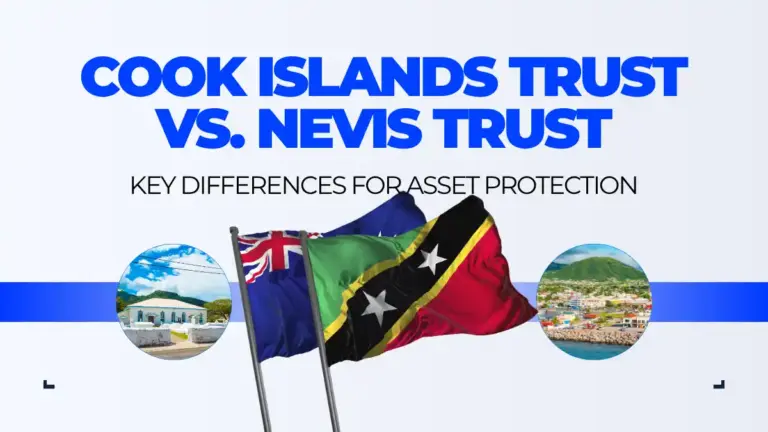
If you hear discussions about offshore asset protection strategies, the Cook Islands will be mentioned sooner or later. Why is it? One of the obvious reasons is the way foreign judgments are treated by local laws.
A creditor that won a claim abroad won’t get automatic access to trust property in the Cook Islands. Proceedings must be re-started locally to reach your assets, which deters many creditors.
A Cook Islands international trust is definitely worth taking a good look at before you make a decision.
What about Nevis? Well, it gives the same legal protection and sets one more hurdle for creditors: a financial one. A creditor who wants to bring an action against trust property must post a bond of EC$270,000 (US$100,000) to cover potential legal costs. If the claim is relatively small, the creditor is highly likely to decide that going to court in Nevis is simply not worth it.
Other Offshore Trust Jurisdictions
You can also set up a foreign trust in one of the following jurisdictions:
- Cayman Islands. A STAR trust can serve specific purposes and provide benefits to family members at the same time.
- British Virgin Islands. A VISTA trust can hold shares in a BVI company without requiring the trustee to oversee its day-to-day management.
- Bahamas. The local law allows the settlor to retain certain powers, such as making investment decisions.
- Belize. Worth considering if you want creditor protection but have a smaller budget for setting up the structure.
- Isle of Man. An attractive option for long-term family wealth planning, with regulated professional trust administration services.
Key Factors When Comparing Offshore Trust Jurisdictions
How much time does a creditor have to challenge a transfer and what exactly will they have to prove in court? Check these two things carefully before you choose an offshore trust jurisdiction.
Look at the local registration requirements as well. In the Cook Islands, for example, you will need to find a licensed local trustee company that will register an international trust for you.
Find out how much you will pay for the setup and, most importantly, for annual maintenance. In most cases, you will need to submit reports, and it’s better to discover details in advance.
| Jurisdiction | Main use | Legal details |
|---|---|---|
| Cook Islands | Wealth protection against creditor claims | High burden of proof for fraudulent transfers |
| Nevis | Asset holding through trusts and LLCs | Creditors cannot force discretionary distributions |
| British Virgin Islands | Business ownership | VISTA trusts can directly hold only BVI company shares |
| Cayman Islands | Complex family wealth structures | STAR trusts require an enforcer |
| Bahamas | Flexible family wealth management | Two-year deadline for fraudulent disposition claims under the local FDA |
| Belize | Budget-conscious asset protection | Restrictions on claims based on foreign inheritance, matrimonial and insolvency laws |
| Isle of Man | Long-term family wealth and succession planning | Protection against certain foreign forced heirship claims |
Take a look at our detailed comparison of offshore trust jurisdictions to make a decision.
How to Set Up an Offshore Asset Protection Trust
- Decide what you want to protect. Make a list of the property you own. Will all of it go into the trust or just a part? Discuss your current financial and legal situation with a specialist before making any transfers.
- Choose a jurisdiction. The country where you live and the location of your property will influence your choice. So will the purpose of your structure.
- Find a trustee. Ask whether the trustee has experience managing the types of property you intend to transfer. Find out what services are included in the annual fee.
- Prepare the trust deed. Think carefully about who will receive distributions and under what circumstances. Going to appoint a protector? Specify their powers in the document.
- Pass compliance checks. During due diligence, the trustee will ask for your identification documents and proof of your source of funds. You may also need to explain how you accumulated your wealth.
- Fund the trust and arrange its administration. Signing the documents is not enough. Make sure the legal ownership of the assets transferred is properly documented. Discuss ongoing reporting and record-keeping with your trustee.
The paperwork involved in transferring assets into an offshore trust depends on what you own. A transfer of company shares, for instance, may require changes to the company’s ownership records.
Our specialists can coordinate the entire process, from choosing a jurisdiction to arranging ongoing trust administration.
Offshore Asset Protection Trust Legality, Taxes and Reporting
Are Offshore Asset Protection Trusts Legal?
Yes, you can legally set up a foreign trust to manage your family wealth or protect it against future risks. However, check the laws of your home country before you do so. Some countries restrict the transfer of property abroad or require you to disclose your interests in foreign structures.
Tax Treatment of Offshore Trusts
Suppose your offshore trust is established in a tax-neutral jurisdiction. Does it mean you will pay no tax on the income it generates? Not necessarily.
Much depends on your tax residency and how your country treats the structure.
In the US, for instance, many asset protection structures are classified as foreign grantor trusts. If you are treated as the owner of a grantor trust for tax purposes, you must report your share of its taxable income even if you receive no distributions.
IRS Reporting and Disclosure Requirements
If you are a US person, you may need to submit several forms:
- Form 3520: you use this form to tell the IRS about certain transfers to a foreign trust, your ownership of the trust for tax purposes, or distributions you receive.
- Form 3520-A: provides annual information about a foreign trust with a US tax owner. The owner must make sure the trust files it.
- FBAR (FinCEN Form 114): add up the value of your reportable foreign financial accounts. Does the total exceed $10,000 at any time during the year? File this form.
- Form 8938: you use this form to declare certain financial assets you hold abroad if their total value exceeds the reporting threshold that applies to you.
What if you fail to comply with reporting requirements? Penalties may be substantial. Discuss your tax filings with an advisor who specializes in foreign trusts.
How Much Does an Offshore Asset Protection Trust Cost?
When planning your budget, think beyond the first year. You will need legal assistance at the beginning, but trustee fees will be a regular expense.
The cost of opening and maintaining an offshore trust varies from one jurisdiction to another. Here is what we charge for some of our trust formation and maintenance services.
| Cost component | Nevis | Cook Islands |
|---|---|---|
| Initial setup fee | From $5,500 | $3,500 |
| Annual trustee fee | From $5,000 | $9,550 (registered office included) |
| Annual renewal or registration fee | $3,500 | $750 |
| Basic annual maintenance | From $8,500 | $10,300 |
| Protector (optional) | $3,000–5,000/year | $3,500/year |
| Bank account opening | From €4,500 | From $4,500 |
Want to combine a Nevis trust with an LLC? Our basic package costs €12,500. If you also need a nominee director and bank account opening services, the price goes up to €19,000.
Remember to budget for accounting and tax advice, too. Ask us for an individual quote based on the property you intend to transfer and the services you will need.
Offshore vs. Domestic Asset Protection Trusts
Did you know that you cannot set up a self-settled asset protection trust in every US state? Nevada, Delaware and Alaska are among the states that allow such structures. However, a court in your home state may not recognize the protection offered by another state’s law.
| Feature | Domestic trust | Offshore trust |
|---|---|---|
| Governing law | US state law | Foreign law |
| Trustee | US-based | Based in a foreign jurisdiction |
| Creditor claims | Within the US legal system | Local proceedings abroad may be necessary |
| Setup and maintenance | Usually cheaper | Usually more expensive |
| Reporting | Domestic requirements | Additional foreign-trust reporting may apply |
| Administration | Easier to manage locally | Cross-border coordination required |
A domestic trust may be quite sufficient if your professional and financial risks are moderate. Take a closer look at the differences between domestic and offshore asset protection trusts before committing to a more expensive structure.
Who Should Consider an Offshore Asset Protection Trust?
Think about where your financial risks come from. Your occupation alone may put your personal wealth at risk.
Doctors and other professionals with high litigation exposure are good examples. Even years of successful practice do not rule out a costly malpractice claim.
Business owners may have personal guarantees on corporate loans. As for real estate investors, they may face claims from tenants or other parties.
Families with property and investments in several countries may have different priorities. They may want to keep their wealth together and pass it on to the next generation under a common set of rules.
Does the value of your property justify the annual cost of maintaining an offshore trust? If your main concern is professional liability, adequate insurance may be a more affordable solution.
Our specialists can help you assess your situation before you commit to a particular structure. Explore our offshore trust formation services to see how we can assist you.
Summary
An offshore trust is a long-term commitment. Before you establish one, consider the risks you face and the responsibilities you are ready to delegate to a trustee. Our specialists can help you determine whether this structure is suitable for your circumstances.
Frequently Asked Questions About Offshore Asset Protection Trusts
Can an offshore asset protection trust protect assets from a lawsuit?
Yes, but it cannot prevent someone from suing you. Even if your property is well protected, you may still have to defend yourself in court and pay for legal assistance.
Can you be both a settlor and a beneficiary of an offshore trust?
Yes. Both Nevis and the Cook Islands allow self-settled trusts. You can also name your spouse and children as beneficiaries of the same structure.
Do assets have to be transferred overseas to establish an offshore trust?
Not necessarily. Suppose you set up a trust in the Cook Islands. You can open a bank account for it in Switzerland. The country where the trust is registered and the country where its property is held do not have to be the same.
Can an offshore asset protection trust be challenged in court?
Yes. A US court, for instance, may order the settlor to bring the assets transferred to a foreign trust back to the US. Whether the foreign trustee must comply with such an order is a separate legal question.
Sources
- Nevis Financial Services Regulatory Commission (FSRC)Nevis International Exempt Trust Ordinance, Cap. 7.03 (N)December 31, 2017 (Revised Edition)
- Cook Islands FinanceCook Islands Trust MattersAccessed November 26, 2026
- HarneysComparison of Key Trust Features for the British Virgin Islands and the Cayman IslandsAccessed November 26, 2026
- Bahamas Financial Services Board (BFSB)Legislative Highlights — Legislation Relating to TrustsAccessed November 26, 2026
- Belize Financial Services Commission (FSC)Trusts Act, Chapter 2022020 (Revised Edition)
- Isle of Man GovernmentTrusts Act 1995Accessed November 26, 2026
- United States Code — Office of the Law Revision Counsel11 U.S.C. § 548 — Fraudulent Transfers and ObligationsAccessed November 26, 2026
- United States Court of Appeals for the Ninth CircuitFTC v. Affordable Media, LLC, 179 F.3d 1228June 15, 1999
- Internal Revenue Service (IRS)Foreign Trust Reporting Requirements and Tax ConsequencesAccessed November 26, 2026
- Financial Crimes Enforcement Network (FinCEN)Report Foreign Bank and Financial Accounts (FBAR)Accessed November 26, 2026